









Most overseas education consultancies start small and expand through hustling.
You respond to all WhatsApp messages. You follow up with universities manually. You scramble around at night looking for lost bank statements when a visa deadline is near. Once the student receives the visa, you feel like you did it for yourself.
This is useful if you have 20 or even 50 students per year.
But, as the number of students approaches 100, things begin to unravel.
Leads are not tracked properly. Counsellors provide various pieces of advice to various students. Your team waits for you to approve before making decisions. Applications pile up. The reconciliation of commissions is a long process. Even with “busy all the time,” revenue growth begins to taper off.
This is where many education consultancies in the Southeast Asian region end up.
In fact, it’s not due to low demand.
Vietnam, Philippines, Indonesia, Thailand and Malaysia are still sending out huge numbers of outbound students annually. Families are spending more on international education than they did five years ago. Students are enrolling earlier. Parents are better informed. There is greater competition among institutions.
The chance remains.
But many agencies are still behaving as small businesses run by their founders in a market that now values systems, speed and scale.
Not all of the oldest agencies are the fastest-growing in Southeast Asia today. They are just the ones who have learned how to build processes before they built bigger teams.
And that changes everything.
The Ceiling Most Southeast Asian Education Consultancies Hit – And Why
Eventually, every mature consultancy firm in Southeast Asia is plagued by the same growth challenges.
The first is excessive reliance on one country of destination.
In Vietnam and the Philippines, many agencies have developed their business almost exclusively around Australia or the UK. This was the case for many years as there was a predictable demand and stable commission structures.
However, a policy change can wreak havoc on a whole business in a single day.
The migration pathway restrictions and visa tightening in Australia have already caused anxiety for many migration agencies, with the potential for visa commission changes in 2026. This was the case with visa changes in Canada recently.
When 80% of your business is in one country, you are always at risk.
The second is founder dependency.
In many agencies, the founder remains the top counsellor, the primary closer, the relationship manager, and the final decision maker on all student applications.
This is no longer possible at scale.
If you are still making all the important decisions in your business, then it cannot grow.
Another significant constraint is operational chaos.
Many agencies continue to handle applications through spreadsheets, individual WhatsApp messages, and random Google Drive folders. Teams manually hunt for missing documents. Follow-ups happen inconsistently. Students receive multiple requests for the same documentation due to a lack of a streamlined workflow.
It causes stress from the inside and confusion from the outside.
Then, students catch on.
The agencies that scale well typically get to a point where they don’t ask:
How can we do more?
And start asking:
How can we create systems that function even if we aren’t there?
The shift in mindset is where true growth begins.
Pillar 1: Expand Beyond One or Two Destination Countries
One of the biggest differences between stagnant agencies and fast-growing ones is destination diversity.
The global student mobility market has changed significantly over the last few years. According to ICEF Agent Voice Survey findings, nearly 73% of education agents globally now recruit students into multiple destination markets instead of relying on one or two countries.
That trend is becoming very visible across Southeast Asia.
Students today are more flexible than before.
A student who initially asks about Australia may eventually choose Ireland because of faster visa processing. A family considering Canada may move toward Germany after comparing tuition costs. Another student may choose Dubai because they want proximity to home and lower living expenses.
Agencies that can offer multiple destination pathways naturally close more students.
And more importantly, they reduce business risk.
This does not mean you suddenly need partnerships with 300 universities.
That’s where many agencies get overwhelmed.
The smarter approach is building destination flexibility first.
For example, if a student profile fits UK business programs, there’s a high chance the same student could qualify for Ireland, Australia, or certain European institutions too.
One student profile can create multiple opportunities.
That changes conversion rates dramatically.
Agencies in Indonesia and Vietnam that traditionally focused only on Australia are now expanding aggressively into Europe and emerging destinations because student demand is shifting toward affordability and post-study work opportunities.
The agencies adapting fastest are winning market share quietly.
Pillar 2: Build a Team That Doesn’t Depend on You for Every Decision
A consultancy becomes difficult to scale when the founder becomes the operating system.
You may feel productive because your team constantly asks for guidance.
But in reality, it slows the business down.
Many founders unintentionally create this problem by staying involved in every micro-decision for too long.
Counsellors wait for approval before suggesting universities.
Application teams cannot proceed without founder verification.
Marketing campaigns pause because “sir needs to review it.”
Eventually, growth becomes impossible because the business only moves at the speed of one person.
The strongest agencies in Southeast Asia build decision-making frameworks early.
That means:
- Standardized counselling processes
- Clear SOPs for applications
- Defined escalation systems
- Shared CRM visibility
- Training systems for junior counsellors
This doesn’t remove quality control.
It removes unnecessary dependency.
One consultancy owner in Manila explained it perfectly during an industry webinar last year:
“The goal is not to become less important to the business. The goal is to stop becoming the bottleneck.”
That mindset matters.
The agencies scaling fastest are not necessarily hiring huge teams. They are building teams that can operate independently.
Pillar 3: Replace Manual Processes with Automated Recruitment Tools
Manual work quietly destroys scalability.
And most agencies underestimate how much time they lose on repetitive admin tasks every day.
Think about how much time goes into:
- Chasing incomplete documents
- Updating students individually
- Tracking applications manually
- Sending repeated reminders
- Following up on commission invoices
- Comparing university requirements manually
Now multiply that across 100 or 300 students.
This is exactly why education agencies globally are investing heavily in recruitment automation tools.
Not because automation replaces counsellors.
But because it frees counsellors to actually counsel students instead of spending half the day organizing paperwork.
Modern recruitment platforms now handle tasks that previously required entire backend teams.
For example:
- Automated application tracking
- Document collection workflows
- Program matching tools
- CRM integration
- Real-time status updates
- Centralized communication logs
This reduces operational friction massively.
Students also expect faster responses today.
If a student submits documents today and waits four days for a reply, they often move to another consultant.
Speed has become part of trust.
The agencies growing fastest in Southeast Asia understand that operational efficiency directly impacts conversions.
Pillar 4: Use a Platform to Manage Volume Without Growing Overheads
This is probably the biggest growth shortcut many agencies ignore.
Traditionally, agencies had to build individual relationships with universities one by one.
That process takes years.
You attend conferences. Build contacts. Negotiate agreements. Learn systems. Understand admission processes separately for every institution.
It’s slow and resource-heavy.
Platforms changed that model completely.
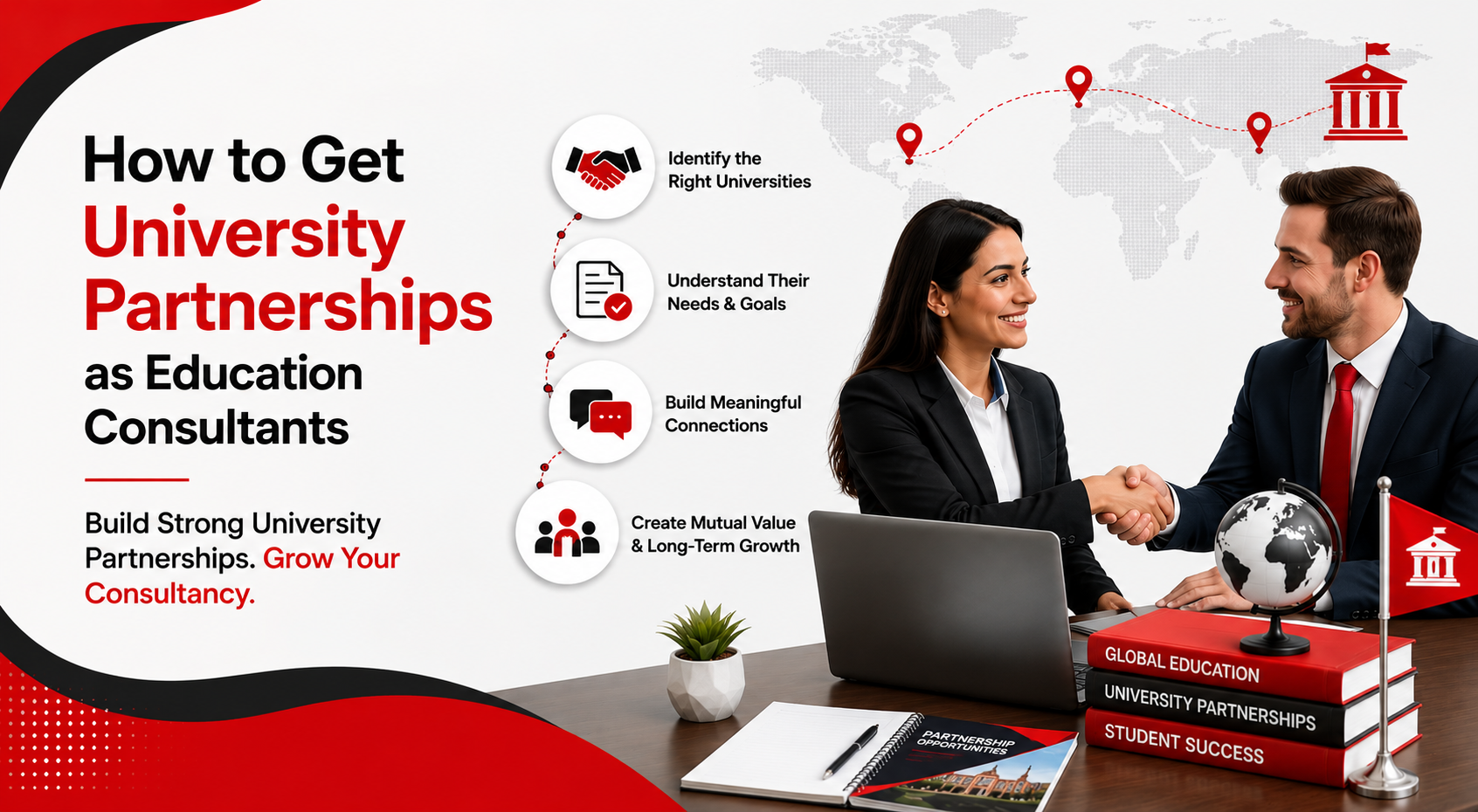
Today, agencies can access large institutional networks through centralized recruitment ecosystems instead of negotiating every partnership independently.
That matters because scaling today is less about “adding more staff” and more about increasing operational leverage.
If your team can manage more applications without increasing complexity, profitability improves dramatically.
This is one reason many Southeast Asian agencies are now partnering with larger global recruitment platforms.
MSM Unify, for example, gives partner agents access to 1,500+ institutions across multiple destinations through a single ecosystem. Instead of spending years building bilateral relationships one university at a time, agencies can immediately expand destination offerings and application capacity.
That changes growth timelines significantly.
Especially for agencies in Vietnam, Indonesia, and the Philippines trying to scale beyond founder-led operations.
Pillar 5: Track Conversion Rates, Not Just Student Numbers
A lot of agencies measure growth incorrectly.
They celebrate lead volume, inquiry numbers, or Instagram engagement. But those metrics do not necessarily translate into revenue. The agencies growing sustainably track conversion efficiency obsessively.
For example:
- Inquiry-to-counselling conversion
- Counselling-to-application conversion
- Application-to-offer conversion
- Offer-to-visa conversion
- Visa-to-enrolment conversion
These numbers tell the real story.
Because if your leads are increasing but your visa conversion rates are falling, your business is not actually improving.
Many experienced agencies in Southeast Asia eventually realize they don’t need dramatically more leads.
They need better systems around the leads they already have.
Even small improvements in conversion percentages can increase revenue significantly without increasing marketing spend.
That’s why high-growth agencies rely heavily on dashboards, CRM tracking, and centralized reporting.
Not because it looks sophisticated.
Because it helps them identify exactly where revenue leaks are happening.
What the Fastest-Growing SEA Education Agencies Do Differently
When you study the agencies scaling fastest across Southeast Asia right now, a few patterns become obvious.
- They diversify destinations early.
- They invest in systems before chaos forces them to.
- They stop relying entirely on founder relationships.
- They automate repetitive operations.
- And most importantly, they think like long-term businesses and not short-term counselling offices.
That mindset shift is important since international education is becoming more competitive every year. Students compare agencies faster.
Parents expect transparency whereas universities want efficiency. And the agencies that survive long term will be the ones capable of handling scale without sacrificing student experience. The good news is that Southeast Asia is still one of the fastest-growing outbound student regions globally.
Vietnam, Indonesia, Malaysia, and the Philippines continue to produce strong demand for international education opportunities. The market is still expanding. But scaling now requires infrastructure, systems, and smarter operational models, and not just harder work.
Final Thoughts
A lot of education consultancies hit a plateau not because they lack ambition, but because they keep trying to grow using the same systems that worked when they were smaller.
That approach eventually breaks.
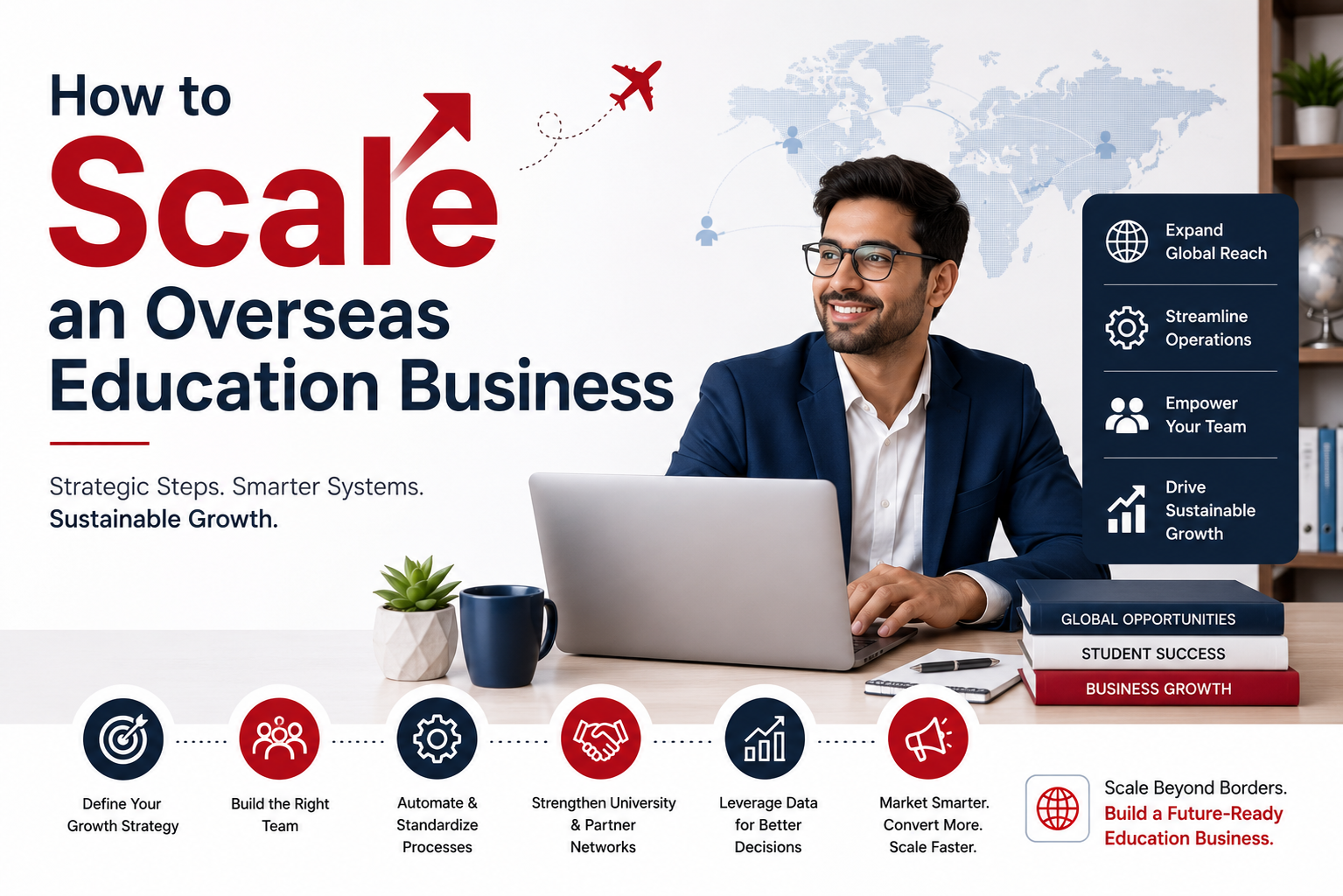
Scaling an overseas education business today means building repeatable processes, diversifying destinations, reducing operational dependency, and creating infrastructure that allows your team to handle more students without creating more chaos.
And honestly, the agencies that understand this early usually grow much faster than the ones trying to manage everything manually forever.
If you’re already handling 50–100 students annually and want to scale sustainably, this is the stage where systems matter more than hustle.
MSM Unify helps Southeast Asian education consultancies scale faster with access to 1,500+ institutions, AI-powered program matching, automated invoicing, centralized application management, and performance dashboards designed for growing agencies.
Agencies looking to expand their global reach can also explore the opportunity to become an MSM Unify partner and access a comprehensive recruitment ecosystem designed for scalable growth.
Instead of spending years building university partnerships one by one, agencies can expand globally through a single platform ecosystem.
That’s often the difference between staying busy and actually scaling.