








If you have ever talked to an education adviser or been interested in getting into a study abroad consultancy, you’ve likely had questions about the financial side of the business.
After all, most students don’t pay large upfront fees to education agents. However, the industry is thriving, new consultancies are continuously being established, and many agencies have developed successful overseas education businesses.
So, where does the money come from?
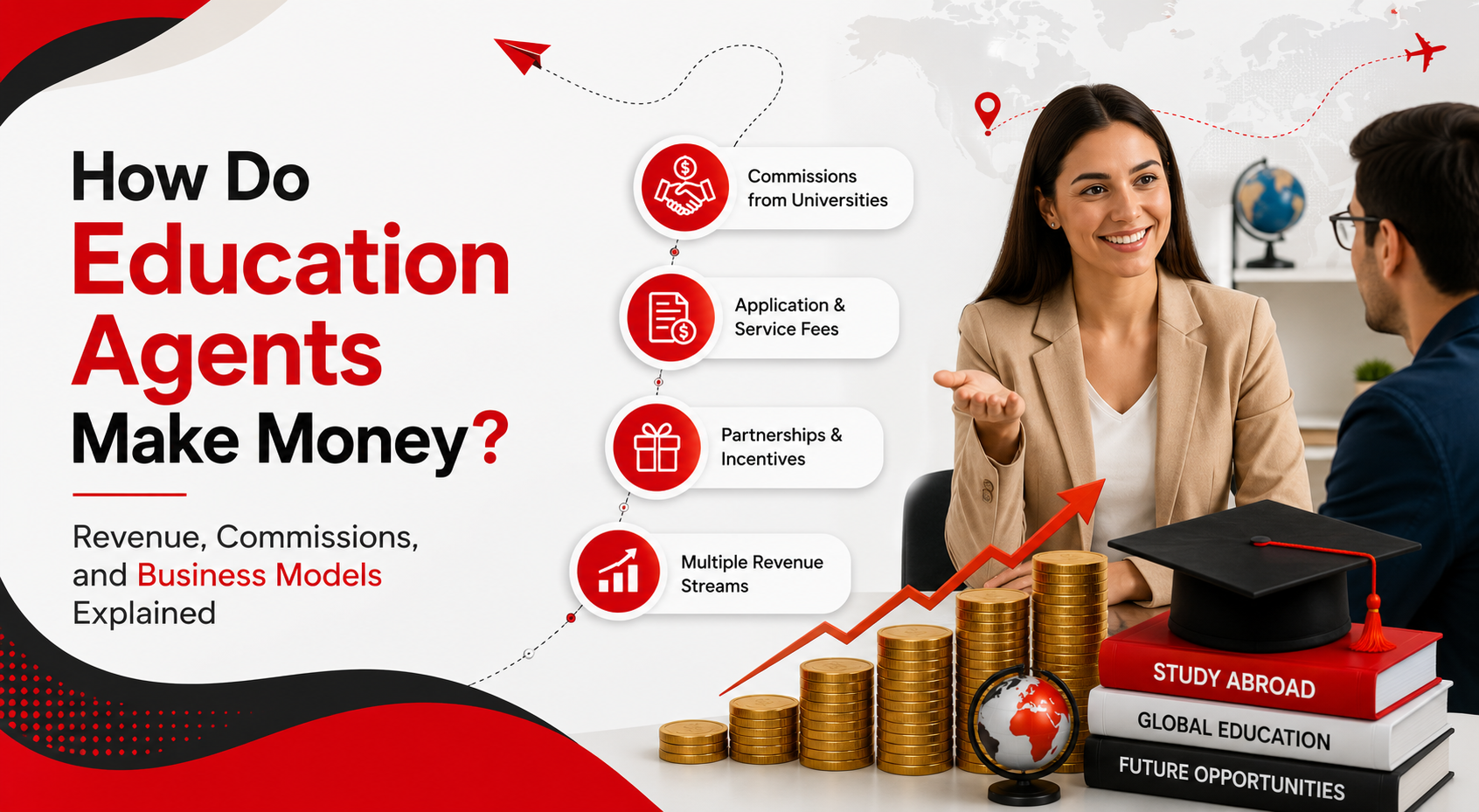
It is not that education consultancies get their income from one source only. The most successful agencies leverage multiple revenue streams to create profitable and sustainable businesses, including university commissions, counselling services, value-added offerings, and technology-driven services.
Understanding how education agents make money is important whether you’re thinking about becoming an education consultant, exploring a career change, or simply trying to understand how the international student recruitment industry operates.
The truth is that education consultancy can be a lucrative career, but, like many professions, it is how good you are at it, your reputation, your student volume, and the systems you create to scale that determine your income.
Why the Education Consultancy Industry Is Growing
International education is one of the greatest service sectors in the world.
Each year, millions of students leave their native country in search of higher education elsewhere. UNESCO reports that over 7.3 million students are studying abroad and that this figure will continue to rise over the next few years.
Outbound student mobility has been steadily increasing in each Southeast Asian (SEA) country, such as Vietnam, the Philippines, Indonesia, Malaysia, and Thailand. Parents are now seeking foreign qualifications, high-paying jobs, and world exposure for their kids.
The demand for professional guidance has increased substantially as more students are interested in exploring overseas education options.
This is where education agents come in.
They help students:
- Choose the right destination.
- Shortlist universities.
- Prepare applications.
- Navigate visa requirements.
- Understand scholarship opportunities.
- Plan their study abroad journey.
And for providing these services, education consultants earn revenue in several different ways.
The Biggest Misconception About Education Agent Income
One of the biggest myths in this industry is that education consultants charge students large fees and make money directly from them.
In reality, many education agencies around the world offer counselling services to students at little or no cost.
Why?
Their primary source of revenue often comes from institutions rather than students.
Universities view education agents as recruitment partners who help them connect with international students in markets they might otherwise struggle to reach.
As a result, institutions compensate consultants for successful student enrollments.
This model has become one of the foundations of international student recruitment.
Revenue Stream #1: University Commissions
The most common answer to the question how do education agents make money is simple:
They earn commissions from universities.
When a student successfully enrolls at a university through an education consultant, the institution may pay the agency a commission.
These commissions generally depend on factors such as:
- Destination country
- Program level
- Tuition fees
- Institutional policies
- Recruitment agreements
Most commission structures are based on a percentage of the student’s first-year tuition fee.
For example:
| Annual Tuition Fee | Commission Rate | Estimated Commission |
| $15,000 | 10% | $1,500 |
| $20,000 | 12% | $2,400 |
| $30,000 | 15% | $4,500 |
Commission structures vary significantly from one institution to another, and figures should always be confirmed directly with partner institutions.
What Influences Education Agent Commission Rates?
Not every institution offers identical commission structures.
Several factors can influence education agent commission levels:
Destination Country
Some countries offer higher average commissions than others.
Institutional Priorities
Universities may increase commissions when recruiting students for specific programs or markets.
Student Volume
Some institutions provide additional incentives to agencies that consistently meet recruitment targets.
Exclusive Partnerships
Special agreements can sometimes result in better commercial terms.
However, successful agencies rarely choose institutions based solely on commission rates.
Student outcomes should always remain the priority.
Revenue Stream #2: Counselling and Service Fees
Although many agencies provide free counselling, some consultants also charge professional service fees.
These fees may cover:
- Career counselling
- University shortlisting
- Application preparation
- SOP reviews
- Visa support
- Scholarship guidance
In certain markets, students are willing to pay for specialized expertise, particularly when applying to highly competitive institutions.
This can become an important additional source of income.
Revenue Stream #3: Premium Application Services
Some consultancies offer premium packages that include additional support, such as:
- Priority counselling
- Interview preparation
- Document editing
- Personalized mentoring
- Admission strategy planning
Premium services allow agencies to diversify revenue without relying entirely on commissions.
Many established agencies use a hybrid model that combines commissions and service-based income.
Revenue Stream #4: Test Preparation and Training
Many consultancies also offer:
- IELTS coaching
- TOEFL preparation
- PTE classes
- Language training
- Career readiness workshops
These services can become meaningful revenue streams, particularly for agencies operating in markets where students seek comprehensive support.
Revenue Stream #5: Visa and Pre-Departure Services
Students often require assistance beyond the university application process.
Consultancies may offer:
- Visa documentation support
- Accommodation assistance
- Forex guidance
- Insurance support
- Pre-departure orientation
Some agencies generate additional revenue through these complementary services.
How Much Can Education Consultants Earn?
One of the most common questions people ask is about education consultant earnings.
The truth is that income varies widely.
A small consultancy handling a limited number of students will naturally generate different revenue than an established agency placing hundreds of students annually.
Several factors influence earnings:
- Number of student enrollments
- Destination mix
- Commission structures
- Service offerings
- Operational efficiency
- Reputation and referrals
There is no single income figure that applies to every consultancy.
Like most businesses, revenue tends to grow with experience, systems, and scale.
The Difference Between Revenue and Profit
This distinction is important.
Many people see large commission figures and assume education consultancies generate enormous profits.
In reality, agencies also have expenses, including:
- Employee salaries
- Marketing costs
- Office expenses
- Technology platforms
- Compliance requirements
- Training and development
Revenue is not the same as profit.
Successful consultancies focus on building sustainable business models rather than simply increasing student numbers.
Why Diversification Matters
One of the biggest mistakes new consultants make is depending entirely on one income source.
For example, an agency that only recruits students for a single destination can become vulnerable to:
- Visa policy changes
- Economic fluctuations
- Institutional changes
- Market disruptions
Diversification creates stability.
This includes:
- Multiple destinations
- Multiple institutions
- Multiple service offerings
- Multiple revenue streams
The strongest businesses rarely rely on one source of income.
How Technology Is Changing Study Abroad Consultant Income
Technology is transforming the economics of education consultancy.
In the past, agencies often needed larger teams to manage increasing student volumes.
Today, automation tools help consultants:
- Track applications
- Manage documents
- Improve communication
- Handle larger student volumes
- Monitor performance
This efficiency allows agencies to grow without increasing overheads at the same pace.
As a result, technology can positively influence study abroad consultant income by improving productivity and scalability.
Why Relationships Matter More Than Commissions
The most successful consultants understand something important:
Students are not transactions.
International education is one of the biggest decisions a family will make, both emotionally and financially.
Agencies that focus only on commissions often struggle to build long-term trust.
By contrast, consultants who prioritize student outcomes usually generate:
- More referrals
- Better reviews
- Higher retention
- Stronger institutional relationships
- Sustainable growth
Reputation remains one of the most valuable assets in this industry.
Building a Scalable Education Consultancy Business
As agencies grow, the business model often evolves.
Many successful consultancies move from being founder-dependent operations to structured businesses with:
- Counselling teams
- CRM systems
- Marketing processes
- Technology platforms
- Institutional networks
- Performance tracking
Systems make growth possible.
Without them, agencies often reach a ceiling where increasing student numbers becomes difficult.
How MSM Unify Helps Education Consultants Grow
One of the biggest challenges for consultants is managing institutional relationships and operational complexity as they grow.
MSM Unify helps address these challenges by providing:
- Access to 1,500+ institutions worldwide
- More than 50,000 programs
- AI-powered program matching
- Multi-institution applications
- Automated invoicing support
- Performance dashboards
- Recruitment management tools
Rather than spending years building every process independently, consultants can leverage technology and institutional access to grow more efficiently.
Final Thoughts
The answer to how do education agents make money is much broader than simply earning commissions from universities. Successful education consultancies usually operate with multiple revenue streams that may include institutional commissions, premium counselling services, test preparation, application support, and value-added student services. Over time, the most resilient businesses are the ones that diversify their income sources and build systems that allow them to grow sustainably.
At the same time, it’s important to remember that education consultancy is still fundamentally a relationship-driven business. Students and families trust consultants with one of the most important decisions of their lives, and that trust cannot be built by focusing on revenue alone. Agencies that consistently deliver positive outcomes, maintain ethical practices, and embrace technology to improve efficiency are often the ones that achieve long-term success. Income follows value, and in international education, creating genuine value for students remains the foundation of a profitable consultancy.
FAQs
1. How do education agents make money?
Most education agents earn commissions from universities when students successfully enroll. Many agencies also generate revenue through counselling services and additional support offerings.
2. What is an education agent commission?
An education agent commission is the payment a university makes to a recruitment partner for successfully enrolling a student.
3. Do students pay education consultants?
Some agencies provide free counselling, while others charge fees for specialized services such as career guidance, application support, or visa assistance.
4. How much can an education consultancy earn?
Earnings vary depending on student volume, commission structures, destinations, and business models.
5. Can education consultancy become a full-time business?
Yes. Many agencies have built highly successful businesses by combining institutional partnerships, multiple revenue streams, and scalable operational systems.