








For years, the education consultancy business has been based on relationships, experience, and a consultant’s ability to manually help students navigate an increasingly complex admissions process. A counsellor would have to spend hours getting to know the profile of a student, finding a program that matches their needs, comparing universities, reminding students of deadlines for applications, reminding students of any missing documents, and answering the same questions over and over again for students.
This model is still in place today, but with a very rapid pace of change.
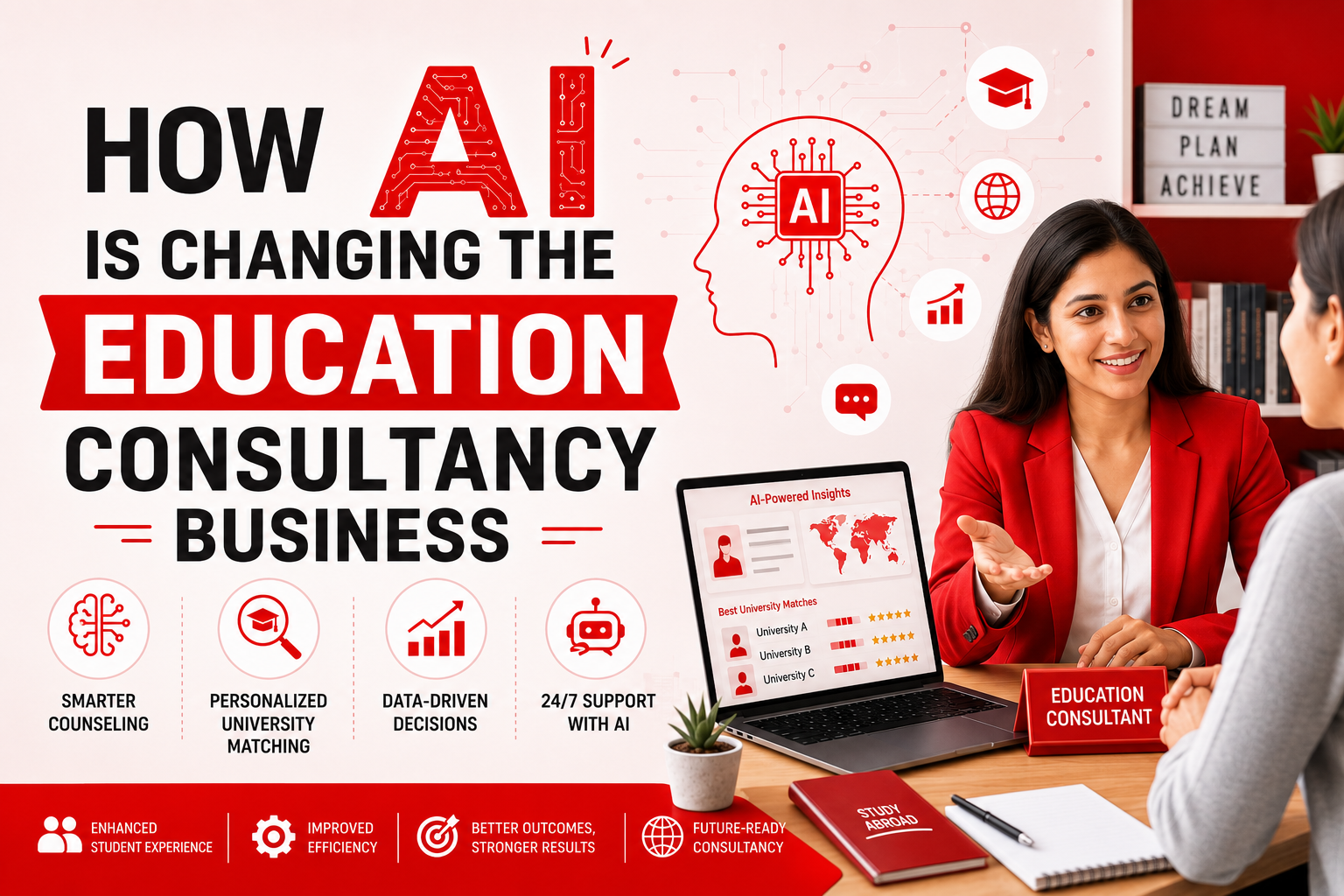
AI is starting to transform the work of an education consultant, the way a student finds a study opportunity, and the way institutions communicate with prospective students. While some consultants initially viewed AI as a threat, many are now realizing that it is becoming one of the most valuable tools available to education professionals. AI doesn’t replace counsellors, but it does support them in working more efficiently, more quickly, and with more students than ever before, without compromising on quality.
As international education demand continues to rise in Southeast Asia, including Vietnam, the Philippines, Indonesia, Malaysia, and Thailand, consultants in the region must understand how AI works as an education consultant. It’s starting to become a competitive edge. In the following article, we will uncover the why and how AI is reshaping the edtech industry.
Why the Education Consultancy Industry Is Adopting AI
Compared to the previous 10 years, the modern process of student recruitment is far more complex.
There are thousands of universities, tens of thousands of programs, and an infinite amount of information available online for students to access. Meanwhile, universities are battling it out for international students, immigration policies remain in flux, and families have higher demands for quick decision-making than ever before.
This has created an increasing demand for education consultants to provide accurate advice in a timely fashion.
Consider a common scenario. A student from Manila wishes to pursue Business studies in Australia. Another student from Ho Chi Minh City is considering computer science programs in Canada and Germany. A third applicant from Jakarta has looked into further studies in the UK. Every student has their own academic record, financial budget, career aspirations, visa requirements, and destination preferences.
Traditionally, a counsellor would take a lot of time looking into options on a case-by-case basis. In today’s digital era, AI can drastically cut down on this workload by streamlining information, matchmaking potential, and uncovering relevant opportunities in a matter of seconds.
This change enables consultants to spend more of their time advising and less of their time searching.
The Biggest Misconception About AI in Education Consultancy
A common fear among emerging consultants is that AI will eventually take over education agent jobs.
The short answer is “no”.
The answer is straightforward: Weighing the pros and cons of studying abroad isn’t a purely monetary equation.
Families are making significant economic, educational, and personal investments. Students frequently require reassurance, guidance, and emotional support throughout the process. Perhaps more than ever before, parents are looking for answers to questions that go beyond the university ranking and the admission criteria.
They want to know:
- Is this country safe?
- Will my child find employment after graduation?
- Is the university a good fit?
- What happens if visa regulations change?
- How will my child adjust to a different culture?
These are conversations that require trust, empathy, and human judgment.
AI can provide information. It cannot replace the confidence students gain from speaking with an experienced counsellor who understands their goals and concerns.
The future of the industry is not AI replacing consultants. It is consultants using AI to become more effective.
How AI Is Improving Student Recruitment
AI student recruitment is among the most notable applications in the field, assisting consultants in finding suitable opportunities more quickly.
Historically, program matching is a process that required manual comparison of the requirements, costs, location requirements, academic criteria, and career interests of students.
This can take hours to complete.
These factors can now be analyzed by AI-based systems that instantly suggest relevant programs.
This can make a huge difference in productivity for consultants handling dozens or hundreds of student cases. Rather than spending an afternoon building a short list, counsellors can spend their afternoon talking with students about the possibilities and assisting them in making their choices.
This makes for a better experience for both the consultant and the student.
Faster Program Matching Means Better Student Outcomes
Choosing a program is one of the most critical decisions that a student has to make.
The wrong school or program can affect a student’s employment prospects, finances and job satisfaction in the future.
AI matching systems can minimize this risk by taking into account several factors simultaneously, such as:
- Academic background
- English language scores
- Budget constraints
- Preferred destinations
- Career interests
- Admission eligibility
- Scholarship opportunities
Rather than relying solely on manual searches, consultants can use technology to uncover options that might otherwise be overlooked.
The result is often a more personalized student experience.
AI for Education Agents: Reducing Administrative Work
Administrative tasks consume a surprising amount of time in education consultancy businesses.
Document collection, application tracking, follow-up emails, status updates, and compliance checks can quickly become overwhelming as student numbers increase.
This is where AI for education agents is making a measurable impact.
Many routine processes can now be automated, including:
- Application status notifications
- Document reminders
- Lead prioritization
- Communication workflows
- Data entry support
- Follow-up scheduling
When repetitive tasks are handled more efficiently, counsellors gain additional time to focus on relationship building and strategic guidance.
For growing consultancies, this operational efficiency can be transformative.
Better Lead Management and Conversion Tracking
One of the biggest challenges facing education consultancies is managing enquiries effectively.
Not every lead is ready to apply immediately. Some students begin researching options a year or more before enrollment.
Without a proper system, opportunities can easily fall through the cracks.
AI-enhanced customer relationship management tools help consultants:
- Identify high-intent leads
- Prioritize follow-ups
- Track engagement patterns
- Predict conversion likelihood
- Monitor application progress
This enables agencies to make smarter decisions about where to invest their time and resources.
Instead of treating every enquiry the same way, consultants can focus attention where it is most likely to generate results.
The Rise of Predictive Analytics in Student Recruitment
One of the more advanced developments in education consultancy technology is predictive analytics.
These systems analyze historical data and patterns to generate insights about future outcomes.
For example, predictive models may help estimate:
- Admission probability
- Scholarship eligibility
- Student conversion likelihood
- Visa approval prospects
- Enrollment trends by destination
While these predictions are never guaranteed, they provide valuable guidance that supports better decision-making.
For consultants managing large student volumes, these insights can improve planning and resource allocation significantly.
Students Now Expect Faster Responses
Technology has changed expectations.
Students who order products online, book travel through mobile apps, and receive instant notifications in every other aspect of their lives expect the same level of responsiveness from education providers.
Waiting several days for a program recommendation no longer feels acceptable to many applicants.
AI helps consultants meet these expectations without increasing staffing costs dramatically.
Faster responses create a better student experience and reduce the likelihood of losing enquiries to competing agencies.
In a competitive recruitment environment, responsiveness often becomes a differentiating factor.
AI Is Helping Smaller Agencies Compete
Large education consultancies traditionally had an advantage because they could invest in bigger teams and broader institutional networks.
Technology is helping level the playing field.
Today, smaller agencies can use AI-powered platforms to access sophisticated capabilities that were previously available only to larger organizations.
These include:
- Program matching tools
- Recruitment dashboards
- Application management systems
- Performance tracking
- Lead management platforms
As a result, boutique consultancies can deliver services that rival much larger competitors.
The Human Skills That Matter More Than Ever
Ironically, as technology becomes more important, human skills become even more valuable.
The most successful consultants of the future are unlikely to be those who simply know how to use software.
They will be those who combine technology with strong interpersonal abilities.
Key skills include:
Communication
Students and families need clear explanations of complex information.
Empathy
Educational decisions often involve uncertainty and stress.
Cultural Awareness
International education requires understanding different backgrounds and expectations.
Career Guidance
Students increasingly seek advice about employability, not just admissions.
Relationship Building
Trust remains the foundation of successful student recruitment.
Technology can support these skills, but it cannot replace them.
What the Future Looks Like for Education Consultants
The education consultancy industry is moving toward a model where human expertise and technology work together.
Consultants will spend less time on administrative tasks and more time helping students make informed decisions.
AI will handle much of the information gathering and operational support.
Counsellors will focus on:
- Advising families
- Solving complex cases
- Providing career guidance
- Building institutional relationships
- Supporting student success
This evolution should be viewed as an opportunity rather than a disruption.
The consultants who embrace technology early are likely to be better positioned for long-term growth.
How MSM Unify Supports AI-Powered Student Recruitment
For consultants looking to modernize their operations, platforms such as MSM Unify are helping bridge the gap between traditional counselling and technology-enabled recruitment.
MSM Unify provides access to:
- 1,500+ institutions globally
- AI-powered program matching
- Streamlined application management
- Multi-institution application capabilities
- Performance dashboards
- Recruitment workflow tools
Rather than replacing the role of the counsellor, these capabilities help agencies manage larger student volumes while maintaining service quality.
This combination of human expertise and intelligent technology represents the direction in which the industry is moving.
Final Thoughts
The conversation around AI often focuses on whether technology will replace existing jobs. In education consultancy, that question misses the bigger picture. The real transformation is not about replacing counsellors but enabling them to deliver better outcomes for students while operating more efficiently. As application processes become more complex and students gain access to more educational options than ever before, consultants need tools that help them navigate that complexity.
The agencies that thrive over the next decade will likely be those that strike the right balance between technology and personal guidance. Students will continue to value human advice when making life-changing education decisions, but they will also expect faster responses, better recommendations, and smoother application experiences. By embracing AI in education consultancy, agencies can meet those expectations while creating stronger, more scalable businesses that are prepared for the future of international student recruitment.
FAQs
How is AI used in education consultancy?
AI helps consultants with program matching, lead management, application tracking, predictive analytics, and recruitment automation.
Can AI replace education agents?
No. AI can support administrative and analytical tasks, but students and families still rely on human guidance, trust, and personalized counselling.
What are the benefits of AI for education agents?
AI improves efficiency, reduces manual work, accelerates program matching, and helps agencies manage larger student volumes.
How does AI student recruitment work?
AI-powered systems analyze student profiles, preferences, eligibility criteria, and institutional requirements to recommend suitable programs and opportunities.
What is the future of education consultancy technology?
The future combines human expertise with intelligent technology, allowing consultants to provide more personalized support while operating more efficiently.