








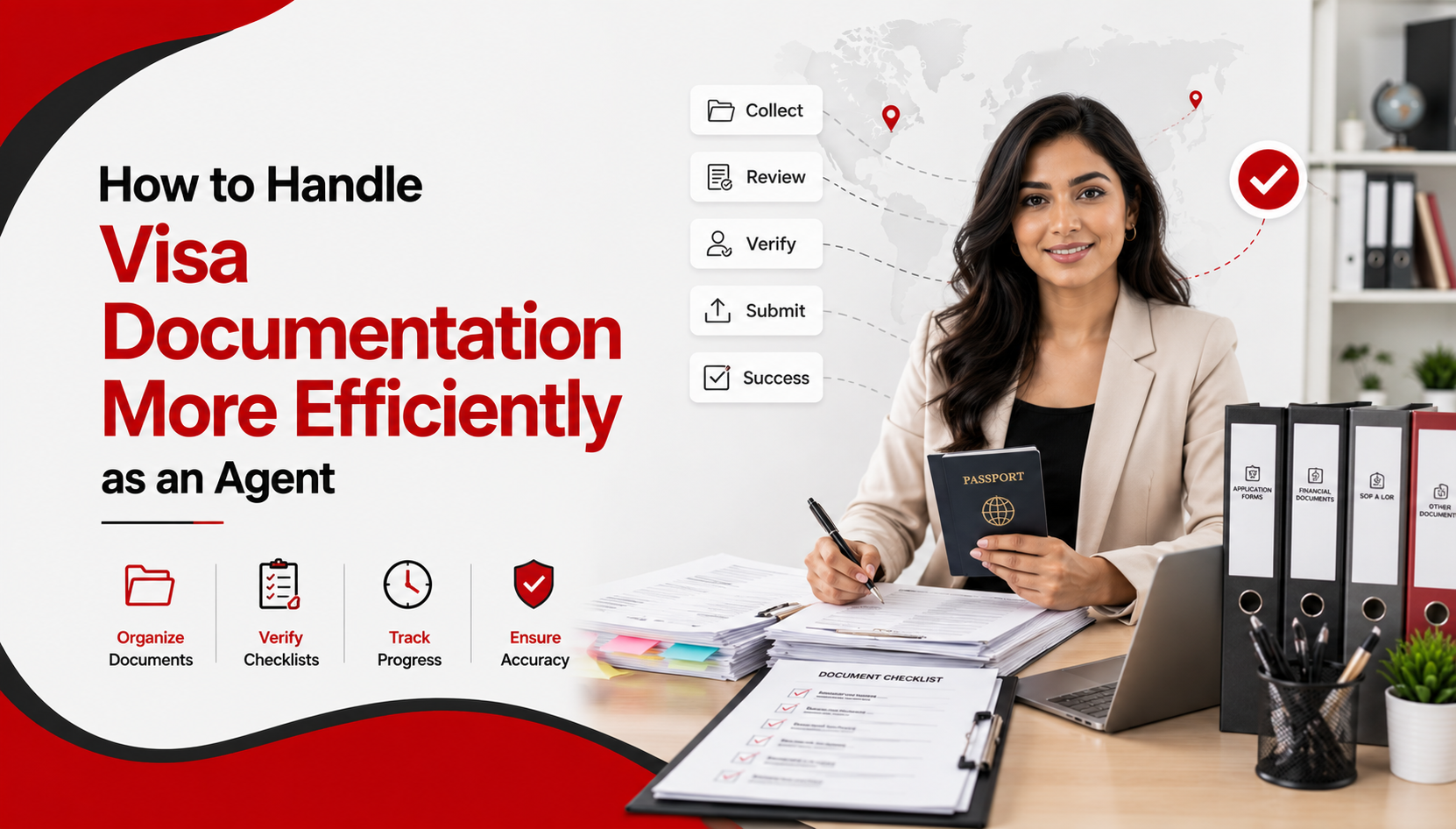

Visa documentation is where many study abroad cases become stressful. The student may have an offer letter, the family may be ready to move ahead, and the counselor may already be planning the next intake. Then one missing bank statement, one unclear sponsor document, one wrong passport scan, or one late medical requirement slows everything down.
For agents, learning how to handle visa documentation efficiently is not only about collecting papers faster. It is about reducing confusion, keeping students calm, and making sure every file is complete before it reaches a risky stage.
Why visa documentation gets messy
Study abroad applications already involve a lot of steps. Visa documentation adds another layer: financial proof, identity records, academic documents, offer letters, acceptance confirmations, health requirements, sponsor details, translations, country-specific forms, and deadlines.
The volume of international student movement makes this even more important. UNESCO reported that 6.9 million students were studying outside their home country, almost three times the number in 2000. That means more students, more destinations, and more pressure on agents to keep documentation clean.
The problem is rarely one big mistake. It is usually a chain of small ones.
| Common challenge | What it can cause |
| Missing papers | Visa preparation gets delayed |
| Different document formats | Files need rework before submission |
| Outdated financial documents | Student has to collect records again |
| Unclear sponsor details | Extra questions and back-and-forth |
| Last-minute university requests | Application and visa timelines overlap |
| Student confusion | Repeated calls, stress, and delayed responses |
This is where a clear visa document checklist becomes the agent’s best friend.
Build the checklist around the destination
A generic checklist is useful only at the beginning. After that, every country needs its own version.
For example, the United Kingdom student visa route requires students to show enough money for course fees and living costs unless an exemption applies. The official UK guidance also explains that financial evidence can be required depending on the applicant’s situation. Australia also requires student visa applicants to prove financial capacity, and Study Australia lists at least AUD 29,710 as the required amount for international student visa applicants.
That is why agents should not send the same document list to every student.
| Checklist type | What it should include |
| Student identity | Passport, photographs, personal details |
| Academic records | Transcripts, certificates, test scores |
| Admission documents | Offer letter, acceptance confirmation, enrolment proof |
| Financial documents | Bank statements, sponsor proof, income evidence, loan letters |
| Country-specific items | Health cover, medical tests, police clearance, biometrics |
| Visa forms | Online application details, declarations, appointment confirmation |
A good checklist should also show who owns each document: student, parent, sponsor, institution, or agent.
Track documents before chasing students
Many agents spend too much time asking the same question: “Have you sent the document?”
That question becomes frustrating for both sides when the agent does not have a clear view of what is received, what is pending, and what needs correction.
A better tracking system should show:
| Document status | What it means |
| Pending | Student has not submitted it yet |
| Received | File has been uploaded or shared |
| Under review | Agent or documentation team is checking it |
| Needs correction | Wrong format, unclear scan, expired document, or missing detail |
| Accepted for file | Ready to be used in the next stage |
| Submitted | Sent through the required channel or included in the visa file |
This improves the full application documentation process. Students get clearer instructions. Counselors stop guessing. Managers can see which cases are at risk before deadlines become urgent.
Make communication coordinated, not scattered
Visa documentation involves sensitive details. Parents may share financial records. Students may send passport copies. Counselors may request corrections. Visa teams may ask for missing information. If all of this is happening across WhatsApp, email, personal folders, and phone calls, confusion is almost guaranteed.
Good study abroad visa support needs coordinated communication.
Instead of saying, “Please send the missing documents,” send a clear update:
“Your passport, offer letter, and academic documents are received. We still need the updated bank statement and sponsor income proof before the file can move to review.”
Instead of saying, “Your financials are wrong,” say:
“The bank statement is readable, but the date range does not meet the requirement. Please arrange an updated version before Friday.”
The tone matters. Students and parents are already nervous at the visa stage. Clear communication reduces panic.
Avoid last-minute documentation work
A visa file should not begin after the offer letter is received. The preparation should start earlier, especially for destinations with financial, health, or sponsor documentation requirements.
A practical agent workflow can look like this:
| Stage | Documentation action |
| Counseling | Explain basic visa document expectations |
| Shortlisting | Check destination-specific financial planning early |
| Application submission | Start collecting identity and academic documents |
| Offer received | Confirm conditions and acceptance steps |
| Pre-visa review | Check financial, sponsor, and country-specific records |
| Final file preparation | Review format, dates, spelling, scans, and consistency |
| Submission support | Keep student informed on next steps and timelines |
This is one of the simplest ways to handle visa documentation efficiently. Do not wait until the student is already under pressure.
Keep compliance in mind
Agents are not just helping students collect papers. They are helping them understand that visa documents must be accurate, consistent, and genuine.
This is where education consultant compliance matters. Students should never be encouraged to hide information, adjust dates, submit unclear records, or use documents they do not fully understand. A clean file protects the student and the agency.
The goal is not to “make a file look good.” The goal is to make sure the file is complete, truthful, and organized according to the relevant requirements.
A simple internal compliance review should check:
| Review point | Why it matters |
| Name spelling | Must match passport and academic records |
| Dates | Avoids inconsistencies across documents |
| Sponsor relationship | Helps explain financial support clearly |
| Bank statement period | May affect financial evidence acceptance |
| Document clarity | Reduces risk of unreadable submissions |
| Translation needs | Important for non-English documents |
| Offer conditions | Ensures academic or payment steps are complete |
How MSM Unify helps organize the journey
Visa documentation does not sit separately from the rest of the student journey. It connects to counseling, university shortlisting, application submission, offer tracking, and enrollment steps.
With MSM Unify, recruitment partners get access to automated recruitment tools and a self-service dashboard for student applications, giving agents better control over submissions and commissions. The platform also connects students, educational institutions, and recruitment partners in one global education marketplace, which helps keep the wider study abroad journey more organized.
For agents, the practical value is workflow clarity. Student information, application progress, and uploaded details are easier to manage through a portal instead of being scattered across too many places. MSM Unify’s agent support information also notes that student information can be edited in the portal under the Students section, which supports cleaner record management before final steps.
That structure helps agents move from application to documentation with fewer gaps.
Final thoughts
Visa documentation becomes difficult when the process is unclear. Missing papers, inconsistent formats, late requests, and scattered communication can turn a strong student case into a stressful one.
To handle visa documentation efficiently, agents need destination-wise checklists, document status tracking, early preparation, coordinated communication, and a strong internal review process. The more organized the file is, the easier it becomes to support students with confidence.
MSM Unify helps consultants manage the student journey more smoothly from application to documentation, giving teams better visibility and reducing the daily confusion that comes from scattered files and manual follow-ups.