









Manual follow-ups do not look like a big problem at first. One student needs a transcript reminder. Another needs an offer update. Someone else has to send a passport scan. A parent wants to know when the deposit is due.
By noon, the counselor has sent twenty small messages and still has not reviewed a single new application properly.
That is the real issue. Follow-ups are necessary, but when every reminder depends on memory, personal chats, and scattered notes, the admissions process starts leaking. Students go quiet. Documents arrive late. Applications sit unfinished. Deadlines come too close. The team works hard, but the workflow still feels messy.
For agencies that want to reduce manual follow-ups for study abroad agents, the answer is not simply “send more reminders.” The answer is to build a system where the right reminder appears at the right time, linked to the right student file.
Where manual follow-ups usually go wrong
Study abroad applications are not linear. A student may be shortlisted for three universities, waiting for documents on one, under review at another, and holding a conditional offer from the third.
Now imagine the same counselor managing fifty students like that.
Global demand makes the workload even heavier. UNESCO reported that 6.9 million students were studying outside their home country, a number that has tripled since 2000. The same report noted that global higher education enrollment reached 264 million students.
That scale shows why agents need stronger workflows. More students mean more destinations, more universities, more intake cycles, and more communication.
| Manual follow-up problem | What happens in real life |
| Reminders stay in WhatsApp | Other team members cannot see the full case |
| Documents come in different places | The wrong file may be uploaded later |
| Deadlines sit in personal calendars | The agency has no shared view |
| University emails go to one person | Updates get delayed when that person is busy |
| Students keep asking “any update?” | Counselors spend time repeating status messages |
This is how leakage happens. Not because nobody cares, but because the process depends too much on people remembering everything.
The follow-ups agents repeat every week
Most follow-ups are predictable. That is why they should not take over the day.
| Follow-up type | Common message |
| Document reminder | “Your academic transcript is still pending.” |
| SOP or CV reminder | “Please send the revised version today so we can review it.” |
| Offer update | “Your application is still under review.” |
| Conditional offer | “These conditions must be completed before the next step.” |
| Deposit deadline | “Your payment deadline is coming up.” |
| Visa file reminder | “Please start preparing your financial documents.” |
These messages matter. The problem is repetition. When counselors manually chase every student, they lose time that should go into counseling, shortlisting, eligibility checks, and application review.
Salesforce reported that sales reps spend 60% of their time on non-selling tasks, including manual notes, searching for material, and internal chasing. It also reported that sellers use an average of eight tools to close deals. Study abroad agents face a similar daily drag when they keep switching between chats, emails, spreadsheets, folders, and university systems.
That is where agent workflow automation becomes useful. It does not replace the counselor. It removes the most repetitive parts of the chase.
Use a dashboard before the day gets crowded
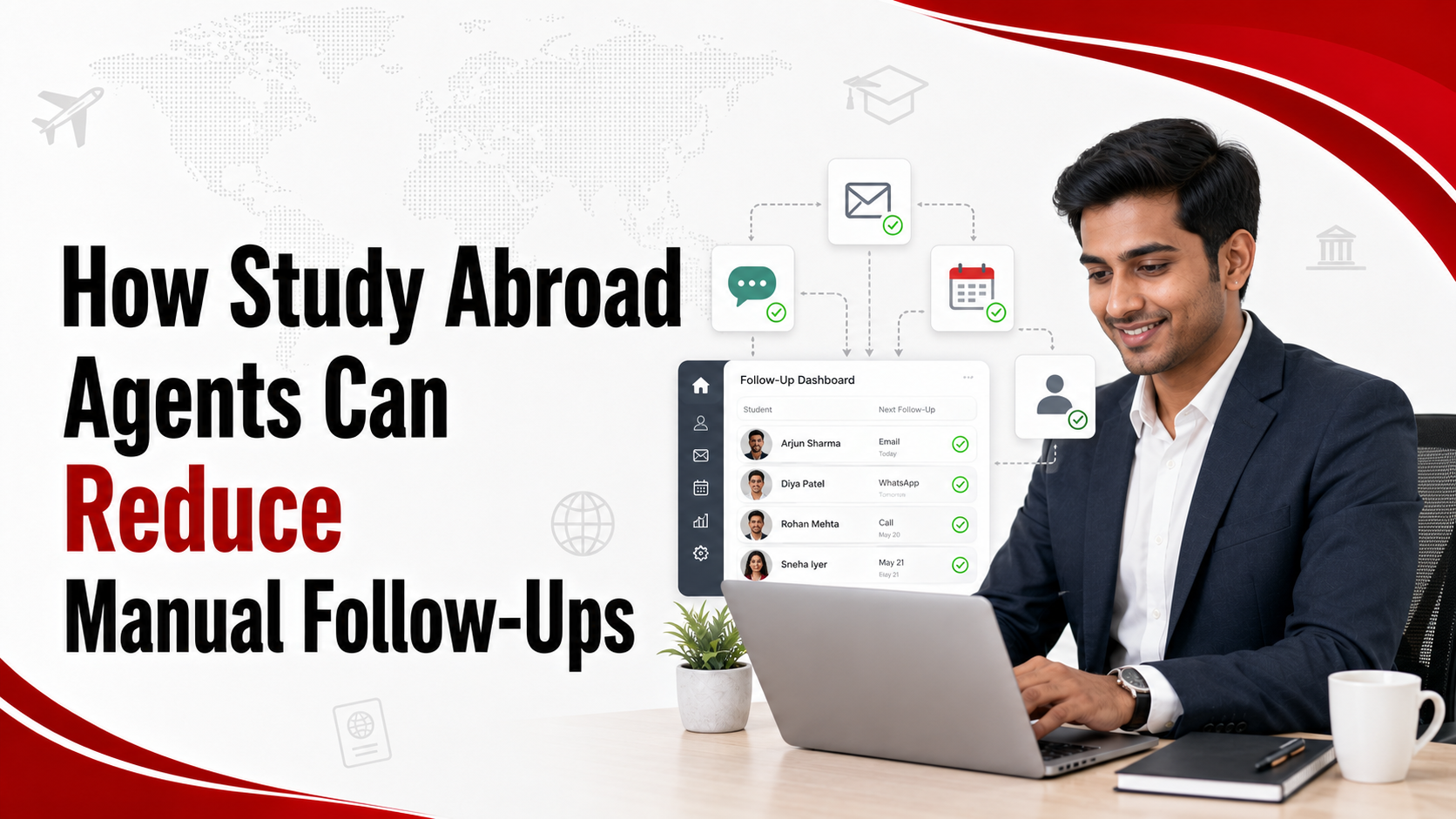
A centralized dashboard gives counselors a simple view of what needs attention. Instead of asking, “Who was I supposed to follow up with today?” the counselor can start with a ready list.
A good dashboard should show:
| Dashboard item | Why it helps |
| Students with pending documents | Counselors know who needs a reminder |
| Applications ready for review | The team can move files faster |
| Submitted applications | Follow-ups with universities become easier |
| Conditional offers | Students do not miss offer conditions |
| Deposit deadlines | Payment-related delays are reduced |
| Visa-stage students | Document preparation starts earlier |
This is one of the most practical ways to reduce manual follow-ups for study abroad agents. The counselor still communicates personally, but the system decides what needs attention first.
Keep status updates tied to the student file
Students become anxious when they do not know what is happening. Parents become anxious when money or deadlines are involved. Many “follow-ups” from students are really requests for clarity.
A better process gives students short, useful updates before they have to ask.
For example:
| Student concern | Better status update |
| “Did you submit my file?” | “Your application was submitted today with your transcript, passport, and SOP.” |
| “Any update?” | “Your application is under review. The next follow-up is scheduled for Friday.” |
| “What is pending?” | “Only your updated bank statement is pending for the next step.” |
| “Is my offer final?” | “It is conditional. These two requirements must be completed first.” |
This is what good student communication management looks like. It is not about sending long messages. It is about sending clear messages at the right stage.
Automate reminders, but keep the human voice
No student wants to feel handled by a machine. Still, basic reminders should not depend on a counselor’s memory.
The useful middle ground is simple: automate the trigger, personalize the message.
A system can remind the counselor that a transcript is pending. The counselor can still write the message in a warm, specific way. A system can flag a deposit deadline. The counselor can still explain what the deadline means and what the student should do next.
This is how agencies can automate student follow-ups without sounding cold.
Where MSM Unify helps agents work cleaner
MSM Unify supports recruitment partners with automated recruitment tools and a self-service dashboard for student applications, giving agents better control over submissions and commissions. It also helps agents expand school, college, and university partnerships worldwide.
For everyday work, the value is practical. Agents can manage student applications with more visibility instead of depending on separate spreadsheets and scattered conversations. MSM Unify also supports a standardized application process, lets agents check application status from the dashboard, and allows student information and uploaded documents to be edited before final submission where applicable.
That makes MSM Unify useful for agencies trying to reduce repetitive chasing. The work becomes easier to see, easier to assign, and easier to follow through.
A simple follow-up workflow for agents
A clean workflow can look like this:
| Stage | Follow-up action |
| New inquiry | Capture student details and assign counselor |
| Counseling completed | Send shortlist and confirm interest |
| Documents pending | Trigger reminders for missing files |
| Application ready | Review before submission |
| Application submitted | Track university status |
| Offer received | Explain conditions and next steps |
| Deadline approaching | Send student and parent reminder |
| Visa stage | Track financial and identity documents |
This keeps the student journey moving without making the counselor chase everything manually.
Final thoughts
Manual follow-ups will always exist in student recruitment, but they should not control the whole day. When agents rely only on memory, chats, and personal trackers, small gaps become bigger problems: missed documents, delayed applications, unclear updates, and anxious students.
To reduce manual follow-ups for study abroad agents, agencies need centralized dashboards, stage-based reminders, cleaner status updates, and stronger application visibility.
MSM Unify gives consultants a more organized way to manage communication, applications, and university coordination from one place. For growing teams, that means less repetitive chasing and more time for the work that actually needs a counselor’s judgment: helping students make the right study abroad decision.