RIT Croatia, formerly known as the American College of Management and Technology (ACMT), was established in Croatia in 1997 when the Ministry of Science, Education, and Sports of the Republic of Croatia initiated the establishment of private higher education institutions.
Due to its reputation in creating and maintaining successful international partnerships, one of the most prominent private American universities, Rochester Institute of Technology, was chosen as the best partner in these efforts.
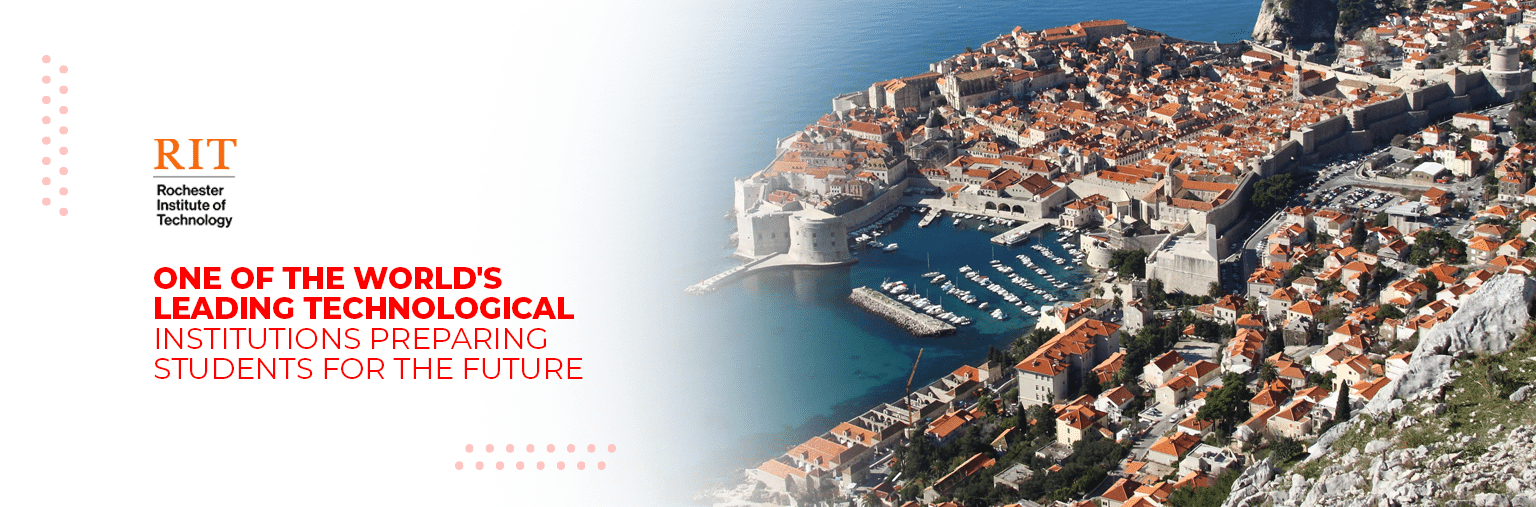
In 2013, the American College of Management and Technology changed its name to RIT Croatia to fully comply with the parent institution. RIT Croatia offers programs of study at two campuses, one located in the coastal resort city of Dubrovnik and one in the country's capital, Zagreb. It offers three undergraduate programs: Hospitality and Tourism Management (Dubrovnik), Business Administration and International Business (Zagreb), and Information Technology/Web and Mobile Computing (Dubrovnik and Zagreb).
In addition, as part of RIT Croatia's life-long learning initiatives, it is facilitating the opportunity for students to earn Master of Science degrees from Rochester Institute of Technology at RIT Croatia's Zagreb campus: Master of Science program in Service Leadership and Innovation and Master of Science in Information Sciences and Technologies.
RIT Croatia is the only educational institution in Croatia that grants two diplomas: an American degree from RIT and a Croatian degree from RIT Croatia, awarded for undergraduate programs.
Upon successfully completing a four-year undergraduate program, students will receive an internationally accredited bachelor of science (BS) degree from Rochester Institute of Technology, providing them with a competitive advantage in the global job market.
In addition to the American degree, all students who successfully complete one of the four-year programs will receive a degree of Baccalaureus/Baccalaurea (by earning 240 ECTS points). This is a Croatian degree granted by RIT Croatia.
The European Credit Transfer and Accumulation System (ECTS) is a tool of the European Higher Education Area (EHEA) for making studies and courses more transparent and thus helping to enhance the quality of higher education.
ECTS is a learner-centered system for credit accumulation and transfer, based on the principle of transparency of the learning, teaching, and assessment processes. Its objective is to facilitate the planning, delivery, and evaluation of study programs and student mobility by recognizing learning achievements, qualifications, and learning periods.
ECTS credits express the volume of learning based on the defined learning outcomes and their associated workload. Thirty (30) ECTS credits are allocated to the learning outcomes and associated workload of a semester. One ECTS credit corresponds to 25 to 30 hours of work. Academic Year consists of two semesters and has 60 ECTS credits assigned.