




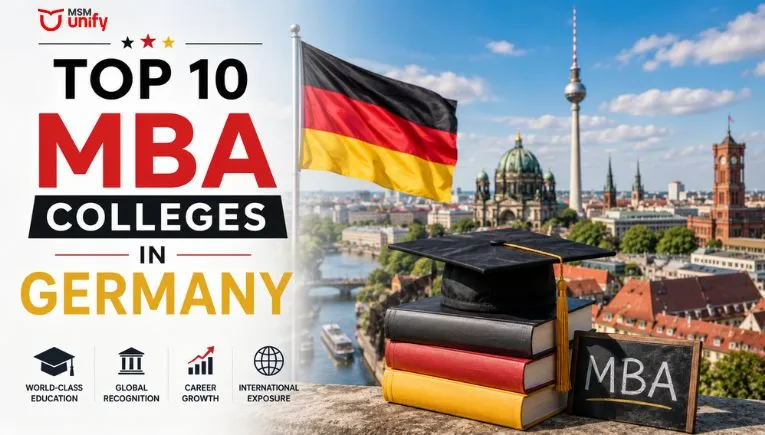

Mannheim Business School holds the 65th spot in the Financial Times Global MBA Ranking 2026 and holds the number 1 spot in Germany that makes it the country’s highest-ranked MBA school. Its tuition fee is around €47,000 that is approximately ₹52.6 lakh.
In comparison, Saarland University also offers a full-time MBA for around €12,000 (approximately ₹13.4 lakh).
There is a difference of almost €35,000 (around ₹39 lakh) between the two programmes, even though both are among the top MBA colleges in Germany.
Germany is known for offering tuition-free education, but there’s an important catch when it comes to MBAs. While many regular Master’s programmes at public universities do not charge tuition fees, German classify MBAs as continuing education programmes. As a result, public universities are allowed to charge tuition for these courses.
This guide compares the best MBA colleges in Germany based on both rankings and tuition fees, helping you understand what you get for your investment. It also covers important requirements such as the APS certificate, which is mandatory for applicants from India, China, and Vietnam, along with other key factors you should consider before choosing an MBA in Germany.
German MBA at a Glance
| Factor | Figure |
|---|---|
| Highest-ranked school | Mannheim Business School, FT rank 65, QS rank 46 |
| Fee range across the top 10 | €12,000 to €50,000 (about ₹13.4 lakh to ₹56 lakh) |
| Typical duration | 12 to 15 months for full-time programmes |
| Blocked account needed | €11,904 a year, €992 a month maximum withdrawal |
| Extra step for Indians | APS certificate, required for the visa, costs ₹18,000 |
| Post-study stay | 18-month permit under Section 20, any job allowed |
| EU Blue Card salary bar | €50,700, or €45,934.20 reduced rate |
| German schools in the FT top 100 | Four, all listed below |
Top 10 MBA Colleges in Germany
Let’s now take a look at the MBA colleges in Germany that must be on your shortlist. The first five carry FT or QS rankings. Some of these are full-time programmes. Others are executive courses for working professionals in Germany. Those will not suit a fresh applicant from India.
| # | School | FT 2026 | QS 2026 | Fee (EUR) | Fee (INR) | Format | Duration |
|---|---|---|---|---|---|---|---|
| 1 | Mannheim Business School | 65 | 46 | €47,000 | ₹52.6 lakh | Full-time | 12-15 months |
| 2 | WHU Otto Beisheim | 69 | 57 | €49,500 | ₹55.4 lakh | Full-time | 12 months |
| 3 | ESMT Berlin | 79 | Not listed | €50,000 | ₹56 lakh | Full-time | 15 months |
| 4 | Frankfurt School of Finance | 92 | 40 | €42,400 | ₹47.4 lakh | Full-time | 12 months |
| 5 | HHL Leipzig | Not ranked | 151-200 | €42,500 | ₹47.6 lakh | Full-time | 15-21 months |
| 6 | TUM School of Management | Not ranked | Not listed | €42,900 | ₹48 lakh | Executive only | 4 semesters |
| 7 | RWTH Business School | Not ranked | Not listed | €35,000 | ₹39.2 lakh | Full-time | 18 months |
| 8 | Munich Business School | Not ranked | Not listed | €32,000 | ₹35.8 lakh | Full-time | 12 months |
| 9 | SRH Berlin | Not ranked | Not listed | See below | See below | Full-time | 3 semesters |
| 10 | Saarland University | Not ranked | Not listed | €12,000 | ₹13.4 lakh | Full-time | 12 months |
1. Mannheim Business School
Mannheim is the only German school inside the FT global top 65. It ranks 65 worldwide and first in Germany. QS places it at 46 globally and 13th in the European Union.
The full-time MBA runs 12 to 15 months. Tuition is €47,000, close to ₹52.6 lakh.
Mannheim holds Triple Crown accreditation from AACSB, EQUIS, and AMBA. Fewer than 1% of business schools worldwide hold all three.
The outcomes justify the fee for most students. About 93% are employed within three months of finishing. Average salary three years out is roughly US$142,000, near ₹1.36 crore.
2. WHU Otto Beisheim School of Management
WHU ranks 66 in the world. It is just one place behind Mannheim. The cost of studying MBA at WHU is €50,000 which comes to about ₹56 lakh in INR.
Their management programme is for 12 months. That is the shortest format among Germany’s top-ranked schools.
WHU is for someone who wants a fast career switch. A 12-month course also means one less year of living cost.
3. ESMT Berlin
ESMT QS ranking is 80 in the world. The cost of studying MBA is €50,000. The MBA program duration is for 15 months.
ESMT was founded by 25 German companies. This includes Siemens, Allianz, and Deutsche Bank. That corporate backing shows up in its recruiter access.
Berlin is also Germany’s startup capital. ESMT is fit for applicants who are targeting technology or entrepreneurship rather than traditional consulting.
4. Frankfurt School of Finance and Management
Frankfurt School ranks 96 globally. At €42,000, it is the cheapest of Germany’s four FT-ranked schools.
The MBA programme here runs for 12 months. Frankfurt is home to the European Central Bank and Germany’s banking sector.
This is the clearest pick for a finance or fintech career. Location does real work here, in the same way Bayes does for London.
5. HHL Leipzig Graduate School of Management
HHL is one of Germany’s oldest business schools. The cost of studying MBA at HHL costs €43,000. The course is for 15 to 21 months.
HHL has a strong record in entrepreneurship. Several German unicorns were founded by its alumni.The longer format is worth noting. A 21-month course adds living costs for an extra year as compared to WHU’s 12-month program.
6. TUM School of Management
TUM is a public university, but it’s still not free. The cost of studying MBA here costs €39,000. That still sounds high, considering its the price to be paid for a public institution. Continuing-education courses like the MBA may charge fees even at public universities.
TUM is Germany’s leading technical university. Its MBA suits engineers and technology professionals who want to move into management.
7. Munich Business School
Munich Business School charges €32,000, or about ₹35.8 lakh. That is roughly a third less than ESMT.
The school is private and focuses on international management. Munich itself hosts BMW, Siemens, and Allianz.
MBS is a reasonable middle option. You get a Munich network without a €50,000 fee.
8. RWTH Aachen University
RWTH Aachen is a public university with an MBA at €30,000, close to ₹33.6 lakh.
RWTH is Germany’s strongest engineering university. Its MBA leans heavily toward technology and operations management.
An Indian engineering graduate targeting German manufacturing should look here first. The industry links are genuine rather than marketing.
9. SRH Berlin University of Applied Sciences
SRH Berlin charges €21,600, about ₹24.2 lakh. That is under half the ESMT fee.
The school teaches in English and sits in Berlin. It is an applied-sciences university, so the teaching is practical rather than research-led.
SRH will not carry the brand weight of Mannheim or WHU. For an applicant whose budget caps near ₹25 lakh, it is a real option rather than a compromise.
10. Saarland University
Saarland University has the cheapest MBA on this list at €12,000, which is roughly ₹13.4 lakh as per today’s conversion in 2026.
This price is about a quarter of what Mannheim charges. It is a public university near the French border.
Saarland will not open consulting doors like a top-ranked school will. It does let you earn a German MBA for under ₹27 lakh. That total includes your blocked account amount. You still get the same 18-month work permit after graduation.
MBA Colleges in Germany with Low Fees: The Full Truth
Most Indian applicants arrive with one belief. Education in Germany is free. That belief is half right. The wrong half costs people money.
Regular master’s degrees at public universities are almost free. You only pay a semester contribution. It is usually €100 to €350 per semester. That is €200 to €700 per year. TUM, LMU Munich, Kiel, Tübingen, and RWTH Aachen work this way. This applies to a standard MSc.
MBAs are the exception. German law classifies the MBA as continuing education. Colleges are allowed to charge tuition fees for such programmes even at public universities. That is why TUM charges approximately €39,000 for an MBA.
In such case, an Indian applicant has three honest routes:
| Route | Annual cost | Trade-off |
|---|---|---|
| MSc in Management at a public university | €194 to €825 in semester fees | Not an MBA; usually no work-experience requirement |
| Low-fee MBA (Saarland) | €12,000 plus semester fee | A real MBA, but no ranking and a smaller network |
| FT-ranked MBA (Mannheim, WHU, ESMT, Frankfurt School) | €42,400 to €50,000 | Strongest outcomes, highest cost |
Fees for MBA Colleges in Germany: What a Year Really Costs
Other than tuition fee, you need a reserved amount in your bank account for German student visa that must be at least €11,904 for the given year. This is approximately ₹13.3 lakh. You are allowed to withdraw up to €992 per month. This as not changed since 2025.
Now, take a look at the minimum and maximum cost to study in MBA at top colleges in Germany:
| Cost line | Mannheim | Saarland |
|---|---|---|
| Tuition | €47,000 | €12,000 |
| Application fee | €150 | Not published |
| Semester contribution | Not charged | €824.60 |
| Blocked account, 1 year | €11,904 | €11,904 |
| Total | €59,054 | €24,729 |
| In rupees | about ₹66.1 lakh | about ₹27.7 lakh |
There is almost €35,000 (around ₹39 lakh) difference in the fee of the most and least expensive top universities in Germany.
But try to understand the return on investment on an MBA. Let’s consider Mannheim. The average salary after three years of graduation is around $142,000 or roughly ₹1.36 crore which is almost twice the full first-year cost.
Saarland has not published any salary figures on its website. That absence is telling too. A school that does not report outcomes often has not measured them.
What Does The Employment Data Actually Tell?
Here is what no comparison site will tell you. Only two out of ten schools publish current MBA employment data. Others either publish nothing, present it in a different form, or show figures from years ago. That pattern does not follow the ranking order. It inverts it.
| School | Publishes MBA outcomes? | Most recent cohort | Average salary |
|---|---|---|---|
| HHL Leipzig | Yes, full ungated report | Classes 2023-24 | €66,138, excluding bonus |
| Munich Business School | Yes, employment report | No cohort year stated | €80,923 |
| Mannheim | On-page detail; 2024 data gated | Class of 2023 | US$110,264 base |
| ESMT Berlin | Placement yes, salary blended | Class of 2024 | €100,000 total comp, 3-year blend |
| WHU | No current open report | Class of 2022 | €76,093, excluding bonus |
| Frankfurt School | No report; page data is old | Class of 2018 | €71,000 |
| TUM | No | None | Not published |
| RWTH Business School | No | None | Not published |
| SRH Berlin | No | None | Not published |
| Saarland | No | None | Not published |
Here are two takeaways from this data.
Salaries in these schools are not comparable. Mannheim quotes base pay in US dollars. WHU and HHL quote euros excluding bonus whereas ESMT quotes total compensation across three years. Frankfurt School is only mentioning statistics of 2018..
Second, transparency is lacking. HHL sits outside the FT ranking entirely and publishes the most complete report here. Frankfurt School sits inside the FT top 100 and shows you eight-year-old numbers.
Ask all shortlisted schools for their placement rate and median salaries. Insist on the cohort year too. A school that measures its outcomes will send them. Those who don’t measure it, will send you a brochure.
Thoughts of Indian Students On Studying in Germany
Don’t believe forum posts blindly. Rather, treat them as a signal instead of a fact.
German language decides many outcomes. One widely shared account came from an Indian MBA graduate in Germany. Classmates with strong German had far fewer job problems. RWTH’s own flagship Executive MBA is taught in German, which tells you something about the local market.
Career switching is harder than the brochures suggest. The same account reported that most of the cohort returned to the industry they came from. Mannheim’s published data pushes back on this, at 97% switching country, function, or industry.
That contradiction is the point. One is a forum post, the other is a published statistic with a cohort attached. Ask each school for its own switch data rather than trusting either.
Ask these three questions on every call. What share of the last cohort was placed in Germany, and how many of those roles needed German? What was the median salary, not the average? Which cohort year is that figure from?
Admission Requirements for MBA Colleges in Germany
Admission requirements are mostly the same in all German business schools.
- Bachelor’s degree in any field from a recognised institution
- Work experience of one to three years (depending on the school)
- GMAT or GRE score is required in some universities. Most universities accept a minimum of 600 GMAT score.
- English proficiency of B2 level or higher. This requires submitting an IELTS or TOEFL score of band 6 and above.
- One or two recommendation letters mostly from an employer
- Statement of purpose which explains your career goals
- APS certificate, mandatory for applicants from India
The APS certificate step is commonly and most often missed by Indian applicants. APS stands for Akademische Prüfstelle. The certificate verifies that your Indian degree and documents are genuine.
This certificate is only required for applicants from India, China, and Vietnam. You must hold it before you apply, not after. Processing takes weeks, so start it early.
APS is a visa requirement, not a university application requirement. You need it before you book your visa appointment. Some universities ask for it earlier, so check each one.
The fee is ₹18,000 and is non-refundable. APS India says the process takes at least two weeks, and publishes no fixed processing time. There is also a newer step. APS India now requires a Digital Master Test, called dMAT, for selected master’s applicants in affected fields.
How Indian Students Apply to MBA Colleges in Germany
As an Indian student you need to follow these steps in order. Or else your application might get delayed
- Start with your APS certificate first. Nothing else can move forward without it. It also takes the longest time to process.
- Take your English test, and your GMAT if needed. Book early, since scores take weeks to reach schools.
- Shortlist MBA colleges in Germany based on your budget and target industry. For shortlisting you should consider fee, ranking, and outcome.
- Apply directly or individually to each school. Germany has no single central portal for MBA admissions.
- Accept your offer and open a blocked account. Add €11,904 in your bank account and block it.
- Book your student visa appointment. Slots at German missions in India can fill up several months in advance.
- Apply for your 18-month job seeker permit after you finish the program. Plan for that final step from day one. Germany gives graduates 18 months to find work. You can work in any job during that time. It is not limited to your field.
That last step is worth planning from day one. Section 20 of the German Residence Act gives graduates up to 18 months to find work. You may take any type of job at that time, including temporary work.
Two conditions apply. The permit is not renewable. You must also show health insurance and secured maintenance for all 18 months.
If you land a role paying €50,700 or more, you can move to an EU Blue Card. A reduced threshold of €45,934.20 applies in shortage occupations. It also covers new entrants who earned their degree within the previous three years. Both figures are the 2026 rates.
You may also have read about Germany’s Opportunity Card. It does not apply to you if you graduate from a German university. That card is for people applying from abroad. It lasts only 12 months. It also limits work to 20 hours a week. The Section 20 route is longer and unrestricted.
Scholarships for MBA Colleges in Germany
Funding comes mainly from two places.
DAAD is Germany’s academic exchange service. Its EPOS programme, for development-related postgraduate courses, fits MBA-level applicants best. EPOS asks for at least two years of professional experience.
The EPOS stipend is €934 a month. Be careful with this number online. DAAD’s own pages show €861, €934, and €992 in different places, because they were updated at different times. Check the specific programme page.
School scholarships are the second route. Mannheim, WHU, ESMT, and Frankfurt School all run merit awards.
Early-bird tuition discounts are easier to get than a scholarship. WHU offers €3,000 to €6,000 off depending on your round. HHL offers €1,500 to €6,000, and Mannheim €1,000 to €4,000. Both scholarship budgets and early-bird discounts shrink as rounds progress.
Why Choose MSM Unify for Your German MBA?
Germany will reward those applicants who get the sequence right and it punishes those who do not. If an APS certificate has been started late, it can cost you a full intake. No amount of academic strength can fix that.
MSM Unify’s counsellors work through the process one step at a time:
- APS guidance, started early enough to protect your intake, including the dMAT step
- Shortlisting against your budget and target industry, with full-time and executive programmes clearly separated
- Application support for essays, references, and school-specific forms
- Blocked account and visa paperwork, including appointment timing at German missions
- Honest cost planning covering tuition, semester fees, and realistic scholarship odds
- Post-study planning for the Section 20 permit and the EU Blue Card route
Is Germany on your shortlist? A free MSM Unify counselling session can be a quicker way to check where you exactly stand. You will get an exact answer on what this degree would cost your family.