

Study in France: Colleges, Scholarships, Fees, Intakes | MSM Unify

Study in Canada

study in canada img

A hassle-free visa process, affordable tuition fees, and highly-ranked universities are some of the many reasons why Canada is the most sought-after study-abroad destination.

Study in Australia

Study in Australia img

Every year over 637,000 International students choose to study in Australia for a variety of reasons such as the availability of several undergraduate, postgraduate, and part-time work programs.

More Countries

Study in France

World-Class Education Without the US/UK Price Tag

Heavily subsidized by the government, French public universities offer top-ranked, QS-recognized degrees for a fraction of what you’d pay elsewhere. Best of all, hundreds of programs are taught entirely in English, so no French language skills are mandatory. Get a world-class European degree without the burden of lifelong student debt!

  • 3,500+ Higher education institutions
  • 370,000+ International students
  • 44 Universities in QS World Rankings 2025
  • Post-study work opportunities for graduates

Study in France

France is the ideal place to study abroad owing to its rich cultural heritage, renowned universities, modern facilities, good food, and thriving student life!

The yearly public tuition in France for a non-EU student in 2026–27 is about 2,900 euros. Campus France’s fee page confirms it. A comparable public university year in the US or UK will charge you tens of thousands of euros more. This is why so many Indian families are now planning to study in France after 12th . 

This is a full guide that helps Indian students to study in France. It will cover real costs, eligibility, and top French universities. It also covers popular courses, exams, and the exact application route from India.

Many families who are still deciding which top study abroad destination in France, Germany, the UK, or the US start with cost. This guide focuses on what it takes to study in France from India. It will help you know everything from a 12th-pass application to choosing the right course.

france

Key Highlights - Study in France

France is a leading study destination offering high-quality education, diverse programs, and excellent career prospects. Here are the key highlights to study in France for Indian students after 12th:

Factors France
Average tuition fees (per year)

Bachelor’s degree: €2,770 – €3,500

Master’s degree: €3,770 – €4,500

Duration of programs

Bachelor’s degree: 3 years

Master’s degree: 1-2 years

Eligibility criteria

Academic credentials: High school diploma for Bachelor’s, relevant Bachelor’s degree for Master’s

Documents required

SOP, LOR, Passport, Student visa, Academic transcripts, Proof of funds, etc.

Student visa fees

€99 – €120

Popular courses

Business Administration, Engineering, Fashion and Luxury Management, Hospitality and Tourism, Artificial Intelligence, Political Science, Arts and Design

Test score requirements

GRE: 300+ (For selected Master’s and Ph.D. programs)

GMAT: 550+ (For MBA and business-related programs)

IELTS: 6.0 – 7.5 (Varies by institution and program)

TOEFL: 85 – 100+

TCF/DELF: B2+ (For French-taught programs)

Post Study Work Permit
APS, 1 year for Indian students (available only for limited countries)
Work rights during your degree
Around 964 hours per year or 20 hours per week
Main intake to study in France after 12th
September, January
Route to study in France from India
Etudes en France portal
France Logo

Why study in France

Most students who plan to study abroad are looking at the US, UK, or Canada  by default. Instead of choosing a mainstream country, consider these reasons why you should study abroad in France. Here are some key reasons that answers why studying in France in a better option.

Why so many pick study in France for Indian students over other options:

  • Cheaper than the US, UK, or Canada. 
  • A wide, ranked university system.
  • English-taught options alongside French ones. 
  • A real post-study work path.
  • Legal part-time work during your studies.
You Won’t Be Drowned in Debt

Public universities in the US or UK can charge 30-40 lakh per year as tuition fees alone. In France, the government will pay 70% of your fee. Considering the recent fee updates, a Master course would cost around €4000 (₹4.5 lakh) a year. You get a world class degree when you study in France after 12th for a fraction of the cost. This means that you start your career with zero financial stress.

This is the best part while choosing France to study as this country treats international students like its own. Through a program called CAF, the government deposits money into your account every month. It also helps by paying 30% to 40% of your room rent. Plus, healthcare is also completely free. No other country can give you such a benefit.

Once you complete your Master’s, you will get a 2-year job search visa. Here is a secret perk for students who are planning to study in France from India. If you find a job in your field with decent pay, it helps. Your company won’t need to face complex legal steps to hire you. It also won’t need to prove that no local can do the job. The visa transition is super smooth.

Once you graduate with a Master’s, France gives you a 5-year multi-entry Schengen visa. Even when you return to India after a few years, you can pack bags and travel or do business in 29 European countries. You won’t have to apply for a tourist visa again.

Don’t stress about the language barrier for your classes. Most of the top tech, management, and data science courses are taught 100% in English. You only need to know basic conversational French to order  coffee and talk to locals.

Interested in studying abroad?

Share your details & our experts will call to discuss your goals

Name
Checkboxes

Ways To Study in France for Indian Students After 12th

You can study in France after 12th without losing a single year.

A 12th-pass Indian student applies straight to a French bachelor’s degree, called a Licence. The study in France for Indian students after 12th route needs no gap year and no foundation course.

That direct entry is a key reason families choose France for Indian students after 12th, over other countries. Plenty of families assume a bridging year is compulsory somewhere in Europe. In France it is not.

To study abroad in France after 12th you only need to clear the language and admission bar for that first year.

Nothing else blocks a 12th-pass student who wants to study in France after 12th. That makes study in France for Indian students after 12th one of the fastest routes into Europe.

India sits among the 73 countries covered by the Etudes en France route. That route is compulsory, not a choice. A fresh Class 12 graduate who wants to study in France after 12th cannot apply straight to a French university.

Parcoursup, the portal French and EU students use, is off-limits too. Every student who plans to study in France from India uses the Etudes en France portal instead.

That portal connects you to the Campus France India office. It is the only legal way to study in France after 12th.

Introduction 8 France career opportunities
How to study in France for Indian students after 12th?
  1. Register on the Etudes en France portal and create your Campus France profile.
  2. Submit your Class 10 and Class 12 mark sheets, plus a CV and statement of purpose.
  3. Add your language test score: TCF or TEF for a French-taught Licence, or IELTS, TOEFL, or Duolingo for an English-taught one.
  4. Attend the Campus France interview, held before any university even reviews your file.
  5. Wait for admission decisions from your shortlisted universities.
  6. Accept an offer, then apply for the student visa through France-Visas.
The first-year track to study in France for Indian students after 12th is called the DAP, or Demande d’Admission Prealable. A student already partway through a degree, or holding a finished one, applies differently. They go straight to a later year or a master’s, through the same portal.

Student visa requirements for France

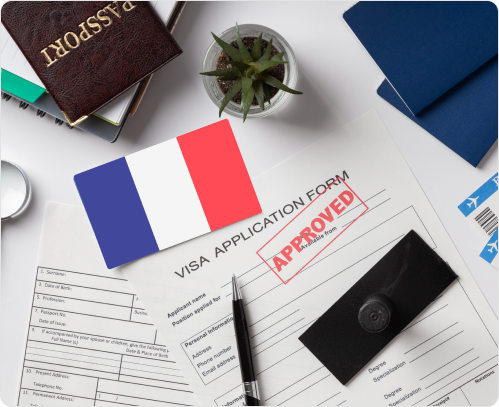
To study in France, international students must obtain a france student visa based on the duration of their course. The process requires specific documents, eligibility criteria, and compliance with the latest regulations.

Documents Required to Apply for a French Student visa

France passport img

Types of student visas available

Latest updates to keep in mind

Top courses to study in France

France is home to some of the world’s best universities, offering diverse programs in business, engineering, fashion, and more. With globally recognized degrees and strong industry connections, students gain excellent career prospects.

Below is the list of popular courses to study in the France:

Course name Top universities offering the course Average tuition fees (per year) Average salaries (per year)
Business and Management

– HEC Paris

– INSEAD

– ESSEC Business School

– EDHEC Business School

– ESCP Business School

€10,000 – €20,000

€30,000 – €120,000

Engineering

– École Polytechnique

– CentraleSupélec

– Institut National des Sciences Appliquées de Lyon (INSA Lyon)

– Grenoble Institute of Technology

– École des Ponts ParisTech

€2,500 – €17,000

€45,000 – €70,000

Fashion and Luxury Management

– Institut Français de la Mode

– ESMOD International

– SKEMA Business School

– Paris College of Art

– Mod’Art International

€12,000 – €30,000

€30,000 – €90,000

Hospitality and Tourism Management

– Vatel International Business School

– Ferrandi Paris

– Le Cordon Bleu Paris

– Institut Paul Bocuse

– École Supérieure Internationale de Savignac

€7,000 – €18,000

€35,000 – €60,000

Data Science and Artificial Intelligence

– Université Paris-Saclay

– Sorbonne University

– Université Grenoble Alpes

– Université PSL (Paris Sciences & Lettres)

– École Normale Supérieure de Lyon

€3,000 – €20,000

€50,000 – €85,000

Please note: The tuition fees mentioned here serve as a point of reference. The actual amount will depend on the French university.

Top Universities to Study in France

France is home to some of the highly ranked universities. Overall, the 35 French universities are amongst QS world university rankings for 2024. Apart from this, 10 French universities are ranked among the 2022-2023 list of the top 300 global universities. Some of the highly-ranked universities according to QS World University Rankings 2024 are listed below:

Université PSL ( Paris Sciences and Lettres) 

QS World University Rankings 2025: 24

Institut Polytechnique de Paris

QS World University Rankings 2025: 46

Sorbonne University

QS World University Rankings 2025: 63

Université Paris-Saclay

QS World University Rankings 2025: 73

École Normale Supérieure de Lyon

QS World University Rankings 2025: 187

Université Paris 1 Panthéon-Sorbonne

QS World University Rankings 2025: 283

Université Paris Cité

QS World University Rankings 2025: 302

Université Grenoble Alpes

QS World University Rankings 2025: 334

Sciences Po

QS World University Rankings 2025: 350

France’s grandes écoles follow a separate track from public universities which are often more selective. Several schools, like HEC Paris and Sciences Po are highly ranked in their fields. They do not always top the global rankings. A shortlist based only on the table above misses this second system. Also check subject rankings, along with the overall score.

Beyond Paris: Regional Universities to Shortlist

There are parts of France other than Paris that have good options to study after 12th. Following colleges are in the Times Higher Education’s 2026 rankings globally:
  • Ecole Normale Superieure de Lyon: ranked 301st-350th, strong in the sciences
  • Universite Grenoble Alpes: ranked 351st-400th, strong in engineering and tech
  • University of Bordeaux and Universite de Montpellier: both ranked 401st-500th

Toulouse, Lyon, and Grenoble are reputed in the areas of aerospace, business, and engineering.

Compare that against the higher living cost of a Paris campus when you are deciding where to study abroad in France.

Rent and daily expenses in Paris are above the national average. A regional city like Lyon, Toulouse, or Grenoble will further extend the same monthly budget further. You don’t have to give up a ranked university or a strong local job market either.

Who Can Apply to Study Abroad in France?

There are two ways to study abroad in France. The first is what the university asks for. The second is what the French state asks for through Etudes en France and the visa.

On marks:

  • Bachelor’s students require a completed Class 12 record from a recognized board. Students must match the subject and grade profile set by the target course.
  • Master’s students need a completed bachelor’s degree. They also must meet the minimum grade set by each college.
  • France has no one nationwide cutoff that applies across every university. Confirm the exact number with each shortlisted course.

On language runs with the marks test, not after it:

Programme language Test accepted Typical level needed
French-taught (DAP / Licence 1)

TCF-DAP or TEF

B2 (CEFR)

French-taught (other years, Master’s)

TCF or TEF

B2, sometimes B1 for select courses

English-taught, Bachelor’s

IELTS, TOEFL, or Duolingo

IELTS 6.0-6.5 or equivalent

English-taught, Master’s

IELTS, TOEFL, or Duolingo

IELTS 6.5+ or equivalent

France does not set a nationwide minimum score for English tests. The real cutoff comes from each university and course. Confirm the exact figure on your target course’s own page before applying.

Documents Required to Study in France After 12th

The list of documents for university and the visa overlap heavily. Still, these are not the same lists. If you don’t understand this difference, it can be the most common reason that your file will get delayed.

Beyond Paris: Regional Universities to Shortlist

  • Passport-style photograph
  • Valid passport
  • Full mark sheets, Class 10 and Class 12 (plus degree certificates for a master’s student)
  • CV / resume
  • Statement of purpose
  • Proof of the required French or English test score
France passport img

Documents for the Student Visa

  • University’s official enrolment certificate
  • Proof of accommodation in France
  • Proof of the €878-a-month financial resources rule (blocked account statement or scholarship letter)
  • Health insurance coverage
  • Fee payment receipt from the Etudes en France route
  • Campus France interview confirmation (mandatory for Indian students specifically)

Once you arrive in France, you must validate your visa online within 3 months of your arrival.

Use the government’s own portal, and pay by bank card or a bought electronic stamp.

In case you skip this step, your visa will no longer be valid. It won’t matter if the rest of your paperwork was complete.

Even house-hunting has paperwork. France softens it with VISALE which is a free government-backed rental deposit guarantee for student tenants. VISALE replaces the usual guarantor a landlord asks for and this guarantor is often the hardest paper to arrange from India.

Study in France Roadmap: From Application to Arrival

Your plan to study in France becomes much easier when admission, visa and arrival steps, are all treated as one connected process.

Step 1: Research Courses and Universities

Start by deciding what you want to study in France after 12th. Compare universities, courses, teaching language, eligibility requirements, tuition fees, intake dates and subject-specific rankings.

Step 2: Check Your Eligibility

Review your Class 12 or bachelor’s qualifications against the exact course requirements. At the same time, check whether you need French or English language proficiency.

Step 3: Prepare Your Documents and Language Test

Keep your academic records, passport, CV, statement of purpose and language test score ready. If you are applying for an English-taught course, check whether IELTS, TOEFL or Duolingo is accepted. For French-taught courses, check the relevant TCF or TEF requirement.

Step 4: Register on Etudes en France

Indian students who are applying through the applicable route must create their profile on the Etudes en France portal. Upload all required documents and complete the application as per the prescribed timeline.

Step 5: Attend the Campus France Interview

Complete the Campus France interview. You must be prepared when it comes to explaining your academic background, course choice, university preference and plans to study in France after 12th.

Step 6: Wait for University Decisions

Once the application is processed, wait for admission decisions from the universities that you had shortlisted to study in France after 12th. Compare your offers carefully before selecting the programme you want to pursue.

Step 7: Accept Your Offer

Accept the university offer and complete the required enrolment formalities. Keep the official enrolment or admission certificate safely, as it becomes an important part of the visa process.

Step 8: Apply for the Student Visa

Once you have completed the relevant admission and Campus France steps, prepare your France-Visas application. Arrange financial proof, accommodation documents, insurance and other required paperwork.

Step 9: Arrange Accommodation and Travel

Finalise your accommodation and travel plans after the visa process is sufficiently advanced. Keep printed and digital copies of your passport, visa, admission letter, accommodation proof and other important documents.

Step 10: Arrive in France

Carry your academic, identity, financial and accommodation documents with you. After arrival, complete the required visa validation and other post-arrival formalities within the prescribed timelines.

Step 11: Complete University Registration

Finish your university registration, settle into your accommodation and complete any remaining administrative requirements.

Step 12: Start Your Study in France Journey

Once the formalities are complete, you can begin your programme and settle into student life in France.

Study in France Document Checklist

Keeping the documents for admission and visa applications separate can make the entire process easier to manage.

Admission and Etudes en France Checklist

  • Valid passport
  • Passport-style photograph
  • Class 10 mark sheet
  • Class 12 mark sheet
  • Degree certificate and academic records for master’s applicants
  • CV / resume
  • Statement of purpose
  • Required French or English language test score
  • Additional course-specific documents, if required
  • Campus France interview details/confirmation

Student Visa Checklist

  • Official university enrolment certificate
  • Proof of accommodation in France
  • Proof of required financial resources
  • Health insurance coverage
  • Etudes en France fee payment receipt
  • Passport and visa application documents
  • Campus France documentation required for the visa process

Pre-Travel Checklist

  • Passport and visa
  • University admission/enrolment documents
  • Accommodation confirmation
  • Academic certificates and mark sheets
  • Language test score report
  • Travel/flight documents
  • Digital backup of important documents
  • Copies of financial and insurance documents

Cost of Studying in France

A family budgeting to study in France after 12th needs three different numbers, not one headline figure. Those numbers are tuition, the mandatory campus fee, and living costs. Every figure below is dated to the 2026-27 academic year.

Cost component Amount (2026-27) Notes
Public tuition, Bachelor’s (Licence)
~€2,902/year
Non-EU rate, per Campus France
Public tuition, Master’s
~€3,950/year
Non-EU rate, per Campus France
Public tuition, Doctorate
~€400/year
Same rate as EU/French students
Private college or grande ecole tuition
€6,000-€18,000+/year
Varies by college and course
CVEC campus life contribution
~€105/year
Paid once at enrolment; some scholarship holders exempt
Minimum living funds for the visa
~€870/month (€10,536/year)
Rose from €615/month on August 1, 2026
Etudes en France route fee (India)
~INR 20,000
Rose from INR 18,500 on August 1, 2026
Visa fee
€50
For Etudes en France route countries, including India
OFII validation fee
€60
Paid once, after arrival

Two of these numbers moved together on the same day, and most guides online still quote the old ones. The visa’s minimum funds requirement jumped 43% on August 1, 2026, from €615 to €878 a month.

The Etudes en France route fee for Indian students rose from INR 18,500 to INR 20,000 the same day. A family budgeting from a post written even earlier in 2026 is likely planning around the wrong number.

Put tuition and living costs together. A bachelor’s year in France then runs to roughly €13,500, tuition and living funds combined.

That’s well under half of what the same year costs in the US or UK.

And this is without scholarships or an MSM Unify education loan consultation.

How the Cost to Study Abroad in France Compares With Other Countries

You must not skip this comparison. You must understand how one public university year will cost in five countries. It is the clearest way to understand how much you can save when you are studying abroad in France.

Country Average annual tuition, foreign students Source
France
~€2,900 (Bachelor’s) / €3,950 (Master’s)
Campus France, 2026-27
Germany
Mostly tuition-free at public universities (semester fee €100-€400); about €3,000/year in Baden-Württemberg
German public university fee rules, 2026
United Kingdom
£11,000-£38,000 (Bachelor’s) / £9,000-£30,000 (Master’s)
British Council, Study UK, 2026
United States
$31,000/year average, public out-of-state / $45,000/year average, private
College Board, Trends in College Pricing, 2025-26
Canada
CAD $41,746/year average, Bachelor’s / CAD $24,028/year average, Graduate
Statistics Canada, 2025-26

Germany has a more affordable cost to study abroad in France on tuition alone. But when you add living costs and visa access to this comparison, then France is a clear winner. Few countries have low public tuition with a broad English-taught course list and India-specific scholarships.

Scholarships to Study in France

Two India-specific government scholarships are available other than France’s general Eiffel course. Each one has a specific eligibility criteria that you must check before you count on the money.

Scholarship Open to Monthly allowance Age limit How to apply
Charpak Bachelor
Indian citizens & OCI cardholders
€860
23 or under
Direct application (closed for the 2026 session at the time of writing)
Charpak Master
Indian citizens & OCI cardholders
€860
30 or under
Direct application, after university admission
Eiffel Excellence
Master’s/PhD students, priority fields
Not published by Campus France
29 (Master’s) / 35 (PhD)
Nominated by the admitting college only, not applied for directly

The Charpak Scholarship also covers health insurance, priority CROUS student housing, and subsidised campus meals at €1 each. Confirm the current cycle’s status directly with Campus France India before you plan around it. Eligibility windows shift year to year.

The Eiffel Excellence Scholarship covers priority fields the French government sets each year. For the 2026 campaign, that window ran October 1, 2025 to January 8, 2026.

Results arrived from March 30, 2026 onward. A similar calendar repeats most years.

Beyond these two, many universities and grandes écoles offer merit scholarships. These often stack with a partial CVEC waiver. Take a strong record straight to your shortlisted college’s admissions office, alongside the national schemes above.

Exams Required for Indian Students to Study in France

Most people get this backwards. You don’t pick your exam based on whether you’re stronger in English or French. The course picks it for you, based on the language it teaches in.

Test Language Used for Typical requirement Validity
TCF-DAP
French
First-year Licence (DAP route)
B2 level (CEFR)
2 years
TEF
French
DAP route and other French-taught courses
325/450 written score (B2, roughly 14/20)
5 years for the DAP exemption
IELTS
English
English-taught courses
6.0-6.5 (Bachelor’s), 6.5+ (Master’s)
Set by each university
TOEFL
English
English-taught courses
Set by each university
Duolingo English Test
English
English-taught courses (growing acceptance)
Set by each university

Look at that last column for a second. A TEF score holds its DAP exemption for five years, while a TCF score gives you two.

Say you might take a gap year, or need a backup attempt. Plan around that three-year gap.

Neither French test shuts the door on you permanently.

Both TCF and TEF let you retake after a short wait if your first score falls short. A structured IELTS and TEF preparation track with MSM Unify helps you close that gap early.

Better to fix it now than lose a whole intake to it.

Watch for one trap. Plenty of students hedge by applying to both French-taught and English-taught courses.

That is a fair move. It means two tests, not one.

A TCF score won’t stand in for an English one. IELTS won’t stand in for French.

Why Choose MSM Unify to Study in France After 12th?

None of these steps are impossible on their own. Sequencing them is where families struggle. It is the hardest part of any plan to study in France from India.

Your Etudes en France file, your university shortlist, and your visa timeline all have to click together. They also have to click in the right order.

Get one wrong and you don’t lose a week, you lose a whole intake.

What MSM Unify handles for you:

  • University shortlisting built around your actual profile, not a generic list of famous names
  • Etudes en France application support for students studying in France after 12th grade. It includes prep for the required Campus France interview
  • Exam guidance for TCF, TEF, or IELTS, depending on where you’re applying
  • Visa and money-proof paperwork, walked through step by step instead of left to guesswork
  • Honest cost planning for what it takes to study abroad in France: tuition, living funds, and the scholarships you have a real shot at
  • Arrival support for the OFII validation deadline and the VISALE rental guarantee, two things first-timers miss

Are you weighing whether to study abroad in France? A free MSM Unify counselling session is a quick way to check where you stand. You’ll also get a straight answer on what the year would cost your family.

Cost of studying in France

Cost of studying in France affordable tuition fees compared to other top study destinations. While public universities have lower fees, private institutions, and specialized programs can be more expensive. Living costs vary based on the city and lifestyle.

Important factors for student expenses:

  • Public vs. private institutions – Tuition fees at public universities are much lower than at private institutions
  • City of residence – Paris has higher living expenses compared to other cities in France
  • Student privileges – There are discounts on transportation, entertainment, and dining
  • Health coverage – International students are required to have compulsory health insurance
  • Budget planning – Plan for initial expenses, including visa fees and housing deposits

The table below shows the costs of studying in France that students can consider.

Expense type Average cost per year Remarks
Bachelor’s degree tuition fees

€170 – €3,000

Key Public universities have lower fees; private institutions cost more

Master’s degree tuition fees

€243 – €20,000

Specialized programs at top schools can be expensive

Accommodation

€3,600 – €12,000

University dorms are cheaper than renting private apartments

Transportation

€300 – €900

Student discounts are available on public transport

Health Insurance

€300 – €600

Mandatory for international students; varies by provider

Utilities (Electricity, Internet, etc.)

€600 – €1,500

Shared apartments help reduce costs

Miscellaneous

€1,200 – €3,000

Includes entertainment, shopping, and personal expenses

Food & groceries

€2,400 – €4,800

Cooking at home is cheaper than dining out

Student visa fees

€99 – €200

Includes long-stay visa and administrative costs

Please note: The expenses mentioned here serve as a point of reference. The actual amount may vary.

The average cost of studying at private universities can go as high as €3,000-€30,000 per year. Apart from this, living in Paris can cost up to €1,250-€1,400 per month.

Lorem ipsum dolor sit amet, consectetur adipiscing elit. Ut elit tellus, luctus nec ullamcorper mattis, pulvinar dapibus leo.

Scholarships to study in France

Many universities offer scholarships to study in France specifically for international students. These scholarships may be based on academic merit, leadership potential, or other criteria.

Here are some of the prominent scholarships available for international students studying in France:
group diverse grads throwing caps up sky france 12

Intakes in France

Like most other countries, France also offers 2 primary intakes for admission into the universities.

Intakes Deadline
January intake

July – August

September intake

March – May

Please note:  The specific intake dates and application periods may vary slightly between different universities and programs in France.

September intake is the biggest intake in France. The timeline for application plays a crucial role when applying to any of the universities. Candidates must initiate their applications by March and should submit the required documents by June.

Job prospects in France

The employment market in France has shown strength, with the employment numbers expected to hit 28.6 million in 2025, representing a 0.35% rise from the last year.

The unemployment rate decreased by 0.2 percentage points to 7.3% during the second quarter of 2024, close to its lowest rate since 2008.

Following are some of the most in-demand career opportunities in france in 2025, along with their average yearly pay:

Part-time jobs Average annual salary
Specialist Doctors

€180,000

IT Managers

€60,000 – €90,000

Engineers

€45,000 – €70,000

Financial Analysts

€50,000 – €80,000

Marketing Managers

€50,000 – €80,000

University Professors

€50,000 – €80,000

Pilots

€60,000 – €100,000

Lawyers

€50,000 – €100,000

Bank Managers

€70,000 – €90,000

Orthodontists

€150,000

Please note: The salaries mentioned here serve as a point of reference. The actual amount will depend on the individual’s skill set and credentials.

In order to stay in France after completion of education international students are required to have a mandatory promise of employment or a work contract. International students should be able to earn a minimum wage of €2,220 per month.

France attracts students from all corners of the globe. The country boasts a vast selection of academic programs, ranging from arts and humanities to science and engineering, ensuring that students can pursue their academic passions. Ultimately, studying in France provides an unforgettable journey of growth, education, and cultural discovery.

Embark on your journey to success with MSM Unify overseas education consultant, your guide to studying in the France. Explore the endless possibilities that await you!

FAQs

Got questions?

Find answers here

Group 1000004588

How to study in France?

Everything runs through one government portal called Etudes en France. There is no way around it. India is one of 73 countries where this route is compulsory. You build a profile, upload your mark sheets and a language score, then apply to your shortlist. The visa stage only opens once a university accepts you and you clear the Campus France interview.

Data Sources: Campus France, Etudes en France portal (2026)

To study in France from India you must use Etudes en France. Parcoursup will not work, and neither will a direct email to the university. Plenty of students get this wrong. Most French university sites push the Parcoursup route. Parcoursup is built for French and EU students, not for you. That one route covers the DAP path for a first bachelor’s year, plus later-year and master’s entries. Everyone who plans to study in France from India files in the same place.

Data Sources: Campus France India, Application and Admission Procedure page (2026)

For English-language courses, French is not obligatory. French-language courses normally require B2 or C1 level French, evidenced by DELF/DALF tests. A few universities administer internal language tests as well to evaluate candidates’ French competence prior to admission.

Yes, most universities also accept a medium of instruction certificate from previous studies. Some accept TOEFL, Duolingo, or internal language tests. For French-taught programs, IELTS is not necessary. Always refer to university-specific requirements before applying.

Scholarships such as Eiffel Excellence, Erasmus+, and Campus France provide funding. Numerous universities offer merit-based and area-specific scholarships. Good grades and early applications help to ensure increased chances of being funded for tuition and living costs.

Yes, international students can work 964 hours a year (about 20 hours a week) while they study. Working in retail, hospitality, and tutoring are typical options.

Students can apply for a 2-year work permit renewal if they find employment based on their studies. IT, finance, engineering, and healthcare industries offer high demand for professionals.

Yes, one needs health insurance. Under-28s can enroll in French Social Security, which pays for most of the healthcare costs. Private insurance is necessary for students older than 28.

It is easy for an international student to get accommodation to study in France, but that varies with the city. Some of the options are university residences (€200–€400/month), private apartments (€500–€1,000/month), and flat shares. Early booking is advisable due to demand.