
- Engineering
- BE/BTech
- MTech/ME
How Many Types of Engineering Are There? Explore Top Branches

Content Manager
Confused about which engineering branch to choose? Explore the different types of engineering, from Computer Science to Mechanical and Civil Engineering. Discover popular specialisations, top courses, and career opportunities to find the best engineering field for your future.
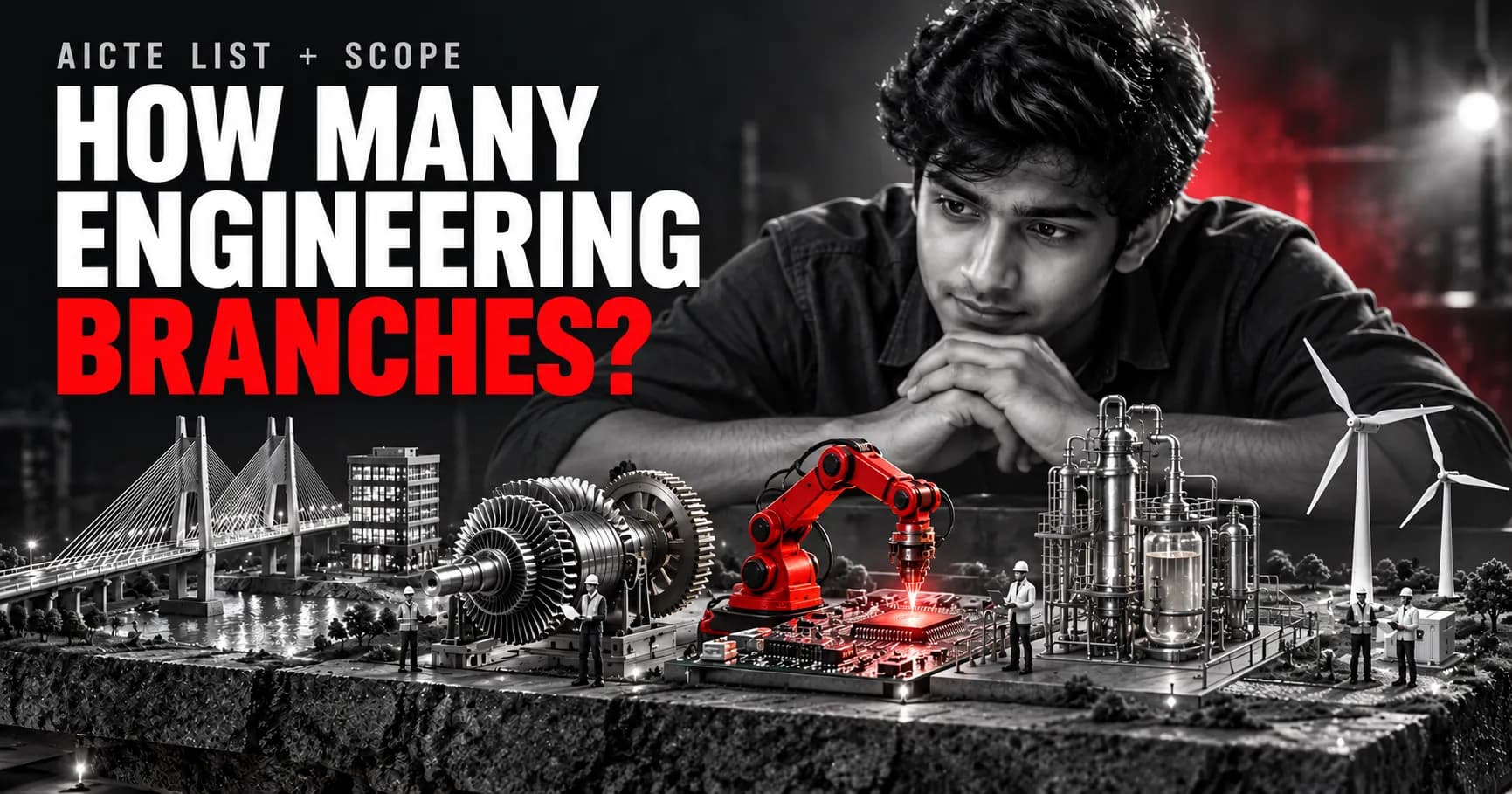
Engineers decide whether a bridge stands, a rocket lands and a payment goes through. The Chenab Rail Bridge now stands 359 metres above its river. Chandrayaan-3 landed softly on the Moon on 23 August 2023. UPI processed 24.07 billion transactions in September 2026. Different types of engineers built each one.
So how many types of engineering are there? India's official AICTE list names 15 core branches. Many of them grew from four classical roots: civil, mechanical, electrical and chemical engineering. Add the specialisations inside each branch, and the count grows further.
There is no single official number for how many types of engineering exist, because no body fixes one. The answer depends on how you count. The four classical roots are the oldest count. The AICTE Approval Process Handbook 2024-27 lists 15 core branches by name. GATE 2027, conducted by IIT Madras, has 30 test papers. This guide explains each count and then shows what engineers in each branch build, with real people and projects from India and abroad.
4
Classical roots
Civil, mechanical, electrical, chemical
15
Core branches named by AICTE
Approval Process Handbook 2024-27
30
GATE 2027 test papers
Conducted by IIT Madras
5
Course formats after 12th
From regular BTech to regional language
How Many Types of Engineering Are There? Three Ways to Count
The three counts are four classical roots, 15 core branches named by AICTE, and 30 GATE 2027 test papers. Each count answers a different question, so the tabs below keep them apart.
Many engineering schools trace the field back to four roots. These are civil, mechanical, electrical and chemical engineering. They are the shortest answer to how many types of engineering exist. Many newer branches grew out of these four.
How many branches of engineering are there in India?
India's AICTE handbook names 15 core branches, and its list ends with "etc.", so more exist. To answer how many branches of engineering are there in India, use the AICTE list and check Annexure-11 for approved course names. Colleges then add specialisations inside these branches.
| Core branch named by AICTE | What engineers build today | What you could build after graduating |
|---|---|---|
| Civil | Bridges, roads, tunnels, metro lines and dams | Rail and metro links in hard terrain, using lessons from the Chenab Rail Bridge |
| Mechanical | Engines, vehicles and factory machines | Electric vehicles, rocket parts and factory robots |
| Electrical and electronics | Power systems, circuits and chips | Solar, wind and storage systems for the 500 GW goal of 2030 |
| Electronics and communication | Mobile networks, radios and communication devices | Chips and secure communication links, including quantum-secured links |
| Electronics and telecommunication | Telephone and data networks | Networks that keep digital payments running for billions of transactions |
| Electronics instrumentation | Sensors that measure and control heat, pressure and flow | Sensors for smart factories, hospitals and power plants |
| Computer science | Software, data systems and AI | AI tools that run on national computing, such as the IndiaAI Mission |
| Chemical | Plants that turn raw materials into fuel, medicine and plastic | Materials for chip plants and batteries, and cleaner fuels |
| Automobile | Cars, bikes, engines and their safety systems | Electric and connected vehicles |
| Industrial | Factories, hospitals and supply chains with less waste | Smarter factories and faster supply chains |
| Agriculture | Tractors, irrigation systems and farm machines | Sensor-based irrigation and smarter farm machines |
| Food technology | Safe ways to process, pack and store food | Safer food that stays fresh for longer |
| Metallurgy | Metals and alloys, from railway steel to light aircraft parts | Lighter, stronger metals for aircraft and railways |
| Mining | Safe ways to take coal, ores and minerals from the earth | Safer mines run with sensors and robots |
| Textile | Fibres, fabrics and the machines that make them | Technical fabrics and cleaner fabric production |
A BTech takes four years, so a student who joins in 2027 graduates in 2031. The last column shows the scope for each branch by then. It follows national goals such as the 500 GW target for 2030 and projects already under way. It is not a job forecast.
Which count should a student use?
When you decide how many types of engineering to compare, use the AICTE list, because AICTE approves the courses colleges can offer. The GATE list matters for MTech planning. See the GATE 2027 syllabus for each paper.
Why do some websites say 40, 100 or 200 types?
No official body publishes such a count. When a site answers how many types of engineering exist with 100 or 200, it usually counts each specialisation as a separate type. Structural engineering and power systems are examples. These numbers count at a finer level than the official lists.
The table names the branches. The next section shows what engineers in each branch build.
What Do Engineers Build in Each Branch? Real People and Real Projects
Engineers in each branch build things you use every day, from bridges and power to apps and medicine. The best way to understand how many types of engineering exist is to see what each one builds. The examples below use real work from India and abroad.
Open a group below, then pick a branch to see what it builds, the key figures and the real people behind it.
Buildings, machines and power
What does a civil engineer build?
A civil engineer designs and builds public structures such as bridges, roads, tunnels, metro lines and dams.
359 m
Chenab Rail Bridge above the river
World's highest railway arch bridge
57.1 km
Gotthard Base Tunnel, Switzerland
World's longest railway tunnel
760 km
Konkan Railway led by E. Sreedharan
Mumbai to Mangalore
- Bridges, roads and tunnels
- Metro lines and railways
- Dams and water systems
Chenab Rail Bridge, Jammu and Kashmir
It was inaugurated on 6 June 2025. Prof. Madhavi Latha of IISc Bengaluru worked on it as a geotechnical consultant. Geotechnical engineers study soil and rock so that a structure does not slip or sink. IISc says her team worked on the stability of slopes, the design of foundations and slope stabilisation systems, including rock anchors.
E. Sreedharan, India
He is known for the Konkan Railway and the Delhi Metro, and he was a principal adviser to the Kochi Metro.
Gotthard Base Tunnel, Switzerland
It opened on 1 June 2016. At 57.1 kilometres, it is the world's longest railway tunnel.
Software, chemistry and the environment
What does a computer science engineer build?
A computer science engineer builds software, data systems and artificial intelligence.
24.07 billion
UPI transactions in September 2026
NPCI data
38,000+
GPUs under the IndiaAI Mission
20,000 more announced
2024
Nobel Prize in Chemistry for AlphaFold
Shared by Demis Hassabis and John Jumper
- Apps and software
- Data and payment systems
- AI tools
UPI, India
A system of this size works only when software, networks and servers keep running every minute of the day.
Nandan Nilekani, India
He studied electrical engineering at IIT Bombay and graduated in 1978. He co-founded Infosys and later chaired the UIDAI, which created the Aadhaar number. His story shows how a branch name does not limit your work.
Demis Hassabis, DeepMind
He studied computer science at Cambridge and co-founded DeepMind. His team built AlphaFold, a program that predicts the 3D shape of proteins. Proteins are tiny machines in the body, and their shape decides how they work.
Space, health and robots
What does an aerospace engineer build?
An aerospace engineer designs aircraft, rockets and satellites.
23 Aug 2023
Chandrayaan-3 soft landing
Near the lunar south pole
2017
Agnikul Cosmos founded
Based at IIT Madras
- Aircraft
- Rockets
- Satellites
Chandrayaan-3, ISRO
ISRO's Chandrayaan-3 landed softly on the Moon on 23 August 2023. P. Veeramuthuvel, an ISRO engineer, was the project director of the mission.
Agnikul Cosmos, India
Private companies now build rockets too. Agnikul was founded by Srinath Ravichandran, Moin SPM and Satyanarayanan Chakravarthy. Its Agnibaan rocket made India's first launch from a private launch pad. The rocket used an engine printed as a single piece with a 3D printer.
What do petroleum, marine and geomatics engineers build?
Petroleum engineers find oil and gas, marine engineers design ships, and geomatics engineers make maps. These are three more GATE 2027 papers beyond the AICTE core list.
🛢️Petroleum engineeringFinds oil and gas and brings it out of the ground.🚢Naval architecture and marine engineeringDesigns ships, boats and offshore structures.🛰️Geomatics engineeringMakes maps and land data from surveys and satellites.Which successful engineers came from each branch?
Successful engineers come from every branch. Pick a tab to see one or two people per branch, with their degree and what they built or led. It is a selection, not a ranking.
| Branch | Engineer and degree | What they built or led |
|---|---|---|
| Civil | M. Visvesvaraya, trained in civil engineering at Poona | Chief engineer of the Krishna Raja Sagara dam on the Kaveri, and a flood-protection system for Hyderabad |
| Civil | E. Sreedharan, civil engineering, GEC Kakinada | The 760 km Konkan Railway and the Delhi Metro |
| Civil | Fazlur Khan, civil engineering, University of Dhaka | Structural systems for the John Hancock Center and the Willis Tower in Chicago |
| Mechanical | Satish Dhawan, mechanical engineering, Punjab University, Lahore | Chaired ISRO from 1972 to 1984 and led the growth of India's space programme |
| Mechanical | Adam Steltzner, mechanical engineering, UC Davis | Led the team behind the landing system of NASA's Curiosity rover on Mars |
| Automobile | R. Velusamy, automobile engineering, Anna University | Led the development of Mahindra's mHawk diesel engines |
| Industrial | Tim Cook, industrial engineering, Auburn University | Ran Apple's worldwide operations and supply chain, and became CEO in 2011 |
Degree names follow each person's university, employer or government biography. IIT Delhi names Sood's and Kaul's degree "textile technology". Visvesvaraya earned a licentiate in civil engineering in 1884, not a degree.
These projects show how many types of engineering touch daily life. Colleges are also adding new branches, and the next section covers them.
Which Are the Trending and Emerging New Engineering Branches in Colleges?
The emerging engineering branches in Indian colleges are AI and data science, robotics, semiconductors and VLSI, quantum science, aerospace, materials and clean energy. Official sources show a new course, a new GATE paper or national funding behind each one. These branches also change how many types of engineering a student can choose from.
12
Chip projects approved
India Semiconductor Mission, August 2026
300.50 GW
Non-fossil capacity
As of 31 July 2026
38,000+
GPUs under IndiaAI
20,000 more announced
₹6,003.65 crore
National Quantum Mission budget
2023-24 to 2030-31
| Emerging branch | Official sign | What you could build by 2031 |
|---|---|---|
| AI and data science | AICTE approves data science and AI courses. GATE 2027 has a Data Science & Artificial Intelligence paper. | AI tools on the IndiaAI Mission's 38,000+ GPUs, with 20,000 more announced |
| Robotics and automation | GATE 2027 adds a new Robotics & Automation paper. | Robots for sewers, patient rehabilitation and oil and gas sites, as Genrobotics builds today |
| Semiconductors and VLSI | AICTE approves VLSI courses. MeitY targets training 85,000 chip design engineers in 10 years. | Chip designs for India's 12 approved chip projects |
| Quantum science | The National Quantum Mission has ₹6,003.65 crore for 2023-24 to 2030-31. | Quantum computers and quantum-secured links over 2,000 km, as the mission plans |
| Aerospace | IISc adds a new BTech in Aerospace Engineering for 2026-27. | Crew and station parts for Gaganyaan and the Bharatiya Antariksh Station |
| Materials science | IISc adds a new BTech in Materials Science and Engineering for 2026-27. | Quantum materials such as superconductors for qubits, which the National Quantum Mission aims to develop |
| Clean energy | India targets 500 GW of non-fossil capacity by 2030. GATE 2027 has an Energy Science section in its Engineering Sciences paper. | Grid and storage systems for the 2030 target |
What interesting projects could you join by the time you graduate?
If you join in 2027, you graduate in 2031, and several large projects will be running or just finished. The timeline shows the dates the government has set for them.
Q4 2026
First uncrewed Gaganyaan test mission
Targeted by ISRO. It will test technologies, including the Vyommitra half-humanoid.
2027
First crewed Gaganyaan mission
The government targets the first flight with Indian astronauts by 2027.
March 2028
Venus Orbiter Mission
The government expects the launch in March 2028.
2028
Chandrayaan-4
ISRO's chairman has said the mission must launch by 2028. It aims to land on the Moon and show the technology to return to Earth.
2028
First module of the Bharatiya Antariksh Station
The government plans to launch the first module, BAS-01, by 2028.
2030
500 GW non-fossil capacity target
Power grids and storage need engineers to build and run them.
2030-31
National Quantum Mission ends
Its goals include quantum computers and quantum-secured communication links.
2031
You graduate, if you join in 2027
These projects will be running, just finished or moving to the next stage.
2035
Bharatiya Antariksh Station operational
The government targets a working station of five modules by 2035.
These are government targets, and dates can change. They show the kind of work your degree can lead to. They are not job promises.
Which new engineering branches are colleges adding?
Colleges are adding AI and data science, VLSI, quantum, aerospace and materials programmes. The Ministry of Education told Parliament on 2 December 2024 that AICTE approvals include courses in Data Science, Artificial Intelligence and VLSI. IISc adds three new BTech programmes for 2026-27: Aerospace Engineering, Materials Science and Engineering, and Mechanics and Computing. Admission is through JoSAA 2026 only. IIT Mandi's Senate approved a BTech in Quantum Science and Engineering in March 2026.
Which engineering branches are in demand?
No official body ranks branches by job demand. Government funding still shows where new work is coming. The India Semiconductor Mission had approved 12 projects worth over ₹1.64 lakh crore by August 2026. The IndiaAI Mission is backed by more than ₹10,300 crore and offers more than 38,000 GPUs. Funding creates work over several years, but it does not promise a job in your city. Check each college's placement record before you choose.
Where will engineers be needed in different industries?
Engineers will be needed in energy, chips, digital systems, space, infrastructure, healthcare, robotics, quantum technology and the environment. The table shows the scope for engineers in each, with one real project. These show where work is funded or being built. They are not job counts.
| Industry | Engineers needed | Scope for engineers |
|---|---|---|
| Energy | Electrical, mechanical, civil, chemical | Build solar, wind, grid and storage for the 500 GW non-fossil target of 2030 |
| Semiconductors | Electronics, VLSI, chemical, mechanical | Run the 12 chip projects approved under the India Semiconductor Mission and design chips |
| Digital payments and AI | Computer science, data science | Keep UPI running at 24.07 billion transactions a month and run IndiaAI computing |
| Space | Aerospace, mechanical, materials | Launch missions like Chandrayaan-3 and private rockets like Agnibaan |
| Infrastructure | Civil, geotechnical | Build bridges on mountain slopes, like the Chenab Rail Bridge |
| Healthcare | Biomedical, AI | Make screening tests, like Niramai's thermal-image test for breast cancer |
| Sanitation and robotics | Robotics, mechanical | Build robots like Bandicoot so that no worker enters a manhole |
| Quantum technology | Electrical, computer science, physics-based branches | Build quantum-secured communication links over 2,000 km under the National Quantum Mission |
| Environment | Environmental, chemical | Stop river plastic with devices like The Ocean Cleanup's Interceptors |
Next, see which course formats lead into these fields.
How Many Types of Engineering Course Can You Take After 12th?
How many types of engineering course are there after 12th? There are five main formats in the AICTE Approval Process Handbook 2024-27. Most students choose the first format. The others suit students who come from a diploma, who already work, or who want to study in their own language. The handbook does not allow BE or BTech through open and distance learning.
| Course format | How it works | Who it suits |
|---|---|---|
| Regular BE or BTech | A four-year undergraduate degree | Students who finish 12th with science |
| Lateral entry | Joins the degree in the second year | Diploma holders |
| Integrated or dual degree | Combines two degrees, such as BTech and MTech, in about five years | Students who want an early postgraduate degree |
| Working professional | Flexible timings, approved by AICTE | People who already hold a job |
| Regional language | Taught in a regional language | Students who learn best in their own language |
Most engineering courses after 12th use the first format. The other formats add routes for different students.
How many types of BTech are there?
Counting by format, how many types of BTech exist comes to five, as the table shows. BE and BTech are both four-year undergraduate degrees at the same level. The name depends on the university. Counting by branch, the number of BTech types follows the AICTE list in the first section.
Some IITs also offer five-year BTech and MTech dual degrees. IIT Bombay admits students to its dual degree directly through JEE Advanced and JoSAA. IIT Kanpur and IIT Roorkee admit students to BTech through JEE Advanced and JoSAA, and let enrolled students switch to a five-year dual degree.
Which entrance exam leads to which engineering course?
JEE Main, JEE Advanced, MHT CET and GATE cover most of the engineering paths in this guide. Open the exam page that matches your goal.
📝2027JEE Main 2027Entry route for NITs, IIITs and many other engineering colleges.See JEE Main🎯2027JEE Advanced 2027Entry route for the IITs, followed by JoSAA counselling.See JEE Advanced📚2027MHT CET 2027State entrance exam for engineering colleges in Maharashtra.See MHT CET🎓2027GATE 2027National test for MTech admission, conducted by IIT Madras.See GATEOnce you know the route, the next step is to choose a branch that fits you.
How Do You Choose the Right Engineering Branch?
Choose the branch by interest first, then check approval and cut-offs before you apply.
Which are the top engineering branches in India?
No official list ranks the top engineering branches. The top engineering branches in a news list may not suit your strengths. Demand for a branch also changes with the job market, the city and the college. Choose by interest first, then check the college and the cut-off. How many types of engineering should you compare before you choose? Two or three branches are enough for a first shortlist. Use the table below to shortlist the top engineering branches for your interests.
| If you enjoy | Look at these branches | Example in this guide |
|---|---|---|
| Building things you can see and touch | Civil, mechanical, aerospace | Chenab Rail Bridge, Ather Energy |
| Circuits, power and chips | Electrical, electronics | AMD, India Semiconductor Mission |
| Code, data and AI | Computer science, data science | UPI, AlphaFold |
| Plants, materials and medicine | Chemical, metallurgy, biomedical | Jamnagar refinery, Niramai |
| Machines that work on their own | Robotics, instrumentation | Bandicoot robot |
Should you choose an emerging branch or a core branch?
Choose a core branch for wider options, and an emerging branch only if the college has strong labs and teachers. Most emerging fields rest on core ones. Chip design rests on electronics, and robotics rests on mechanical, electronics and computer science. This is a reasoned view, not an official ranking.
Check approval before you apply
AICTE approves engineering courses at technical institutions, and the National Board of Accreditation (NBA) accredits individual programmes. Confirm both on the official websites for the engineering courses after 12th that you shortlist, before you pay any fee.
Read the JEE Main 2027 syllabus and the JEE Advanced exam pattern next to explore the Top NIT Colleges in India and IIT admission options.
Your choice also matters for the country. The next section explains why.
Why Does India Need Great Engineers?
India needs great engineers because it is building roads, power plants, chip units, payment systems and rockets at the same time. Each needs skilled people to design it, build it and keep it running. This is why the question of how many types of engineering exist matters.
13 June 2014
India becomes a permanent signatory of the Washington Accord
The National Board of Accreditation signed for India. Its accredited programmes at Tier-I institutions became eligible for recognition in member countries.
23 August 2023
Chandrayaan-3 lands softly on the Moon
ISRO completed the first soft landing for India on the Moon.
6 June 2025
Chenab Rail Bridge is inaugurated
The world's highest railway arch bridge stands 359 metres above the river.
August 2026
12 semiconductor projects approved
Total investment of over ₹1.64 lakh crore across six states.
September 2026
UPI processes 24.07 billion transactions
NPCI data for a single month.
2030
Target of 500 GW non-fossil electricity capacity
A national goal that power, civil and mechanical engineers must deliver.
2047
AICTE aim of making India a technical hub
Stated in the foreword of the Approval Process Handbook 2024-27.
Does India need engineers to build its energy future?
Yes, because a target is only a number until engineers build it. The 500 GW goal for 2030 needs solar parks, wind farms, grid lines and storage. Electrical, mechanical, civil and chemical engineers each build a part of it.
Do chips and digital systems need new engineers?
Yes, because both must run without a break. Each chip plant needs electronics, chemical, mechanical and software engineers. A payment system with 24.07 billion transactions in one month cannot afford a long failure.
Why does India need engineers who can solve local problems?
Because India has local problems that global companies may not fix. Genrobotics built a robot so that no worker enters a manhole. Niramai built a breast cancer screening test that uses heat images. Both are engineering answers to Indian needs.
Will the demand for engineers continue in future?
It is likely to continue. A bridge, a power plant or a chip unit takes a few years to build and several decades to maintain, so each project creates long-term work. New branches also keep appearing, so the answer to how many types of engineering exist will keep growing. This is a reasoned view, not an official forecast.
Why do the quality of engineers and their degrees matter?
Quality decides whether Indian degrees are recognised abroad and trusted at home. India became a permanent signatory of the Washington Accord on 13 June 2014, with the National Board of Accreditation as its member. NBA-accredited undergraduate engineering programmes at Tier-I institutions are eligible for recognition in other member countries. Check the NBA website for the current status.
What Should You Do Next?
You now know how many types of engineering exist and what each branch builds. Pick the branches that match your interest, then read the exam page for your route, such as JEE Main 2027 or JEE Advanced 2027. If you live in Maharashtra, also read the MHT CET 2027 page. If you plan an MTech, read the GATE 2027 page. Then compare engineering courses after 12th in colleges that accept your score. All entrance exams are listed on the MSM Unify entrance exams page.
🏛️IIT BombayCourses, fees, ranking and placement details.See IIT Bombay🏛️IIT KanpurCourses, fees, ranking and placement details.See IIT Kanpur🏛️IIT RoorkeeCourses, fees, ranking and placement details.See IIT Roorkee📝All entrance examsDates, syllabus and pattern for every engineering exam.Browse examsHow Many Types of Engineering Are There? Frequently Asked Questions
How many types of engineering are there?
There is no single official number for how many types of engineering exist. Students can count in three ways: four classical roots, 15 core branches named in the AICTE Approval Process Handbook 2024-27, and 30 test papers in GATE 2027. Larger numbers online usually count specialisations.
How many branches of engineering are there in India?
The AICTE Approval Process Handbook 2024-27 lists 15 core branches by name, and the list ends with "etc.". Colleges add specialisations such as artificial intelligence, data science and robotics inside these branches.
How many types of engineering course can I take after 12th?
There are five main formats: regular BE or BTech, lateral entry, integrated or dual degree, working professional, and regional language courses. These formats cover the engineering courses after 12th described in the AICTE handbook. Diploma holders usually join through lateral entry.
How many types of BTech are there?
Counting by format, there are five types of BTech. Counting by branch, the number follows the AICTE list of core branches and the specialisations each college offers. BE and BTech are both four-year undergraduate degrees at the same level.
Data sources: AICTE Approval Process Handbook 2024-27, GATE 2027 website (IIT Madras), Ministry of Education, MeitY, Ministry of Science and Technology, IISc, IIT Mandi, ISRO, Press Information Bureau, NPCI, National Board of Accreditation, The Ocean Cleanup, SpaceX, Genrobotics and the official websites of the institutions named above.
Content authored by:
Updated on
Headline: EdTech Leader | AI & SEO Strategist | Computer Science Engineer: Atul leads SEO, content, and data at MSM Unify India. He plans the organic content strategy and also owns the structured data that feeds it. He works with a team of product managers, engineers, QA, designers, writers, and SEO specialists. Together they create guides for Indian students and parents on colleges, entrance exams, and studying abroad. Atul has built a step-by-step content process that uses AI tools with a human in the loop. Every page goes through several stages. It starts with research, where each fact is checked on the official source. A second, independent source is then used to confirm that the fact is correct and the latest. Third-party sites are used only to spot differences and are never treated as a source. Before writing, the team studies what students actually search for and what the top results leave out. This study covers Google, Bing, DuckDuckGo, ChatGPT, and Perplexity, including AI answers and “People also ask” questions. Pages written by Atul are in plain English that can be understood in one read, and they open with the question the reader is most likely to have. Before a page goes live, every number, name, date, and fact is checked again against its official source. Finally, an editor reads and humanises every page, however good the draft is. Atul believes that advice on education should be simple, honest, and based on official facts. Fees and figures should come with their source. A student should be told clearly when a college is not the right fit.