
- Engineering
- BE/BTech
- Executive MBA
- MBA
- MTech/ME
What Colleges Teach vs Industry Needs 2027

Content Manager
Your degree may look impressive, but does it match what companies actually want? Discover the growing gap between college education and industry expectations in 2027. Find out which skills employers demand, what colleges are missing and how students can stay ahead in the competitive job market.
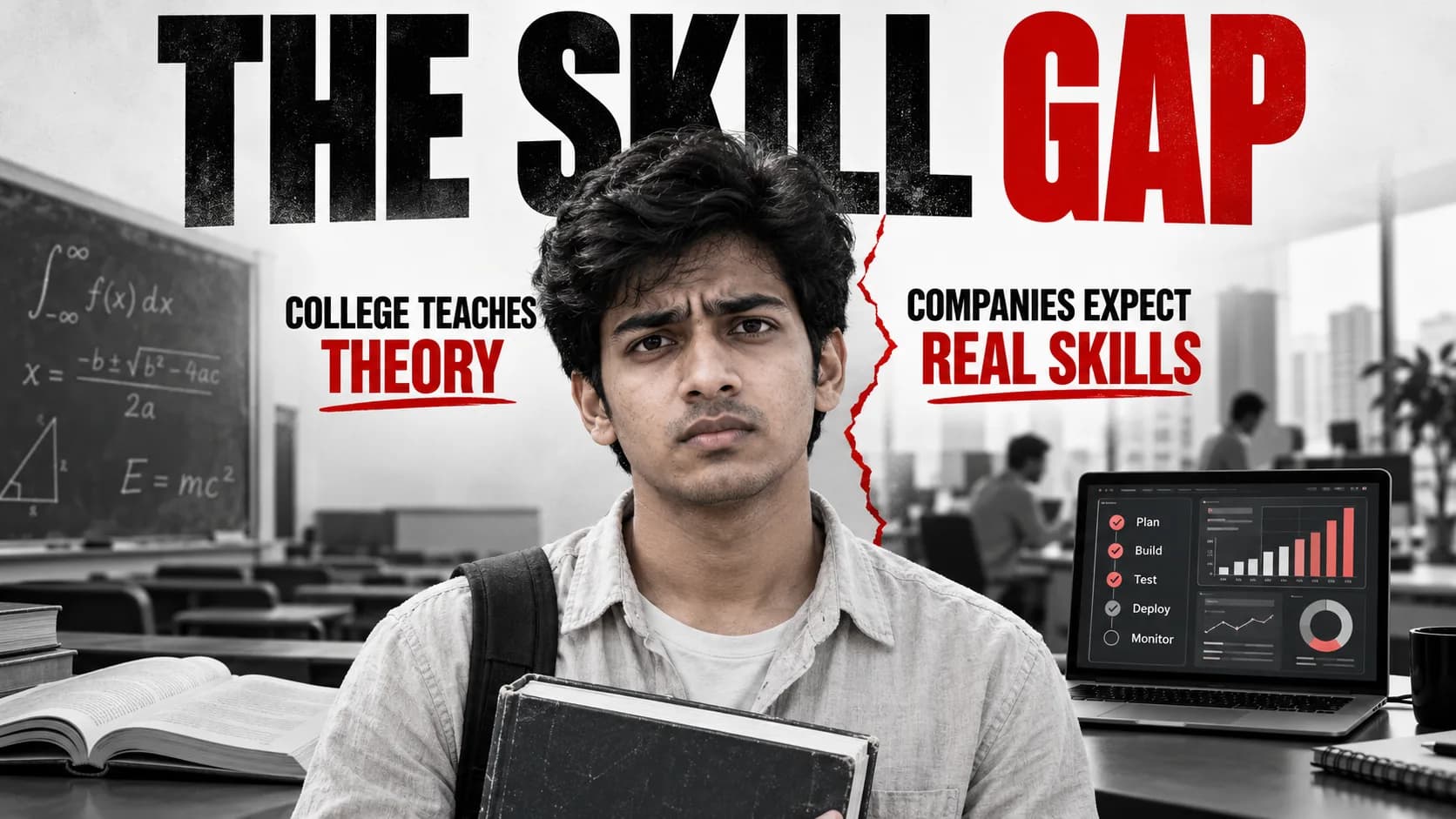
You may be asking yourself, "Is my degree really getting me ready for a job?" The honest answer is: it gets you ready for exams, and only partly for work. What colleges teach is mostly subject knowledge. What companies expect is that same knowledge used on messy, real tasks, along with clear communication and comfort with AI tools. The good news is that the current rules let your college close this gap through credits, internships and apprenticeships. But each college decides how far to go.
Maybe your parents have started asking, "So what happens after the degree?" The official data shows why the question is fair. In 2025, 11.2% of graduates aged 15 and above were unemployed, against 3.1% of all persons in the same age group, as per the Periodic Labour Force Survey (PLFS). The survey does not say why. So don't read it as "degrees fail". Read it as a reason to check your own preparation.
11.2%
Graduates (15+) unemployed
PLFS 2025, all persons 3.1%
120 / 160
Credits in a 3-year / 4-year degree
UGC NHEQF, May 2023
Up to 50%
Credits that can come from skill courses
UGC NCrF SOP
79%
Indian employers who list analytical thinking as a core skill
WEF employer survey, 2025
What does your degree officially include?
You might think your degree is only about the classroom. It is not. The University Grants Commission (UGC) rules already ask colleges to add skills, internships and work experience to the degree, supporting the broader vision of Skills India. Whether your college does it well is a separate question, and we come to that below.
Here is what the rules say and what each one means for you.
| Part of the degree | What the UGC rule says | What it means for you |
|---|---|---|
| Credits | A 3-year degree needs at least 120 credits and a 4-year degree at least 160 | One credit is 30 hours of learning, so real skill work can earn credits |
| Internship | 2 to 4 credits. An internship of 60 to 120 hours after the 4th semester is mandatory | You should get one work experience before you graduate |
| Skill courses | Up to 50% of credits can come from skill-based courses | You can build skills inside the degree, not only after it |
| Apprenticeship | A 3-year degree can embed 1 to 3 semesters of apprenticeship, a 4-year degree 2 to 4 | Paid work can be part of the degree, if your college offers it |
| Exit after year 1 or 2 | A certificate or diploma comes with a 4-credit skill course | Even if you leave early, you take one job skill with you |
These rules come from the UGC National Higher Education Qualifications Framework (May 2023), the internship guidelines (2023), the National Credit Framework (NCrF) rules, and the Apprenticeship Embedded Degree Programme (AEDP) guidelines.
Not every college has adopted them yet. So go and ask your own department what it offers.
What do companies say they expect from freshers?
Say you are in your final year and wondering what a recruiter is actually looking for. Companies say analytical thinking comes first, then adaptability and AI skills. These come from an employer survey by the World Economic Forum (WEF), so they tell you what employers say, not what they pay for.
For India, the WEF survey in 2025 reports these core skills:
- Analytical thinking: 79% of surveyed Indian employers.
- Resilience, flexibility and agility: 63%.
- AI and big data: 62%, and it rises to 94% for skills in increasing use by 2030.
- Creative thinking: 59%.
- Leadership and social influence: 55%.
The same survey says 65% of Indian employers see skill gaps as a barrier. Globally, 39% of workers' existing skills will change or become outdated by 2030.
Look at that list again. It reads more like habits than subjects. Employers are asking for ways of working: break a problem into parts, adapt when the tool changes, and use AI instead of avoiding it. These skills also influence career options After 12th, as students need to prepare for changing workplace demands. A semester exam does not test most of this.
What do official documents say about the gap?
Maybe you have heard that "freshers are not job-ready" and wondered who says so. Three official causes are named. The Economic Survey 2025-26 quotes the 2025 National Skill Gap Study of the Ministry of Skill Development and Entrepreneurship (MSDE). It says the mismatch comes from weak foundational skills, a gap between what industry needs and what training gives, and slow adaptation to new technology.
NITI Aayog, in its October 2025 roadmap on jobs in the AI economy, adds two points:
- AI curriculum in India "takes time to catch up" with the technology.
- Entry-level work such as quality assurance (QA) testing and first-level customer support is work AI can already handle, so hiring for it may slow.
Please read NITI Aayog's numbers carefully. They are scenarios built with industry partners, not forecasts. It estimates that technology services employment of 7.5 to 8 million could fall to 6 million by 2031 in the downside case, or rise to 10 million with action.
The Economic Survey (paragraph 14.44) also says waiting until after graduation to build experience "may no longer be feasible". Neither document measures what has actually happened to Indian freshers. So take this as a warning, not as a result.
Where does the gap show up in a single subject?
You may wonder, "I study this subject properly, so where is the gap?" It is in the task, not in the topic. The table below is our own illustration, not an official list. It shows how the same subject changes between a classroom and a job.
| Subject | What you study | What work asks you to do |
|---|---|---|
| Statistics | Formulas, proofs, textbook data | Explain a trend from untidy data in a spreadsheet |
| English | Essays, grammar, literature | Write a clear email or report in five lines |
| Core engineering | Derivations and numerical problems | Read a drawing or specification and find the fault |
| Accounting | Ledger entries for fixed cases | Match real invoices and bank entries in software |
| Final-year project | One report for one examiner | Work that a teammate or customer can use |
Look at the right column once more. Not one row asks you to repeat a definition.
What can you do inside your degree to close the gap?
Start with the credit rules, because you can act on them this semester. Here is what to do, in order.
- Ask your department what colleges teach beyond the syllabus, in three questions. Walk up to the department office and ask three simple things. Does our college follow the credit framework? Can I earn credits from skill courses? Is there a mandatory internship in my programme?
- Pick skill courses on purpose. SWAYAM Plus offers more than 500 industry-aligned courses from 89 industry partners across 17 sectors, as per the Press Information Bureau (10 August 2026).
- Do an internship for credit. The AICTE internship portal lists internships in weekly, monthly and semester-long formats, and credits go to your Academic Bank of Credits account.
- Ask about apprenticeship-embedded degrees. Only some colleges offer them.
- Keep proof. Save the output of every course and internship: a file, a report, or a short note from the person who supervised you.
Credit rules are the college's choice
Just because a rule exists at UGC level, it doesn't mean your college offers it. Ask in writing what your college offers as skill courses, internships and apprenticeships for credit in your programme.
If you are still deciding on a course or an exam, see the MSM Unify career and college guides.
FAQs on what colleges teach and what companies expect
Commonly asked questions
Answers to what readers ask most often.
Q: Is my degree enough to get a job in 2026?
What colleges teach is a necessary base for many jobs, but it is not enough on its own. In 2025, 11.2% of graduates aged 15 and above were unemployed, against 3.1% for all persons. The survey does not give the reasons, so build one applied skill and one piece of proof alongside your degree. Data Sources: MoSPI, Periodic Labour Force Survey Annual Report 2025.
Q: What do companies expect from freshers in India?
What companies expect from freshers, as ranked by employers surveyed in India in 2025, starts with analytical thinking at 79%, then resilience and agility at 63% and AI and big data at 62%. These are employer survey results, not measured hiring outcomes. Data Sources: World Economic Forum, Future of Jobs Report 2025, India profile.
Q: Do I have to do an internship in my UG degree?
Yes. UGC's 2023 internship guidelines say an internship of 60 to 120 hours after the fourth semester will be mandatory for UG students. Internship credits are 2 to 4 out of 120 or 160. Check how your own college applies this. Data Sources: UGC, Internship and Research Internship Guidelines, 2023.
Q: Can I earn degree credits from skill courses?
Yes, up to 50% of total credits of a UG or PG programme can come from skill-based courses under the NCrF procedure, if your college has adopted it. One credit equals 30 hours of learning. Data Sources: UGC, SOP for Operationalisation of NCrF in HEIs; Press Information Bureau, 10 August 2026.
Content authored by:
Updated on
Headline: EdTech Leader | AI & SEO Strategist | Computer Science Engineer: Atul leads SEO, content, and data at MSM Unify India. He plans the organic content strategy and also owns the structured data that feeds it. He works with a team of product managers, engineers, QA, designers, writers, and SEO specialists. Together they create guides for Indian students and parents on colleges, entrance exams, and studying abroad. Atul has built a step-by-step content process that uses AI tools with a human in the loop. Every page goes through several stages. It starts with research, where each fact is checked on the official source. A second, independent source is then used to confirm that the fact is correct and the latest. Third-party sites are used only to spot differences and are never treated as a source. Before writing, the team studies what students actually search for and what the top results leave out. This study covers Google, Bing, DuckDuckGo, ChatGPT, and Perplexity, including AI answers and “People also ask” questions. Pages written by Atul are in plain English that can be understood in one read, and they open with the question the reader is most likely to have. Before a page goes live, every number, name, date, and fact is checked again against its official source. Finally, an editor reads and humanises every page, however good the draft is. Atul believes that advice on education should be simple, honest, and based on official facts. Fees and figures should come with their source. A student should be told clearly when a college is not the right fit.