
- Management
- Executive MBA
- MBA
What Can I Do After an MBA in India? Jobs, Salary, Government Jobs & Higher Studies
Content Manager
An MBA does not end with a placement offer. This guide covers all six real paths after an MBA in India: taking the campus job, searching off campus if you are not placed, going for PSU/banking/UPSC routes, higher studies, entrepreneurship or family business, and freelancing or consulting. It also covers realistic salary ranges by role, the best Indian cities for MBA jobs, and what to weigh before working abroad, so you can decide the right next step for your own situation.
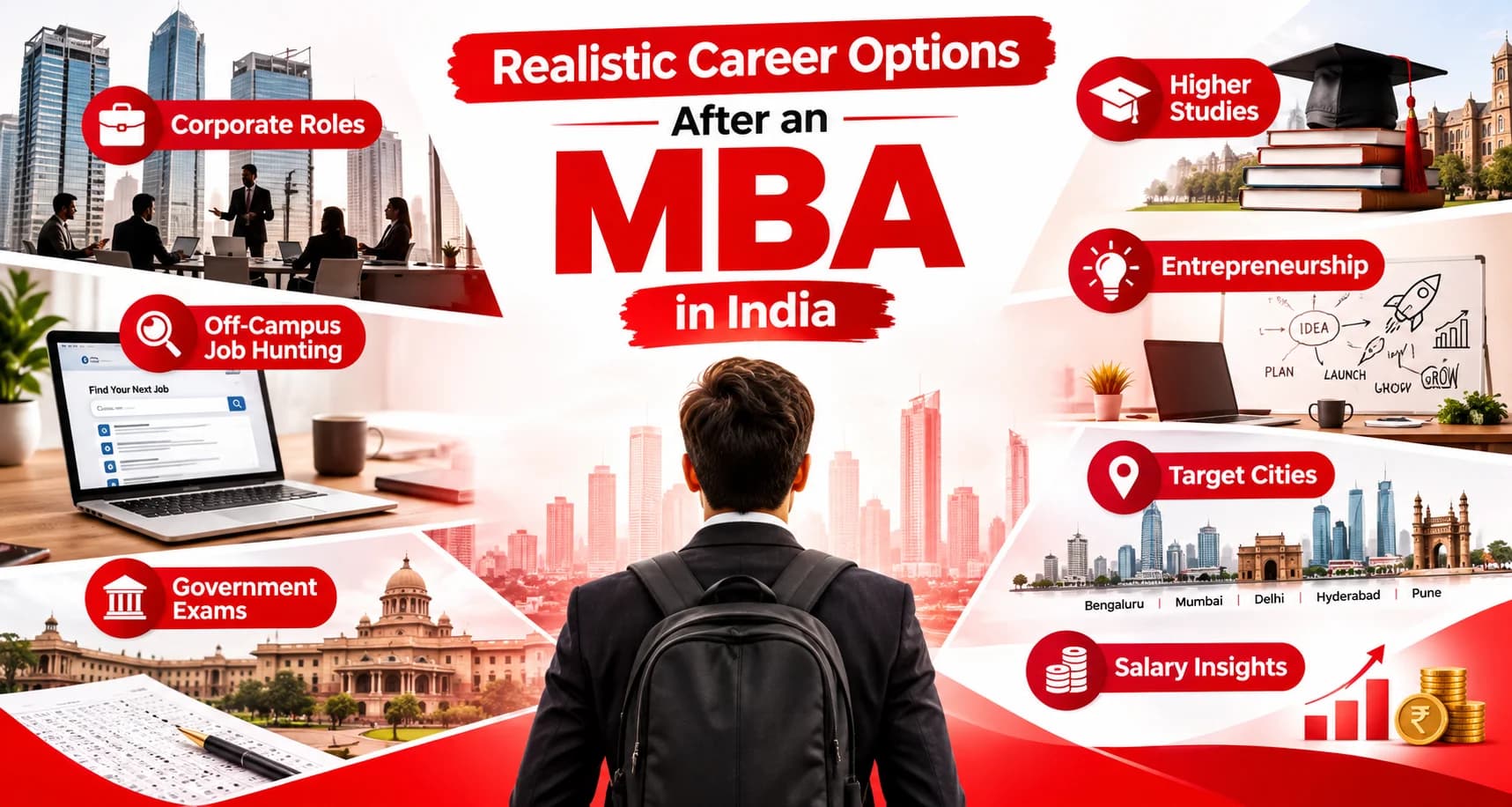
link textWhat can I do after MBA in India? You can take a corporate job, apply for a government or PSU role, study further, start a business or work as a consultant. Most graduates take a job first. Your best option depends on whether you have a campus offer, your specialisation, your college and how much money risk you can take.
This guide answers the question in the order most MBA graduates need it. It starts with the six main paths. Then it covers jobs and salary by specialisation and what to do if you are not placed. After that come government jobs after MBA with salary, PhD and DBA, and working abroad. The last part answers common doubts such as "Is an MBA still worth it in 2026?"
What Can I Do After MBA in India? Six Paths
There are six main answers to "What can I do after MBA in India?" Many graduates follow more than one over their career.
💼Take the Campus OfferCheck the fixed pay, the role and the location before you accept. Do not judge the offer by the CTC alone.🔍Look for Jobs Off CampusApply to companies directly, use LinkedIn and ask alumni for referrals. This route is slower but it is open to everyone.🏛️Apply for Government and PSU RolesBank PO, RBI, SEBI, NABARD, PSU management trainee and UPSC need separate exams. An MBA does not replace them.🎓Study FurtherChoose a PhD, a DBA, a master's abroad or a certification such as CFA, FRM or PMP, based on the job you want.🚀Start or Join a BusinessSome graduates start a venture. Others join the family business and apply what they learned.💻Work IndependentlyFreelancing and consulting work better after you have some work experience and a few clients.What Is the Next Step After an MBA?
What can I do after MBA in India as a first step? Take a job in the function you studied, such as finance, marketing, HR, operations or analytics. If you have a campus offer, accept it after checking the fixed pay. If you do not, start off-campus applications at once. Higher studies or a business can come later, once you have some work experience.
After MBA, Which Job Is Best?
The best job after an MBA is the one that matches your specialisation, your pay need and the growth you want. No single job is best for everyone. Use this table to decide.
| If your priority is | Roles to look at | Why |
|---|---|---|
| Highest pay | Consulting, investment banking, product management | These roles pay the most at good colleges |
| Job security | Bank PO, PSU management trainee, regulators | Government pay is fixed and the job is stable |
| Fast growth | Analytics, product, sales and business development | Pay rises quickly with results |
| Work-life balance | Corporate HR, operations, FP&A | Hours are more predictable in most firms |
| Ownership | Family business, startup, consulting | You carry more risk and decide more yourself |
What Can I Do After MBA in India If I Got Placed?
If you got placed, the next job is to read your offer well. Check the fixed pay before you celebrate the CTC. Most offer letters put the joining bonus, the variable pay and sometimes stock options into one headline figure. Ask HR what you will get in hand every month. Then compare it with the average fixed pay for your function and city.
How Do I Read an MBA Offer Letter?
Read the offer in four parts: fixed pay, variable pay, joining bonus and benefits. Fixed pay is what you can plan your rent and loan on. Variable pay depends on your performance or the company's results. A joining bonus is paid once and often has a clause to return it if you leave early.
What Should I Focus on in the First 90 Days?
Learn how the business makes money. Then make your work visible to the people who decide your next role. These two things matter more than your MBA grades after you join. Also keep in touch with your batch and alumni, because they are your first source of referrals.
What Can I Do After MBA in India? Jobs by Specialisation, With Salary
What can I do after MBA in India depends first on your specialisation, because it decides your first job title. Recruiters hire for a function, not for an "MBA graduate". So the job opportunities after MBA depend on the function you studied. The table shows the typical early-career pay range for each specialisation. These are approximate ranges. Pay depends on your college, city and company.
| MBA specialisation | Typical early-career pay (per year) | Common first roles |
|---|---|---|
| Finance and investment banking | ₹8 lakh to ₹25 lakh or more | Financial analyst, investment banking analyst, equity research analyst |
| Consulting and strategy | ₹10 lakh to ₹22 lakh or more | Management consultant, strategy associate, business advisory associate |
| Marketing and brand management | ₹7 lakh to ₹15 lakh | Brand manager, digital marketing manager, market research analyst |
| Business and data analytics | ₹7 lakh to ₹12 lakh | Business analyst, BI analyst, analytics manager |
| Operations and supply chain | ₹6 lakh to ₹10 lakh | Operations manager, supply chain manager, procurement manager |
| Human resources | ₹6 lakh to ₹9 lakh | HR business partner, talent acquisition manager, compensation analyst |
Other common specialisations lead to these roles:
| MBA specialisation | What you do | Roles |
|---|---|---|
| IT and technology | Link business needs with software teams and plan product roadmaps | Product manager, IT project manager, technology consultant |
| Sales and business development | Grow revenue, handle large clients and expand markets | Business development manager, key account manager, regional sales head |
| International business | Manage exports, imports, trade rules and entry into foreign markets | International business manager, export-import manager, global sourcing lead |
After MBA in Marketing, Which Course Is Best?
After an MBA in marketing, a short course in digital marketing, marketing analytics or product management is the most useful. Choose the one that matches the role you want. Brand roles need consumer insight. Growth roles need data and performance marketing. Product roles need user research and basic tech knowledge. A PhD in marketing suits you only if you want research or teaching.
What to Do After MBA for a High Salary?
For a high salary, aim for management consulting, investment banking or product management. These are the jobs after MBA with high salary in India. These roles mostly hire from top colleges, so your college tier matters. Finance and consulting can also pay well at mid-tier colleges, but the first-year pay is lower. Marketing, analytics, operations and HR usually start lower and grow with experience.
MBA Salary in India: What Can You Earn?
For most people asking what can I do after MBA in India, salary decides the answer. MBA salary in India depends on three things: your college, your function and your work experience. The gap between colleges is large. Old IIMs report average packages of about ₹28 lakh to ₹36 lakh. Newer IIMs such as Udaipur and Bodh Gaya report about ₹15 lakh to ₹18 lakh. Many other colleges report less.
What Is MBA Salary at the Top Colleges?
At the older IIMs, the average package for the latest batches is between about ₹28 lakh and ₹36 lakh a year. IIM Ahmedabad reported an average guaranteed cash component of about ₹31.84 lakh for the Class of 2026. IIM Bodh Gaya and IIM Udaipur report averages of about ₹14.8 lakh and ₹17.6 lakh on the MEP basis. See the IIM Ahmedabad placement report for the full breakup.
Can I Get a 1 Lakh Salary After an MBA?
Yes, a salary of ₹1 lakh a month, which is ₹12 lakh a year, is possible after an MBA. It is common at the IIMs and at other top and mid-tier colleges in consulting, finance, analytics and product roles. It is less common in a first job from a lower-ranked college. Also remember that ₹12 lakh CTC gives a lower in-hand salary after tax, PF and variable pay.
MBA Salary by Role
This table shows approximate average pay by role, as reported on salary-tracking platforms. It includes people with different years of experience. Treat it as a guide and not as a promise.
| MBA career path | Approximate pay (per year) | Experience |
|---|---|---|
| Financial analyst | ₹6 lakh to ₹7 lakh | 1 to 7 years |
| Business development manager | ₹7 lakh to ₹9 lakh | 2 to 14 years |
| Business analyst | ₹9 lakh to ₹11 lakh | 1 to 9 years |
| HR manager | ₹10 lakh to ₹12 lakh | 3 to 16 years |
| Operations manager | ₹10 lakh to ₹12 lakh | 3 to 17 years |
| Marketing manager | ₹12 lakh to ₹14 lakh | 2 to 16 years |
| Investment banking analyst | ₹14 lakh to ₹16 lakh | 0 to 4 years |
| Supply chain manager | ₹14 lakh to ₹16 lakh | 3 to 19 years |
| Product manager | ₹22 lakh to ₹25 lakh | 2 to 13 years |
| Management consultant | ₹27 lakh to ₹30 lakh | 2 to 16 years |
What Can I Do After MBA, and What Does Each Path Pay?
Each path after an MBA pays differently. This table puts them side by side.
| Path after MBA | Approximate pay | What decides it |
|---|---|---|
| Campus job at an old IIM | About ₹28 lakh to ₹36 lakh average | Specialisation and recruiter |
| Campus job at a newer IIM | About ₹15 lakh to ₹18 lakh average | Specialisation and batch |
| Bank PO (SBI PO) | About ₹9 lakh gross a year at the start | Fixed pay scale and city |
| RBI, SEBI or NABARD officer | Roughly ₹10 lakh to ₹18 lakh | Grade and allowances |
| PhD at IIM Bangalore | Stipend of ₹52,000 a month plus tuition waiver | Five-year research programme |
| Own business or freelancing | No fixed pay | Clients, savings and time |
What Can I Do After MBA in India If I Am Not Placed? How to Get a Job
If you have no campus offer, what can I do after MBA in India is simple: start applying off campus now. Do not wait for the perfect role. Off-campus hiring is slower than a campus drive, so you need to apply to more companies and start earlier.
Can I Get a 100% Job After an MBA?
No college can promise a 100% job after an MBA. Placement depends on the college, the market and your own preparation. IIM Ahmedabad placed all 392 students who sought placement in the Class of 2026, but many colleges report lower numbers. Ask for three figures from your college: total students, students who sought placement and students placed.
How Do I Find a Job Off Campus After MBA?
Follow these steps in order:
- Write a one-page resume with your specialisation, internship and one clear result.
- Message alumni who are two or three years ahead of you. They often know about openings before they are posted.
- Apply directly to companies that hire from colleges of your tier, even if they skipped your campus this year.
- Use LinkedIn and company career pages every week, and note each application in a sheet.
- Prepare for the same case, finance and HR questions asked in campus interviews.
Should I Take Any Job or Wait for the Right One?
Take a reasonable job that keeps you employed. Do not wait for the perfect role. Many recruiters ask about long gaps on a resume. Two years of real work gives you proof to move to the role you want. Keep applying to better roles while you work.
Government Jobs After MBA With Salary
A government job is one more answer to what can I do after MBA in India. An MBA does not give you a separate government route, and you must still clear the exam for each job. These are the main options.
| Government route | How you enter | Approximate pay |
|---|---|---|
| Bank PO (SBI, IBPS banks) | SBI PO and IBPS PO exams | About ₹9 lakh gross a year at the start for SBI PO |
| RBI Grade B, SEBI Grade A, NABARD | Direct recruitment exams by each body | Roughly ₹10 lakh to ₹18 lakh |
| PSU management trainee | Each PSU's own exam, GATE, UGC NET or CAT, depending on the company and year | Pay scale of the company, often with allowances |
| UPSC Civil Services | UPSC Civil Services Examination | As per the central government pay matrix |
Which Government Jobs Can I Get After MBA?
You can apply for bank PO, RBI, SEBI, NABARD, PSU management trainee and UPSC Civil Services after an MBA. Each has its own exam and age limit. Many banks and PSUs value MBA-Finance graduates for credit, risk and finance roles. Read each notification before you prepare, because the rules change from year to year.
Is an MBA Useful for Bank PO?
An MBA is not needed for bank PO, because any graduate can apply. The SBI PO 2026 age limit is 21 to 30 years. The IBPS PO age limit is 20 to 30 years. Both give relaxation to reserved categories. If you took a gap before or during your MBA, check the age limit early.
Is an MBA Useful for UPSC?
An MBA meets the graduate-degree rule for UPSC but gives no extra marks in the exam. As per the UPSC Civil Services 2026 notification, the age limit for General category is 21 to 32 years as on 1 August 2026. General category candidates get 6 attempts, OBC get 9 and SC/ST have no limit within the age limit. Treat UPSC as a separate, multi-year preparation, not a side plan.
Check the rules every year
Age limits, attempts and eligibility for bank, PSU and UPSC recruitment can change in each notification. Read the latest official notification before you plan your preparation.
Higher Studies After MBA: PhD, DBA and Certifications
Higher studies are one answer to what can I do after MBA in India, but they make sense only when they lead to a specific career. They are not a way to avoid the job market. The three real options are a PhD, a DBA and a professional certification.
Can I Do a PhD After MBA?
Yes, you can do a PhD after an MBA, but an MBA is not required. The IIM Bangalore PhD programme, which was earlier called FPM, runs for up to five years. As per the IIM Bangalore financial support page, it gives a tuition waiver and a stipend of ₹52,000 a month. A housing allowance of ₹26,500 a month is also listed. Entry uses scores such as CAT, GATE, GMAT, GRE or UGC NET JRF, depending on the area. Choose a PhD only if you want research or teaching as a career. See how to get into IIM for the CAT route.
What Is Higher Than an MBA?
A PhD or an FPM is the highest academic degree after an MBA. A DBA, which is a Doctor of Business Administration, is the other doctoral option. Executive programmes such as the PGPX are not higher degrees, but they suit working professionals who want a second credential.
DBA After MBA: Is It Worth It?
A DBA after an MBA suits working managers who want a doctorate while they continue to work. It is usually part-time and runs for three to four years. A PhD is usually the route for tenure-track teaching jobs at IIMs and IITs. A DBA often leads to adjunct or practice-based teaching roles. Check that the university is UGC-recognised before you pay the fee.
Is a CFA or MBA Better?
CFA is better if you want to work in investment management, equity research or portfolio roles. An MBA is better if you want a wider range of roles, a campus placement process and a college network. Many finance professionals do both. CFA has three exam levels, and you can study for it while you work. Compare the cost and time of each with the job you want.
Which Certifications Are Worth Doing After MBA?
A certification adds to your MBA and takes months, not years. Choose by the function you want.
📊CFAFor investment, equity research and portfolio roles.🛡️FRMFor risk management roles in banks and financial firms.📅PMPFor project and programme management roles.Should I Study Abroad After an MBA in India?
Study abroad after an MBA only if the new degree fills a skill gap your MBA did not cover. A master's in data science, public policy or a specific legal field can help a career change. A second general degree rarely justifies the cost. Compare the full cost and the expected job outcome with a shorter certification first.
Start a Business or Join the Family Business After MBA
A business is a real answer to what can I do after MBA in India, but it has no safety net. Many new ventures close within a few years, and an MBA does not change that. What the MBA gives you is a way to test an idea cheaply before you spend money on it.
Should I Start a Business Right After MBA?
Start a business right after an MBA only if you can bear the money risk. A few years of work experience and some savings make it safer. Check the government loan and seed-funding schemes for first-time founders before you look for outside investors.
Should I Join the Family Business After MBA?
Joining a family business has less risk of failure than a new startup. The challenge is different. You have to show that your MBA changed how the business runs. Start with one clear project, such as pricing, costing or a new sales channel, and report the result.
Freelancing and Consulting After MBA
Freelance consulting is a fair answer to what can I do after MBA in India. It works best after you have a few years of experience. Clients pay for results they have seen, not for a new degree. Use freelancing as a bridge or a side income. Do not start it without paying clients and a savings reserve.
Can I Work Abroad After an MBA in India?
Working abroad is also an answer to what can I do after MBA in India, but the degree alone does not get you a visa. Work experience, your function, the employer's sponsorship and the college's reputation all matter. The table shows common destinations and the roles that hire most.
| Market | MBA roles that hire | Note |
|---|---|---|
| UAE and the Gulf | Finance, consulting, sales, operations, supply chain | Often easier to enter with relevant experience |
| Singapore | Consulting, finance, technology, supply chain | Competitive, needs local hiring approval |
| Europe | Consulting, finance, technology, supply chain | Needs a work permit and often a local language |
| UK | Consulting, finance, marketing, technology | Needs employer sponsorship |
| USA | Consulting, technology, finance, product management | Work authorisation is the biggest hurdle |
What Is the Easiest Way to Work Abroad After MBA?
The easiest way is an internal transfer. Join a multinational company in India, build two or three years of experience in your function, and then apply for a transfer to an overseas office. The employer already knows your work, so you do not need a foreign company to sponsor an unknown candidate. Ask yourself which function you can build strong skills in, not only which MBA to pick.
Which Cities Have the Most MBA Jobs in India?
Where you live also changes what can I do after MBA in India. Bengaluru, Mumbai, Gurugram, Hyderabad and Pune have the most MBA jobs. Each city is strong in different industries.
| City | Strong sectors | Common roles |
|---|---|---|
| Bengaluru | Technology, consulting, analytics, startups | Product manager, business analyst, consultant |
| Mumbai | Finance, banking, consulting, consumer goods | Investment banking analyst, financial analyst, brand manager |
| Gurugram | Consulting, FMCG, finance, corporate functions | Consultant, marketing manager, sales manager |
| Hyderabad | Technology, pharmaceuticals, analytics, financial services | Product manager, business analyst, finance roles |
| Pune | IT, automotive, manufacturing, financial services | Operations manager, project manager, business analyst |
Common Doubts After an MBA
Many graduates ask what can I do after MBA in India and then have the same doubts about pay, age, AI and career growth. These are the answers.
Is an MBA Still Worth It in 2026?
An MBA is worth it if the pay you expect covers the fee within a few years. Compare the total fee with your expected first-year take-home pay. For example, the IIM fee range is about ₹18 lakh to ₹27.5 lakh, and old IIMs report average packages above ₹28 lakh. The maths is different at colleges with lower placement pay. Check the placement report before you decide. See the IIM Ahmedabad fee structure for one worked example.
Who Earns More, CA or MBA?
Neither earns more in every case. ICAI said in May 2026 that the average starting package for CAs in its campus placement is about ₹12 lakh to ₹13 lakh. An old IIM MBA reports an average of about ₹28 lakh to ₹36 lakh, but only a small number of students get into these colleges. An MBA from an average college may start below a CA. Pass rates also differ. In May 2026, 14.07% of candidates cleared both groups of CA Final. Read more about toughest exams in India before you compare.
Is MBA Replaced by AI?
No, AI does not replace the MBA. It changes the work that freshers do. Tasks such as basic reports, slides and data summaries are now faster with AI tools. Roles that need judgement, client handling and decision-making still need people. Build skills in data, finance basics and AI tools along with your specialisation.
Is 27 Too Old for an MBA?
No, 27 is not too old for an MBA. CAT has no upper age limit, and IIM Ahmedabad's PGP lists only a minimum age of 19 years. Many colleges value work experience, so a candidate at 27 with experience can have a strong profile. Check each college's rules, because some executive programmes ask for a minimum work experience. See the CAT exam page for the latest eligibility.
Can I Be a CEO After an MBA?
Yes, many CEOs hold an MBA, but the degree alone does not make you one. Sundar Pichai of Alphabet holds an MBA from Wharton. Satya Nadella of Microsoft holds an MBA from Chicago Booth. Tim Cook of Apple holds an MBA from Duke Fuqua. All three also spent many years in senior roles first. An MBA helps with the first step. Results and experience decide the rest.
Which Billionaire Did MBA?
Michael Bloomberg completed an MBA at Harvard Business School. Phil Knight, the co-founder of Nike, completed an MBA at Stanford. Tim Cook completed an MBA at Duke Fuqua. Mukesh Ambani joined the Stanford MBA but left before finishing it. An MBA can help, but many business leaders built their wealth with or without it.
What Can I Do After MBA in India? Pick Your Option
Pick the option that matches your situation today:
Do you have a placement offer?
Accept it after you check the fixed pay, role and location. Treat the first year as the real test.
No campus offer yet?
Start off-campus applications at once. A reasonable job that meets most of your needs is better than a long gap while you wait.
Thinking of a government or PSU job?
Check the age limit, attempts and exam pattern in the latest notification before you start preparing.
Thinking of a PhD or DBA?
Choose a PhD for research or teaching. Choose a DBA if you want a doctorate while you continue to work.
Thinking of a master's abroad?
Be clear about the skill gap it fills. If you cannot name it, a certification will cost less and give a similar result.
Thinking of a business?
Start when you can bear the loss. Do not use a business as a way to avoid the job search.
Final Takeaway: What Can I Do After MBA in India?
What can I do after MBA in India has no single answer. Take the campus offer if you have one, and start off-campus applications at once if you do not. Add a government exam, a PhD, a certification or a business when it fits the career you want. Decide by your college, your specialisation and the risk you can bear.
FAQs: What Can I Do After MBA in India?
What can I do after MBA in India?
After an MBA in India you can take a corporate job, apply for a government or PSU role, do a PhD or DBA, start a business or work as a consultant. Most graduates take a job first and plan higher studies or a business later.
What can I do after MBA in India if I don't get a job?
Start applying off campus at once. Message alumni, use LinkedIn and apply directly to companies that hire from colleges of your tier. Take a reasonable first job instead of waiting for the perfect one.
Can I get a 100% job after an MBA?
No college can promise a 100% job. IIM Ahmedabad placed all 392 students who sought placement in the Class of 2026. Other colleges report different numbers, so ask for the total, sought and placed figures.
What is MBA salary in India?
It depends on your college and function. Old IIMs report average packages of about ₹28 lakh to ₹36 lakh a year. Early-career pay in many other colleges is about ₹6 lakh to ₹15 lakh, depending on the specialisation.