
- Mass Communication
- BA
- MA
How to Become a Journalist After 12th in India: Eligibility & Career

Content Manager
Dream of becoming a journalist? Find out how to start your journalism career after 12th in India. Explore the best courses, eligibility, entrance exams, top colleges, admission process, salary, and career opportunities in journalism and mass communication.
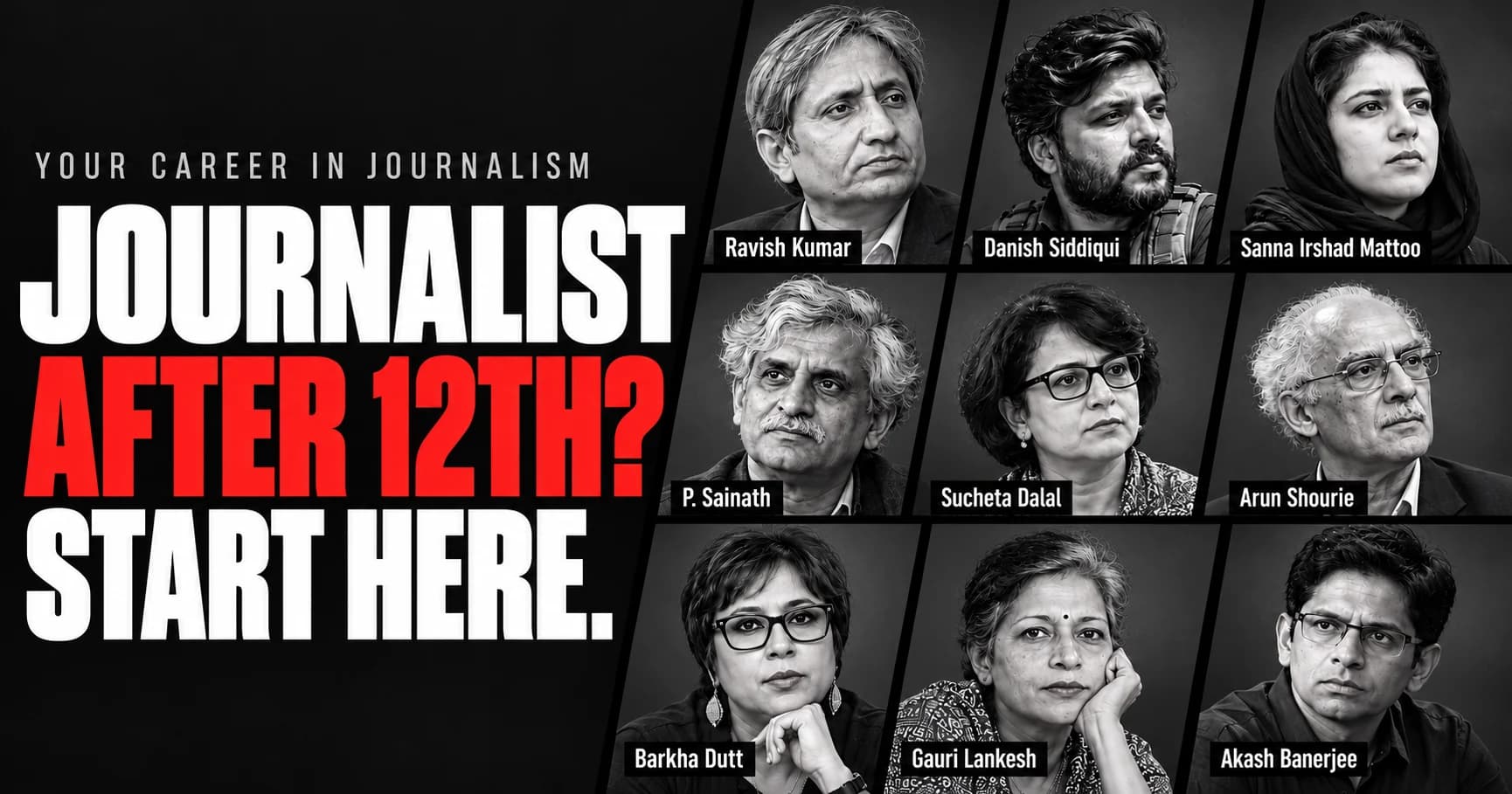
Ravish Kumar grew up in a village in Bihar. Danish Siddiqui studied economics. Sanna Irshad Mattoo started as a freelance photojournalist in Kashmir. Each of them went on to win a major international journalism award.
Can you follow a path like theirs? Yes. You can become a journalist after 12th in any stream: Arts, Commerce or Science. The usual path is a bachelor's degree in journalism and mass communication, then internships, then a first job in a newsroom. This page explains how to become a journalist after 12th in India, step by step.
You will also see what a journalist does on a normal day, what to start in Class 11 and 12, the freelance route, and eight real stories. Each story shows the benchmark that journalist set and the first step you can copy.
50%
Class 12 marks asked by SCMC Pune for its BA in Mass Communication
45% for SC/ST candidates
Up to 5
Subjects you can choose in CUET UG 2026
Mass Media / Mass Communication is one domain subject
Graduates only
Who can join IIMC in 2026-27
IIMC offers MA and PG Diploma, not a bachelor's degree
Journalism has no single gate. A history student, an economics graduate and a village-born reporter have all reached the top. The sections below show the common roadmap first. Then they show the other routes.
Eligibility: Who Can Become a Journalist After 12th?
If you are asking how to become a journalist after 12th, start here. Any student who has passed Class 12 from a recognised board can begin. Each college sets its own marks and entrance rules, so check them before you apply.
What is the minimum eligibility for journalism courses after 12th?
Eligibility for journalism courses after 12th differs by college. The Symbiosis Centre for Media and Communication (SCMC), Pune asks for 50% marks in Class 12 for its BA in Mass Communication. SC and ST candidates need 45%. Students who are waiting for their Class 12 results can also apply. They must show proof of their marks later. This is the rule of one college. Another college may ask for a different percentage.
For CUET UG, the National Testing Agency (NTA) sets no age limit. It also does not fix a minimum Class 12 percentage. The says each university decides its own age, marks and subject rules. So read the prospectus of every university on your list. You can also check BA Journalism and Mass Communication eligibility before you shortlist.
Which stream is best for journalism after 12th: Arts, Commerce or Science?
No stream is compulsory. The CUET (UG) 2026 bulletin lets you choose test subjects irrespective of the subjects you studied in Class 12. Your stream only decides which beat you will understand faster.
Journalism after 12th Arts: History, Political Science, Sociology and English give you the background for politics, culture and social reporting. Ravish Kumar and P. Sainath both studied history before they became reporters.
Journalism after 12th Commerce: Accountancy and Economics help you read budgets, company results and markets. Business reporting needs this skill. Sucheta Dalal, who exposed the 1992 securities scam, is known as a business journalist. Arun Shourie and Danish Siddiqui had economics backgrounds.
Journalism after 12th Science: Biology, Environmental Science and Physics help in health, climate and technology reporting. Such topics need reporters who can explain them in simple words. The stories below show journalists who changed fields, so a Science stream does not close the door.
If you are in Class 11, choose English and one social science subject if you can. This is advice, not a rule.
How to Become a Journalist After 12th: Step-by-Step Roadmap
The common roadmap for how to become a journalist has six steps. It starts in Class 12 and ends with your first job and your first beat.
Class 11-12
Build the base
Choose English and a social science subject if you can. Read one newspaper daily and write short pieces.
Before Class 12 results
Register for entrance tests
Apply for CUET UG and any college entrance test you plan to take.
Years 1-3 (or 4)
Study journalism
Complete BA in Journalism and Mass Communication, BJMC or a similar course.
Every year of college
Intern and build a portfolio
Do one internship each year and keep your best work in one folder.
After graduation
Study further or start work
Apply for a PG diploma or master's course, or apply for newsroom jobs.
First job
Join a newsroom
Start as a reporter, sub-editor or video journalist.
Years 2-3 at work
Choose a beat
Pick a subject such as education, health or business and build your name on it.
Here is a worked example. Aman scores 68% in Class 12 Commerce. He applies for CUET UG with English, Mass Media / Mass Communication and the General Aptitude Test. He joins a BA in Journalism and Mass Communication. He interns with a local newspaper in year one, a news website in year two and a regional channel in year three. In year three, he applies for a PG diploma. This is an example, not a real student.
Step 1: Prepare for CUET UG or a college entrance test
Many central and state universities use CUET UG scores for admission. In 2026, the application window ran from 3 to 30 January. The exam was planned for 11 to 31 May, as per the CUET (UG) 2026 Information Bulletin.
Each test paper has 50 questions and lasts 60 minutes. A correct answer gives 5 marks. A wrong answer takes away 1 mark. You can choose up to 5 subjects in all, including languages and the General Aptitude Test. Mass Media / Mass Communication (code 318) is one of the 23 domain subjects. Check which subject combination your target university accepts. You can read more on the CUET UG exam pattern and the CUET UG syllabus for Mass Media and Mass Communication.
CUET UG 2027 dates
When we checked the NTA website in October 2026, it still showed only CUET UG 2026 notices. Follow the NTA website for the official 2027 notice.
Some colleges use their own tests. SCMC Pune admits undergraduate students through the Symbiosis Entrance Test (SET), as per its admission notice.
Step 2: Choose the right bachelor's course
Most students take BA in Journalism and Mass Communication, BJMC or BA in Mass Communication. Course names differ by university. The duration is three or four years, depending on the university. Look at the course content and not only the name. Good courses teach reporting, editing, media law, digital media and give you internships.
For example, SCMC Pune lists Print Media Reporting and Editing, Data Journalism, Photojournalism and Media Law and Ethics in its programme. It also includes field visits and internships. Compare these details across journalism courses after 12th before you decide.
Step 3: Start your portfolio in the first year
A portfolio is a folder of your published work. Add your best stories, one short video and one audio clip. Write about your campus, your locality and local public services. Learn to shoot clean photos and video on your phone. Check every name, number and date before you publish.
Step 4: Do an internship every year
Newspapers, news websites, regional channels and news agencies take interns. An internship gives you a reference and a real deadline. Danish Siddiqui, whose story is below, moved from TV news to photography and joined Reuters as an intern in 2010.
Step 5: Decide whether to study further
After your bachelor's degree, you can study a PG diploma or a master's course. IIMC is one well-known option. Its rules are explained in the next section. Danish Siddiqui completed an MA in Mass Communication after his economics degree. Sanna Irshad Mattoo studied convergent journalism at the Central University of Kashmir.
Step 6: Get your first job and choose a beat
Entry roles include reporter, sub-editor, video journalist and digital news writer. Within two or three years, choose a beat. It can be education, crime, business, health or sports. A clear beat makes your work easier to notice. P. Sainath made India's poorest districts his beat, and Sucheta Dalal made business hers.
What Can You Do in Class 11 and 12 to Start Now?
You do not need to wait for college to learn how to become a journalist. These habits cost very little. They build your first portfolio and help you in interviews for journalism courses after 12th.
What can a Class 12 student do to prepare for journalism?
Start writing and publishing small pieces now. Here are seven things you can begin this month.
- Run or join the school newsletter or magazine. Report real events, such as sports day, a new school rule or a local problem.
- Read one newspaper daily, in English and in your own language. Notice how the first paragraph carries the main fact.
- Write a short review of a book or film every month. Keep the reviews in one folder or on a free blog.
- Pick one niche, such as your city's buses, school sports or local food. Write about it every week.
- Learn basic phone skills: clean photos, steady video and clear audio.
- Practise writing in English and in one more language. Regional media needs strong writers in the local language.
- Speak to a working reporter in your city. Ask what a normal day looks like.
Journalism Courses After 12th: Which One Should You Choose?
Journalism courses after 12th fall into three groups. These are bachelor's degrees, diplomas or certificates, and a general bachelor's degree followed by a journalism PG course.
| Route | Duration | Best for |
|---|---|---|
| BA in Journalism and Mass Communication, BJMC or BA in Mass Communication | 3 to 4 years | Students who are sure about a media career |
| Diploma or certificate in journalism | Shorter than a degree; varies by college | Students who want a skill-based start |
| Any bachelor's degree, then a journalism PG diploma or master's | Degree plus the PG course | Students who want a subject such as economics, law or science first |
Which journalism courses after 12th are offered by government colleges?
Central and state universities are government colleges. Many accept CUET UG scores for journalism courses after 12th. The CUET (UG) 2026 bulletin lists central universities such as the University of Delhi, Jamia Millia Islamia, Banaras Hindu University, the University of Allahabad and Central University of Kashmir. The bulletin does not say which of them offer a journalism bachelor's course. Check each university's prospectus for BA in Journalism and Mass Communication or Mass Communication and Scholarships for Indian Students for UG Programmes.
Can you join IIMC after 12th?
No. The Indian Institute of Mass Communication (IIMC) lists only MA and PG Diploma programmes. You must be a graduate, or in the final year of your bachelor's degree, to apply.
The four PG Diploma programmes in that notice are Journalism (English), Journalism (Hindi), Radio & TV Journalism, and Advertising and Public Relations. A graduate in any discipline with a valid CUET PG score in Mass Communication and Journalism (COQP17) can apply. The MA programmes need a bachelor's degree with at least 55% marks and the same CUET PG score.
The PG Diploma also has an age limit. For the general category, the candidate must be born on or after 1 August 2001, which is a maximum of 25 years on 1 August 2026. The limit is 28 years for OBC and 30 years for SC, ST and PwD candidates. The MA programmes have no age limit. The Odia Journalism diploma at the Dhenkanal campus uses its own Entrance Exams and interview.
So your bachelor's degree comes first. Choose a subject that you can use for your beat later. You can read about IIMC admission, IIMC fees and IIMC cutoff on our college pages.
What Does a Journalist Do on a Typical Day?
The day depends on your role and your newsroom. The Government of India's Employment News career guide on print media describes the main roles. This section turns those roles into a daily routine. Treat it as a typical pattern, not a fixed schedule.
What does an entry-level reporter do in a day?
A reporter collects facts and files stories. Employment News says reporters file stories on local, state, national and international events and monitor public officials. Barkha Dutt's frontline coverage of the Kargil war shows how far this job can take you.
- Morning: Check the day's schedule, press notes and follow-ups. Decide whom to call.
- Midday: Go to the field. It can be a court, a college, a market or a civic office. Take notes, photos and quotes.
- Afternoon: Write the story and check every name, number and date. Send it to the desk.
- Evening: Answer the editor's questions. Update the story if the facts change.
What does a sub-editor do in a day?
A sub-editor works on the desk and shapes a reporter's story into its final form. Employment News says sub-editors act almost like a gatekeeper. They check stories for errors and inconsistencies. They also cut the copy, write headlines and fit stories into the page or website. P. Sainath began his career as a sub-editor at United News of India in 1980.
What does a digital journalist do in a day?
A digital journalist publishes news on a website, an app or social media. The day includes writing short updates, choosing headlines, shooting short videos and posting at the right time. Many digital newsrooms expect one person to handle more than one of these tasks.
Early in your career, expect long hours around big events and tight deadlines. You will learn faster than in most jobs, because every day ends with a published story.
Modern Journalism Specialisations: Beyond Print and TV
Employment News lists sports, investigative, science and film journalism as common streams. Newsrooms today also hire for data, audio and newsletters. You do not need to choose in Class 12. Choose one after you try two or three in college. Arun Shourie's investigative reports and Danish Siddiqui's photographs show how strong each path can be.
Which journalism specialisations can you choose today?
You can choose from six main specialisations. The table shows what each one involves.
| Specialisation | What you do | Skill to build |
|---|---|---|
| Data journalism | Find stories in budgets, surveys and government data | Spreadsheets and basic statistics |
| Podcast and audio | Record, edit and tell stories in sound | Audio recording and editing |
| Newsletter journalism | Write a regular email on one subject for a fixed set of readers | Clear writing and a narrow niche |
| Investigative reporting | Follow one story for weeks using records and interviews | Patience, record-keeping and media law |
| Video and photojournalism | Tell stories through images for TV, web and social media | Camera work and editing |
| Fact-checking | Test claims and viral posts against records and experts | Source tracing and verification |
Some of these are already part of degree courses. For example, SCMC Pune lists Data Journalism and Photojournalism in its programme. Danish Siddiqui and Sanna Irshad Mattoo, whose stories appear below, both built careers in photojournalism.
How do independent digital outlets like Newslaundry and The Deshbhakt practise journalism?
They work outside the traditional newspaper and TV model. They publish online and reach readers and viewers directly.
Newslaundry describes itself as a reader-supported, independent news media company. It says it is ad-free. Its work includes media criticism, ground reports, investigations, podcasts, videos and animation. Its stories are meant to give value to readers and not clicks for ad revenue.
The Deshbhakt is a political satire show by Akash Banerjee. The Reuters Institute at the University of Oxford says it mocks both government and opposition politicians and critiques media practice. It runs mainly as video on YouTube. The same report says India has the world's largest YouTube audience, at close to 491 million users. It adds that many experienced journalists have moved to YouTube.
What this means for you:
- A digital outlet needs more than reporters. Video editors, researchers, scriptwriters and producers also work in such teams.
- Satire and opinion are different from reporting. A reporter must still verify every fact before publishing.
- Income is not fixed in this model. Newslaundry says it depends on its readers, so building a loyal audience takes time.
- Start by learning video, audio and basic editing in college. These skills help in a newsroom and in an independent outlet.
How to Become a Journalist Without a Degree
You can start without a journalism degree, but the road is harder in large newsrooms. This section explains how to become a journalist without a degree and what you should know first.
Journalism has no licence exam like law or medicine. In a 2013 reply in the Lok Sabha, the government said the Press Council of India chairman had noted the need for an entry qualification in journalism. He formed a sub-committee to study it. We did not find a later rule that makes a degree compulsory. Employers still set their own conditions, so read each job notice.
If you choose this route, follow these steps:
- Pick one subject you can report on well, such as your district, a sport or a local market.
- Write or film five to eight finished stories and keep them in an online folder.
- Offer your work to a local paper, a news website or a regional channel. Ask for a trial assignment.
- Take a short course in reporting or media law to fill the gaps.
- Keep learning, and plan to complete a bachelor's degree later.
The last step matters. IIMC's PG programmes need a bachelor's degree, so a student without any degree cannot apply there.
How to Become a Freelance Journalist
A freelance journalist works for many news organisations and is not on the payroll of one. Here is how to become a freelance journalist in six steps.
- Choose a beat that few reporters cover well.
- Make five sample stories before you approach any editor.
- Pitch one clear story idea at a time. Say what the story is, why it matters now, and who you will speak to.
- Keep your notes, recordings and bills safe, so you can prove every claim.
- Learn the basics of defamation and contempt of court from a media law class.
- Keep a second source of income in the first year. Pay is per story and it can be irregular.
Press accreditation is a separate matter. The Press Information Bureau (PIB) gives accreditation cards under the Central Media Accreditation Guidelines, 2022. As per the PIB's FAQ, the cards are for media persons who live in Delhi and nearby areas, and freelancers must meet experience conditions. You do not need this card to begin.
Sanna Irshad Mattoo shows this route. She works as a freelance photojournalist in Kashmir, and she shared a Pulitzer Prize in 2022. Her story is in the next section.
How to Become a Better Journalist
How to become a better journalist is a question for every stage of your career. These habits help at every level.
- Verify twice. Confirm each fact with a second source before you publish.
- Ask where the proof or money comes from. Sucheta Dalal's 1992 story began with a question about a broker's dealings with a bank.
- Spend time in the field. P. Sainath spent months in India's poorest districts before he wrote about them.
- Report on ordinary people. Ravish Kumar's show covered manual scavengers, rickshaw-pullers and displaced farmers.
- Learn a second skill. Photo, video, audio and data skills make you useful in any newsroom.
- Accept corrections quickly. Publish the correction clearly and learn from it.
Inspiring Journalist Stories: Eight Real Examples
These eight Indian journalists started in very different ways. Each story shows how to become a journalist from a different starting point. It also shows the benchmark they set and one step you can copy.
Ravish Kumar: from a Bihar village to Asia's top journalism award
Ravish Kumar grew up in Jitwarpur village in Bihar. He studied history at Delhi University up to the postgraduate level. In 1996, he joined NDTV and worked his way up from field reporter. NDTV India later gave him his own show, Prime Time. In 2019, he won the Ramon Magsaysay Award. The Ramon Magsaysay Award Foundation said he took up the under-reported problems of ordinary people on his show.
The benchmark: the 2019 Ramon Magsaysay Award, given for taking up the under-reported problems of ordinary people.
The lesson: your first role can be small. Keep going to the people who have the story.
Danish Siddiqui: an economics graduate who became a Pulitzer winner
Danish Siddiqui graduated in economics from Jamia Millia Islamia. He then completed an MA in Mass Communication at the AJK Mass Communication Research Centre in 2007, as per a . He began as a TV news correspondent, moved to photography and joined Reuters as an intern in 2010. He was part of the Reuters team that won the 2018 Pulitzer Prize for Feature Photography for its Rohingya refugee series. In 2022, he shared another Pulitzer with three Reuters colleagues for images of Covid's toll in India. He died on 16 July 2021 while covering fighting in Afghanistan.
The benchmark: two Pulitzer Prizes in photography, in 2018 and 2022.
The lesson: your bachelor's subject does not lock you in. A journalism PG course and an internship can change your direction.
Sanna Irshad Mattoo: a freelance start in Kashmir
Sanna Irshad Mattoo is from Srinagar. She completed a master's in convergent journalism at Central University of Kashmir. She has worked as a freelance photojournalist since 2018. In 2021, she was a Photography and Social Justice Fellow of the Magnum Foundation. In 2022, she shared the Pulitzer Prize for Feature Photography with her Reuters colleagues.
The benchmark: a Pulitzer Prize in 2022, shared with her Reuters colleagues.
The lesson: a freelance career built on one region and one beat can reach a global audience.
P. Sainath: one neglected beat, reported in depth
P. Sainath studied history at Loyola College, Chennai, and then at Jawaharlal Nehru University. He started as a sub-editor at United News of India in 1980. In 1993, he took up a fellowship with The Times of India. He published 84 reports in 18 months on ten of India's poorest districts across five states. Many of those reports became his 1996 book, Everybody Loves a Good Drought. In 2007, he won the Ramon Magsaysay Award, for his commitment to bring the rural poor back to national attention.
The benchmark: 84 reports in 18 months on India's poorest districts, and a Magsaysay Award in 2007.
The lesson: pick a subject that others ignore, and spend real time on the ground.
Sucheta Dalal: a business story that changed the market
On 23 April 1992, Sucheta Dalal wrote a column in The Times of India. It exposed the illegal methods of stockbroker Harshad Mehta in the 1992 securities scam. She followed a tip about the broker's dealings with a bank. She received the Padma Shri in 2006, according to the Press Information Bureau.
The benchmark: a column that exposed the 1992 securities scam, and a Padma Shri in 2006.
The lesson: business reporting needs you to understand how money moves. Commerce and Economics students can use this strength.
Arun Shourie: an economist who led India's most prominent investigative desk
Arun Shourie worked as an economist at the World Bank before he moved to journalism. In 1980, the publisher of The Indian Express appointed him Executive Editor. Under him, the paper published investigative reports on police abuses. They covered false arrests and the blinding of unconvicted prisoners in Bihar. His reporting on a Maharashtra Chief Minister's scheme to profit from artificial shortages of cement and other goods led to the minister's resignation. He kept publishing evidence even after party leaders denied the charges. In 1982, he won the Ramon Magsaysay Award in the category of Journalism, Literature and Creative Communication Arts. The foundation called him a concerned citizen employing his pen as an effective adversary of corruption, inequality and injustice.
The benchmark: investigative reports that forced a Chief Minister to resign.
The lesson: you can enter journalism from another field. Evidence and persistence matter more than your first degree.
Barkha Dutt: the Kargil reporter who became a household name
Barkha Dutt is a television journalist, anchor and columnist. Her frontline coverage of the 1999 Kargil war first made her a household name, according to her Asia Society profile. She has since reported from conflict zones in India and abroad. In 2008, she received the Padma Shri in the field of Journalism, as per the official .
The benchmark: frontline television reporting from a war zone, and a Padma Shri in 2008.
The lesson: be ready to go where the story is. A TV reporter also needs clear speech and calm under pressure.
Gauri Lankesh: an editor who wrote on caste, corruption and communal violence
Gauri Lankesh edited the Kannada weekly Lankesh Patrike. She wrote about caste, corruption, conservatism and communal violence. She also wrote on women's rights and safety. As per Front Line Defenders, she faced regular threats because of this work. She was shot dead in Bengaluru in September 2017. Her life is a reminder that journalism can carry real risk, and that the choice to take it is personal.
The benchmark: she used a local weekly to write on caste, corruption and communal violence.
The lesson: strong regional-language journalism can reach readers that national media do not. Learn your safety and legal rights before you take on sensitive stories.
| Journalist | Benchmark they set | Lesson for you |
|---|---|---|
| Ravish Kumar | Magsaysay Award (2019) for ordinary people's stories | Start small and go to the people |
| Danish Siddiqui | Two Pulitzer Prizes (2018, 2022) | Your first subject does not lock you in |
| Sanna Irshad Mattoo | Pulitzer Prize (2022) | Own one region and one beat |
| P. Sainath | 84 reports on poor districts; Magsaysay Award (2007) | Cover what others ignore |
| Sucheta Dalal | Exposed the 1992 securities scam; Padma Shri (2006) | Learn how money works |
| Arun Shourie | Reports that led to a Chief Minister's resignation; Magsaysay Award (1982) | Back every claim with evidence |
| Barkha Dutt | Kargil frontline coverage; Padma Shri (2008) | Go where the story is |
| Gauri Lankesh | Local weekly on caste, corruption and communal violence | Know your rights and risks |
Journalism Career and Salary After 12th: What to Expect
Journalism courses after 12th lead to roles in print, television, radio and digital news. Photojournalists and data journalists form two more routes. Anchoring is rarely a first job, so plan for a reporting or desk role first.
What are the career paths for a journalist?
You can grow through a newsroom job or through independent work. Employment News lists reporters, senior reporters, chief reporters, sub-editors and editors as newsroom roles. It also lists freelancers, columnists and photojournalists.
| Route | How you earn | How you grow |
|---|---|---|
| Newsroom job | Monthly pay from the organisation | Reporter, senior reporter, chief reporter, then editor |
| Freelance work | Pay for each story | Build a beat, then a list of regular editors |
| Newsletter, podcast or own outlet | Depends on the model you choose; income is not fixed | Build a loyal audience over time, as digital outlets like Newslaundry do |
A newsroom gives you steady pay, training and an editor's guidance. Independent work gives you control over topics but less certainty about income. Many journalists begin in a newsroom and go independent later.
How much does a journalist earn in India?
Pay depends on the organisation, the city, the medium and your skills. We did not find a current official salary survey for journalists. The only official pay figures we found are from a 2016 career guide, which are too old to quote. So this page does not give a fixed number for journalism courses after 12th salary.
Freelancers are paid for each piece they write, as per Employment News. Pay for independent outlets depends on how many readers or listeners you build. At your first job, ask about pay, training and the chance to cover your beat. Compare offers on learning as well as on salary.
FAQs on How to Become a Journalist
How to become a journalist after 12th?
Complete Class 12 in any stream, take CUET UG or the entrance test of your college, and join a BA in Journalism and Mass Communication or BJMC. Do an internship every year and build a portfolio. Then apply for a PG diploma or a newsroom job.
Which course is best for journalism after 12th?
Among journalism courses after 12th, a three or four year BA in Journalism and Mass Communication, BJMC or BA in Mass Communication is the common choice. Check the course content, internship support and faculty before you decide. The best course is the one that gives you regular reporting practice.
Can I become a journalist after 12th Commerce or Science?
Yes. The CUET (UG) 2026 bulletin lets you choose test subjects irrespective of your Class 12 subjects. Commerce helps in business reporting. Science helps in health, climate and technology reporting.
How to become a journalist without a degree?
No licence exam is needed. Build a portfolio of finished stories, offer them to local papers, news websites or regional channels, and take short courses in reporting and media law. A degree is still useful later, and IIMC's PG programmes need a bachelor's degree.
That is how to become a journalist after 12th in India: pick a course, build a portfolio and keep reporting. Every journalist in this article started somewhere. Start with the eligibility rules of two or three colleges on your list. Then write your first five stories while you wait for admissions. Both steps cost nothing and move you closer to your first newsroom.
Data Sources: IIMC Admission Notice 2026-27 (Revised, 20 May 2026); CUET (UG) 2026 Information Bulletin, National Testing Agency; SCMC Pune eligibility and admission notice; Ramon Magsaysay Award Foundation; Pulitzer Prizes website; Jamia Millia Islamia press release (18 April 2018); Fukuoka Prize laureate biography; UC Berkeley Graduate School of Journalism; Press Information Bureau; Padma Awards notification 2008 (Ministry of Home Affairs); Asia Society; Front Line Defenders; Newslaundry About page; Reuters Institute for the Study of Journalism, News Creators and Influencers 2025 (India); Employment News (Government of India), Career in Print Media, 13-19 February 2016 (roles and duties only); Lok Sabha unstarred question no. 5686 (30 April 2013).
Content authored by:
Updated on
Headline: EdTech Leader | AI & SEO Strategist | Computer Science Engineer: Atul leads SEO, content, and data at MSM Unify India. He plans the organic content strategy and also owns the structured data that feeds it. He works with a team of product managers, engineers, QA, designers, writers, and SEO specialists. Together they create guides for Indian students and parents on colleges, entrance exams, and studying abroad. Atul has built a step-by-step content process that uses AI tools with a human in the loop. Every page goes through several stages. It starts with research, where each fact is checked on the official source. A second, independent source is then used to confirm that the fact is correct and the latest. Third-party sites are used only to spot differences and are never treated as a source. Before writing, the team studies what students actually search for and what the top results leave out. This study covers Google, Bing, DuckDuckGo, ChatGPT, and Perplexity, including AI answers and “People also ask” questions. Pages written by Atul are in plain English that can be understood in one read, and they open with the question the reader is most likely to have. Before a page goes live, every number, name, date, and fact is checked again against its official source. Finally, an editor reads and humanises every page, however good the draft is. Atul believes that advice on education should be simple, honest, and based on official facts. Fees and figures should come with their source. A student should be told clearly when a college is not the right fit.