
- Engineering
- BE/BTech
JEE Main Marks vs Percentile 2026: Rank & NIT Chances

Content Manager
The JEE Main Marks vs Percentile 2026 guide explains the expected percentile and rank based on your exam score. Understand the marks vs percentile vs rank calculation and explore your NIT admission chances. Check the key factors that affect your percentile and seat allocation through JoSAA counselling.
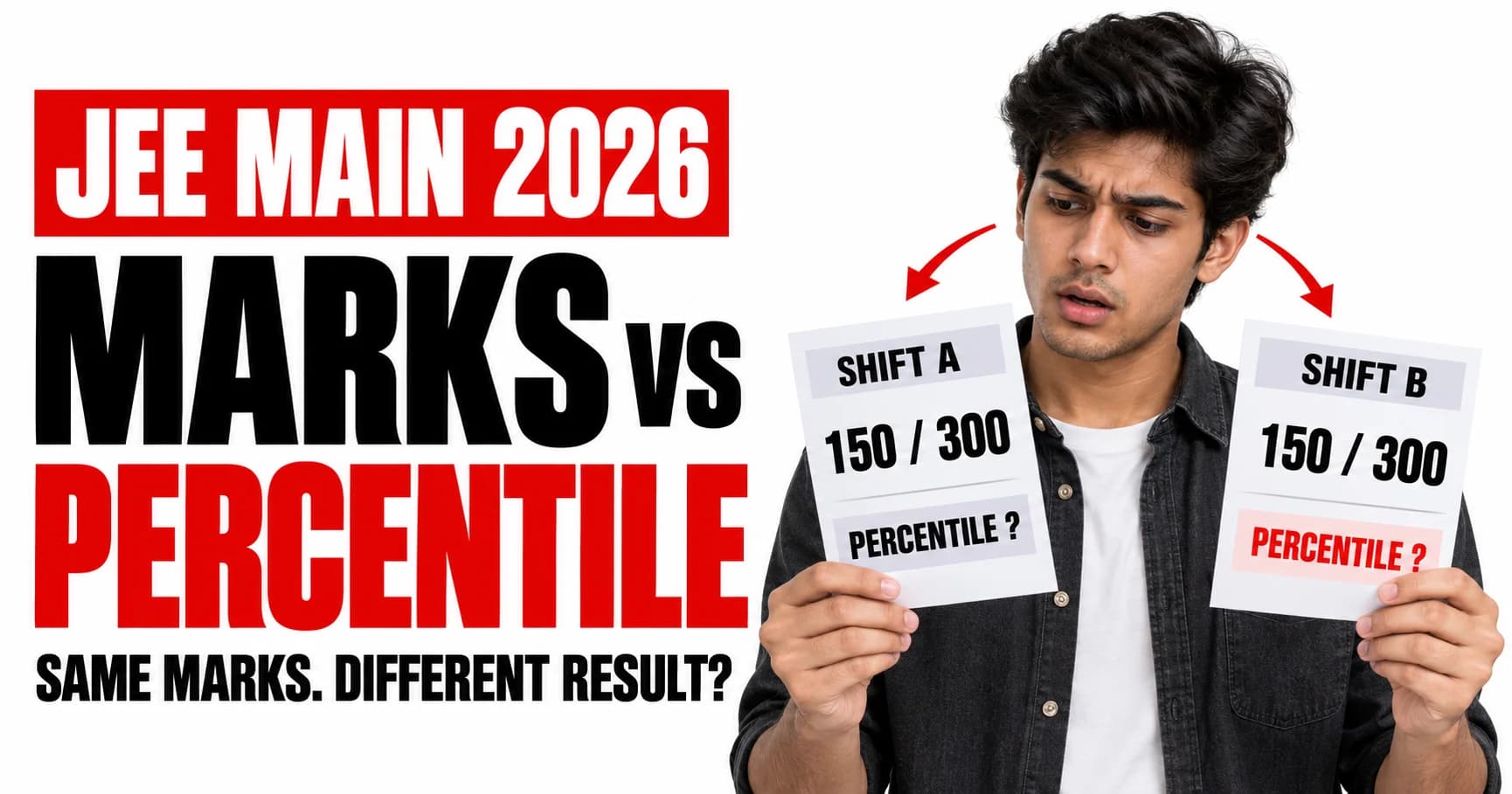
NTA does not publish an official JEE Main marks vs percentile table. In JEE Main marks vs percentile, your marks out of 300 become a percentile only after a comparison. NTA compares you with every candidate in your own shift. This guide gives a JEE Main marks vs percentile 2026 estimate, with ranks, for scores from 20 to 300. It also shows the official 2026 JEE Advanced cutoffs, so you can check where your score stands. The last sections explain how rank turns into an NIT seat.
Data checked on 24 October 2026
Every official figure comes from NTA's JEE Main 2026 Information Bulletin, its press release of 20 April 2026, its shift-wise percentile notice, the JoSAA 2026 Business Rules and the JEE Advanced 2026 brochure. The marks columns are our estimates, because NTA publishes none. NTA had not put a JEE Main 2027 schedule on its website when we checked.
What do you want to know about JEE Main marks vs percentile?
🎯I have my raw marksSee the estimated JEE Main marks vs percentile and rank for your score out of 300.📊I have my percentileTurn your NTA score into a rank with the official-data formula.🏆Check JEE Advanced cutoffsOfficial 2026 percentile cutoffs for every category.See cutoffs🏛️Will I get an NIT seat?Home State quota, Other State quota and female seat rules.15,38,468
Unique candidates who appeared in 2026
NTA press release, 20 April 2026
19
Shifts in two sessions
10 in January, 9 in April
93.4123549
General cutoff percentile for JEE Advanced
Official, 2026
2,50,182
Candidates listed as eligible for JEE Advanced
All categories, NTA 2026
Where does your percentile fit in the admission journey?
In JEE Main marks vs percentile, your percentile is the second step of a five-step path. It sits between your raw score and your JEE Advanced or JoSAA rank. Read the steps below to see what each one decides.
Step 1
Raw score
Your marks out of 300 from the shift you wrote.
Step 2: you are here
Percentile (NTA score)
NTA compares you only with candidates in your own shift.
Step 3
JEE Advanced cutoff
Your category's percentile decides if you can write JEE Advanced.
Step 4
JEE Main rank and JoSAA
NIT seats are allotted by rank, branch, quota and category.
Step 5
Seat allotment
NITs, IIITs and other government-funded technical institutes.
How does JEE Main marks vs percentile work?
JEE Main marks vs percentile is a shift-by-shift conversion. NTA looks at the candidates who wrote your shift and counts how many scored the same as you or less. Your percentile is that share. It shows your standing in your shift. It is not the share of marks you got.
How does NTA calculate the JEE Main percentile?
This formula sits behind every JEE Main marks vs percentile result. It is in Appendix VII of the JEE Main 2026 Information Bulletin. NTA counts the candidates in your shift with a raw score equal to or less than yours. It divides this by the number who appeared in the shift. It then multiplies by 100.
The topper of every shift gets 100 percentile. NTA shows the result up to 7 decimal places to avoid ties. Your total percentile is not an average of your Physics, Chemistry and Mathematics percentiles. NTA works it out from your total raw score.
What is the difference between raw score and NTA score in JEE Main marks vs marks?
In a JEE Main marks vs marks comparison, one figure is your raw score and the other is your NTA score. Your raw score is the marks you earned out of 300. Your NTA score is your percentile. A 100 NTA score means 100 percentile and not 300 marks. The JEE Main marks vs marks gap matters because your NTA score, and not your raw score, decides your rank.
Each correct answer gives 4 marks. Each wrong answer takes away 1 mark. An unattempted question gives 0. This rule covers both the multiple-choice and the numerical questions. So a raw score can even be negative. The bulletin's own example shows lowest raw scores of -39 to -49.
Take 40 correct answers, 10 wrong answers and 25 blank. That gives 160 minus 10, which is 150 marks. Whether 150 marks is a good percentile depends on the shift.
Can 150 marks give two different percentiles?
Yes. The table below uses made-up numbers to show how JEE Main marks vs percentile changes between two shifts. They are not NTA data.
| Item | Shift A (easier paper) | Shift B (tougher paper) |
|---|---|---|
| Candidates who appeared | 1,15,000 | 1,15,000 |
| Candidates with 150 marks or less | 1,07,000 | 1,11,500 |
| Percentile for 150 marks | 93.04 | 96.96 |
In Shift A many candidates scored above 150, so your 150 marks beat fewer of them. In Shift B the paper was tougher and fewer candidates reached 150. Two friends with 150 raw marks end up almost 4 percentile points apart.
JEE Main Marks vs Percentile: Frequently Asked Questions
1. Does NTA publish an official JEE Main marks vs percentile table?
No. NTA publishes the percentile formula in the Information Bulletin and gives each candidate an NTA score, which is the percentile. It does not publish a table that converts raw marks into percentile. Every JEE Main marks vs percentile table you see is an estimate.
2. Is percentile the same as percentage in JEE Main?
No. In JEE Main marks vs percentile, the bulletin says the percentile score is not the same as the percentage of marks obtained. A 90 percentile means you scored the same as or more than 90% of candidates in your shift. It does not mean 90% marks.
JEE Main Marks vs Percentile 2026: Estimated Table for Every Score
Find your marks in the first column of this JEE Main marks vs percentile table. The second column gives the percentile range to expect, including 95 Percentile in JEE Mains, and the third gives the rank that range leads to. Treat each row as your JEE Main expected marks vs percentile range for 2026, not a promise.
| Your marks (out of 300) | Estimated percentile | Approximate rank |
|---|---|---|
| 250 and above | 99.8 to 99.99 | About 3,000 or better |
| 225 | 99.3 to 99.8 | 3,000 to 11,000 |
| 200 | 98.8 to 99.6 | 6,000 to 18,000 |
| 175 | 97.5 to 99.3 | 11,000 to 38,000 |
| 150 | 95.5 to 99.0 | 15,000 to 69,000 |
| 140 | 95.0 to 98.5 | 23,000 to 77,000 |
| 120 | 92.5 to 96.5 | 54,000 to 1,15,000 |
| 100 | 90.0 to 95.5 | 69,000 to 1,54,000 |
| 80 | 86 to 91 | 1,38,000 to 2,15,000 |
| 60 | 78 to 85 | 2,31,000 to 3,38,000 |
| 40 | 55 to 72 | 4,31,000 to 6,92,000 |
| 20 | 30 to 42 | 8,92,000 to 10,77,000 |
These are estimates, not NTA figures. Every JEE Main marks vs percentile range here is wide on purpose. The same marks gave different percentiles in different shifts. The 225 row sits between the 250 and 200 rows, so it is a straight-line estimate between them. Plan with the lower end of your JEE Main marks vs percentile range.
How were these estimates made?
The JEE Main marks vs percentile ranges are our estimates for the 2026 shifts, rounded to the nearest half percentile. The rank column uses NTA's own percentile logic on the 15,38,468 candidates who appeared in 2026. Three things were left out on purpose:
- A JEE Main marks vs percentile table built from one shift, because it holds only for that shift.
- A JEE Main marks vs percentile 2025 or 2024 table, because the number of candidates and the paper difficulty change every year.
- Figures with many decimal places, because NTA does not release the raw score distribution and such precision cannot be checked.
Why do marks at the top end matter more than the table shows?
At the top of JEE Main marks vs percentile, a few marks can move your rank by hundreds of places. In one shift, the 99 to 99.99 percentile band holds only about 1,100 to 1,400 candidates. So a high scorer should read the percentile-to-rank table further down, not just the marks rows above.
JEE Main Marks vs Percentile 2026 Shift Wise: How Big Was the Gap?
NTA does not publish a table of raw marks for each percentile in each shift. So the marks gap between the easiest and toughest shift cannot be fixed from official data. What NTA does publish is the date, the shift and the number of candidates in each percentile band. That is enough to show how crowded each percentile point is. It also makes the JEE Main marks vs percentile 2026 shift wise view more useful than any single table.
How many shifts did JEE Main 2026 have?
JEE Main 2026 had 19 shifts in total. Each shift has its own JEE Main marks vs percentile 2026 shift wise result. Session 1 ran in 10 shifts on 21, 22, 23, 24 and 28 January 2026. Session 2 ran in 9 shifts on 2, 4, 5, 6 and 8 April 2026. NTA's press release of 20 April 2026 lists these dates.
In Session 2, between 1,12,909 and 1,16,602 candidates appeared in each shift. In NTA's shift-wise notice, each one-point percentile band holds roughly 1,000 to 1,600 candidates per shift. For example, the 94 percentile band holds 1,039 to 1,324 candidates in Session 2 shifts. So one percentile point is only about 1,000 to 1,500 candidates. So the JEE Main marks vs percentile 2026 shift wise gap shows up in rank and not just in marks.
What marks gave the same percentile in January and April 2026?
The marks needed for the same percentile differed between sessions and shifts. NTA does not publish these marks, so the table below is an estimate. For JEE Main marks vs percentile 2026 January, read the left column. For JEE Main marks vs percentile 2026 April, read the right column.
| Percentile | Session 1 (January), estimated marks | Session 2 (April), estimated marks |
|---|---|---|
| 99 | 170 to 220 | 150 to 195 |
| 98 | Not estimated | 130 to 175 |
| 95 | 115 to 155 | 95 to 140 |
Session 2 estimates are lower at both percentiles where both sessions are shown. Treat the gap as a pattern and not as a rule for your own shift. The official documents do not rank the shifts from easiest to toughest.
What is the marks vs percentile for JEE Mains 2026 on 22 January Shift 2?
NTA has not published the marks for any percentile in 22 January Shift 2. The shift-wise notice gives other facts. The band from 99.0337870 to 99.9992380 percentile held 1,311 candidates in that shift. Use the Session 1 ranges in the table above as a guide. Any JEE Main marks vs percentile figure for one shift is only an estimate. Do not trust a source that gives an exact marks figure without showing NTA data.
How do JEE Main Session 1 and Session 2 scores combine?
NTA declares the better of your two total NTA scores. In 2026, 8,00,516 candidates appeared in both sessions. In all, 15,38,468 unique candidates appeared: 13,04,653 in January and 10,34,330 in April. NTA counts only the best total score and not the best subject scores.
So a weak percentile in January does not count against you if you improve in April. Your raw marks can differ across sessions, for example 140 in January and 160 in April. JEE Main marks vs marks across the two sessions can differ. Your final JEE Main marks vs percentile position is the better of the two.
Can you use a JEE Main marks vs percentile table from 2025 or 2024?
No. A JEE Main marks vs percentile 2025 table or a 2024 table will mislead you for 2026. Each year has a different number of candidates and different papers. The same marks can land several percentile points away from last year's table. Use an old table only to see the pattern: easy shifts need more marks for the same percentile.
JEE Main Shift-Wise Percentile: Frequently Asked Questions
1. Why does JEE Main marks vs percentile change between shifts?
NTA works out your percentile inside your own shift. If your paper was tougher, fewer candidates scored high. The same marks then beat more candidates and give a higher percentile. In an easier shift, the same marks give a lower percentile.
2. Do I lose if I get an easier shift?
No. NTA's percentile method is meant to make shifts fair. In an easy shift more candidates score high, so you need more marks for the same percentile. Your percentile is what counts, not your raw marks.
3. Which is better for the final rank, January or April?
Neither is better. NTA takes the higher of your two total NTA scores, so writing both sessions can only help you.
JEE Main Expected Marks vs Percentile: What Should You Score?
Your JEE Main expected marks vs percentile depend on the goal you set. The one goal with an official number is JEE Advanced eligibility, so start there. NTA's press release of 20 April 2026 gave a different cutoff percentile for each category. The percentile column below is official. The marks column is our JEE Main expected marks vs percentile estimate. We worked it out from the table above and rounded it to the nearest 5. JEE Advanced Marks vs Rank also helps you understand the marks needed to target a particular rank.
| Category | Official cutoff percentile, 2026 | Estimated marks |
|---|---|---|
| General | 93.4123549 | 90 to 125 |
| EWS | 82.4164528 | 55 to 70 |
| OBC-NCL | 80.9232583 | 55 to 65 |
| SC | 63.9172792 | 35 to 50 |
| ST | 52.0174712 | 25 to 40 |
NTA listed 2,50,182 candidates as eligible for JEE Advanced 2026 across all lists. The General list held 96,873 candidates. The EWS list held 25,009, OBC-NCL 67,597, SC 37,522 and ST 18,790. A separate General PwBD list held 4,391 candidates and runs down to 0.0023186 percentile.
Cutoffs change every year with the paper and the number of candidates. JEE Main marks vs percentile gives you only the first gate. Treat the 2026 values as a guide and not as next year's cutoff. Set your JEE Main expected marks vs percentile target at the upper end of the range for your goal. A tough shift can help you, but you cannot choose your shift. See the JEE Advanced cut-offs page and the JEE Main cut-offs page for the full picture.
JEE Advanced Cutoff: Frequently Asked Questions
1. What are the JEE Main expected marks vs percentile for the General JEE Advanced cutoff?
The 2026 General cutoff was 93.4123549 percentile. We estimate this at about 90 to 125 marks, depending on the shift. The percentile is official and the marks are an estimate.
2. Does clearing the JEE Advanced cutoff give me an IIT seat?
No. The cutoff only lets you write JEE Advanced. An IIT seat depends on your JEE Advanced rank and JoSAA counselling, not on JEE Main.
JEE Main Marks vs Percentile vs Rank 2026: What Rank Does Your Percentile Give?
Your rank is roughly the share of candidates above you, multiplied by the total who appeared. Rank vs percentile JEE Mains 2026 works as a simple ratio. JEE Main marks vs percentile vs rank 2026 is one chain: marks give a percentile, and the percentile gives a rank. Use 15,38,468 as the total for 2026. The table below completes the JEE Main marks vs percentile vs rank 2026 picture. For example, 99 percentile means 1% above you, which is about 15,400 candidates.
| Percentile | Approximate rank | What it means |
|---|---|---|
| 99.99 | 154 | Top 0.01% |
| 99.98 | 308 | Top 0.02% |
| 99.95 | 770 | Top 0.05% |
| 99.9 | 1,540 | Top 0.1% |
| 99.8 | 3,080 | Top 0.2% |
| 99.5 | 7,690 | Top 0.5% |
| 99 | 15,400 | Top 1% |
| 98 | 30,800 | Top 2% |
| 97 | 46,200 | Top 3% |
| 96 | 61,500 | Top 4% |
| 95 | 76,900 | Top 5% |
| 94 | 92,300 | Top 6% |
| 93.41 | 1,01,350 | 2026 General cutoff for JEE Advanced |
| 90 | 1,53,800 | Top 10% |
| 85 | 2,30,800 | Top 15% |
| 80 | 3,07,700 | Top 20% |
| 70 | 4,61,500 | Top 30% |
The top rows matter most for students aiming at the best NIT branches. Every 0.01 percentile there is about 154 ranks. So 99.95 and 99.9 are 770 ranks apart.
What is the 94 percentile in JEE Mains rank?
A simple calculation gives an estimated rank of about 92,308 for 94 percentile. You get this from 6% of the 15,38,468 candidates who appeared in 2026. The official rank may differ by a few thousand, because many candidates share the same NTA score.
The 94 percentile in JEE Mains rank is a common rank. If you belong to EWS, OBC-NCL, SC, ST or PwBD, your category rank will be a smaller number. Category ranks depend on how many candidates of your category score above you.
Does this rank formula match the real 2026 data?
Roughly, but it runs a little high. NTA's General list for JEE Advanced 2026 holds 96,873 candidates between 100 and 93.4123549 percentile. The formula gives about 1.01 lakh for the same range. So the formula was about 4% higher than the official count at this point.
Use the rank vs percentile JEE Mains 2026 formula as a guide. It works for the 94 percentile in JEE Mains rank and for any other percentile. It tends to give a rank number slightly worse than the real one. The 4,391 candidates in the General PwBD list sit below the General cutoff. They do not belong in this comparison.
How does NTA break ties between equal scores?
Ties can change your JEE Main marks vs percentile vs rank result. If candidates have the same total NTA score, NTA applies the tie-break rules in this order:
- NTA score in Mathematics.
- NTA score in Physics.
- NTA score in Chemistry.
- The lower ratio of incorrect to correct answers across all subjects.
- The lower ratio of incorrect to correct answers in Mathematics, then Physics, then Chemistry.
If the tie remains, candidates receive the same rank. Because percentiles run to 7 decimal places, exact ties are rare.
JEE Main Percentile to Rank: Frequently Asked Questions
1. What is the 94 percentile in JEE Mains rank for 2026?
About 92,300 on a simple calculation with the 15,38,468 candidates who appeared. The exact rank can differ by a few thousand because of tied scores. Category ranks are smaller numbers than the common rank.
2. Is rank vs percentile JEE Mains 2026 the same for every candidate?
No. Your percentile is calculated inside your shift, and your rank comes from your NTA score compared with all candidates. A rough conversion is the share of candidates above you multiplied by the total who appeared. Ties are broken by Mathematics, Physics and Chemistry scores.
3. What is the lowest percentile in JEE Main?
It is a very small positive number close to 0. The formula counts candidates with a score equal to or less than yours. So even the lowest scorer counts as at least one candidate. The bulletin's own example gives 0.0035699 for one shift. In 2026, NTA's General PwBD list runs down to 0.0023186.
How do Home State and Other State quotas change your NIT chances?
A good score in the JEE Main marks vs percentile table does not give an NIT seat by itself. NIT Colleges in India fill seats through JoSAA counselling by JEE Main rank. In the JEE Main marks vs percentile vs rank chain, JoSAA is the last step. The JoSAA 2026 Business Rules say seat allocation in the NIT+ System is based on the JEE Main 2026 rank. A closing rank is set for each branch, quota, category and round. So a strong JEE Main marks vs percentile result still has to pass these rules. It is not a percentile or a mark.
What are Home State and Other State seats?
At NITs, IIEST Shibpur and PEC Chandigarh, JoSAA splits the seats of each programme into two quotas. The Business Rules define them like this:
- Home State quota: only for candidates whose State Code of Eligibility is the same as the state where the institute is located.
- Other States quota: all other states and union territories.
The same rank can open a Home State seat at an NIT and not an Other States seat at the same NIT. The share of seats differs by institute. The Business Rules state 50% Home State seats for NIT Goa and NIT Srinagar. For other NITs, check the seat matrix on the JoSAA website.
How is your Home State decided?
Your State Code of Eligibility is the state where you passed Class 12. It is not your native place or home address. The bulletin gives an example. A student passes Class 12 in New Delhi but lives in Noida. The state code is Delhi, not Uttar Pradesh.
OCI candidates who pass Class 12 abroad can take Other States or All India quota seats, but not Home State quota seats. A few states and union territories have no NIT. The Business Rules map them to a nearby NIT, for example Chandigarh to NIT Delhi.
What percentage do you need in Class 12 for an NIT?
The bulletin and the JoSAA Business Rules say you need 75% in Class 12. The figure is 65% for SC, ST and PwD candidates. The other route is to be in the top 20 percentile of successful candidates in your board, by category. The Business Rules decide the final condition each year, so check the latest version.
Check your percentile, then convert it to a rank with the table above. Then compare that rank with the Home State or Other States closing rank for each branch you want. For one NIT's rules and costs, see the NIT Trichy admission and NIT Trichy fees pages.
NIT Seat Chances: Frequently Asked Questions
1. Can I get an NIT at 70 percentile?
In JEE Main marks vs percentile terms, a simple estimate puts 70 percentile at a rank of about 4.61 lakh among the 15,38,468 candidates who appeared. This is a numerical estimate and not an official rank. NIT seats are filled through JoSAA by rank, and each branch, quota and category has its own closing rank. Compare your rank with the closing ranks of your target branches. You also need 75% in Class 12 (65% for SC, ST and PwD candidates). The other route is the top 20 percentile of your board.
2. Does the same rank give the same chance at every NIT?
No. In your own state's NIT you compete for Home State seats. In every other NIT you compete for Other States seats. Each pool has its own closing rank, so one rank can work at one NIT and fail at another.
How do female seats work in JoSAA?
The Ministry of Education asked institutes to raise the share of women in undergraduate programmes to at least 20%. JoSAA does this by creating extra, supernumerary seats for female candidates. This is a separate seat pool. It does not change your JEE Main marks vs percentile result, and it is not a lower percentile cutoff.
How do female-only and gender-neutral seats work?
For every programme, JoSAA creates two pools: Gender-Neutral and Female-Only. The Female-Only pool holds the supernumerary seats. The JoSAA 2026 Business Rules set these rules:
- Non-female candidates can compete only for Gender-Neutral seats.
- Female candidates can compete for both pools. They compete first for the Female-Only seat. Only if they do not get one do they compete for a Gender-Neutral seat.
- The category is checked first, then the gender.
- The number of Gender-Neutral seats in 2026 is not lower than in 2025.
- IITs and IISc must have at least 20% women across their undergraduate programmes. NITs, IIEST Shibpur and some IIITs must have at least 20% in each programme.
The female seats cover all IITs, IISc, NITs, IIEST Shibpur and some IIITs in the 2026-27 allotment. For IITs, the JEE Advanced 2026 brochure says these seats go to Indian nationals and OCI/PIO (I) candidates. The offer is strictly based on JEE Advanced performance.
Female Seats: Frequently Asked Questions
1. Do female candidates need a lower JEE Main marks vs percentile result for an NIT?
There is no lower percentile cutoff. Female candidates get an extra Female-Only seat pool, and they also keep their chance in the Gender-Neutral pool. Both pools use the same rank, category and eligibility rules.
2. Can a lower-ranked female candidate take a seat from a higher-ranked non-female candidate?
No. The Business Rules say a female candidate will not lose a seat to a non-female candidate with a lower rank and the same eligibility.
Why do Maths, Physics and Chemistry scores count differently?
In JEE Main marks vs percentile, NTA converts your raw scores into NTA scores inside your shift. It does this for Mathematics, Physics, Chemistry and your total. Each subject has its own paper in each shift. So the same raw subject marks can give a different subject percentile in another shift.
The JEE Main marks vs percentile total is not an average of the three. Your rank comes from the total NTA score. The subject scores matter when two candidates tie on the total. Then NTA looks at Mathematics first, then Physics, then Chemistry.
The bulletin does not say that one subject is always tougher. How hard each subject felt depends on the paper you got. Spend practice time on the subject where your marks are most likely to change your total. A strong Mathematics score helps in a tie, but exact ties are rare.
What percentile do 20, 40, 70, 80, 100, 120, 150 and 200 marks give?
These are the scores students search for most. The ranges below use the JEE Main marks vs percentile table above. They are estimates and not official NTA conversion figures. Check your own NTA scorecard for your actual percentile.
What percentile is 200 marks in JEE Mains?
In the JEE Main marks vs percentile table, 200 marks gives about 98.8 to 99.6 percentile. That is a rank of roughly 6,000 to 18,000 on the 2026 pool. In the toughest shifts, 200 marks may be well above 99.5.
Can 150 marks get 98 percentile?
Yes, but only in a tough shift. We estimate that 98 percentile needs about 135 to 185 marks. So 150 marks gives a range of about 95.5 to 99 percentile.
Is 140 a bad score in JEE Mains?
No. In the JEE Main marks vs percentile 2026 table, 140 marks gives an estimated 95 to 98.5 percentile. That puts you in the top 1.5% to 5% of candidates. On these estimates, it is above the 2026 General JEE Advanced cutoff of 93.4123549.
What percentile is 120 marks in JEE Mains?
120 marks gives about 92.5 to 96.5 percentile. The result depends heavily on the shift. In a tough shift you may cross the 2026 General cutoff of 93.4123549. In an easy shift you may fall just below it.
What percentile is 100 marks in JEE Mains?
100 marks gives about 90 to 95.5 percentile. That is a rank between 69,000 and 1,54,000. This score can clear the General JEE Advanced cutoff in a tough shift. It can fall below it in an easy one.
What percentile is 80 marks in JEE Mains?
80 marks gives about 86 to 91 percentile on the JEE Main marks vs percentile scale. That is a rank between 1,38,000 and 2,15,000. This score is above the 2026 cutoffs for EWS, OBC-NCL, SC and ST, and below the General cutoff.
What percentile is 70 marks in JEE Mains, and is 77 a good score?
70 marks gives about 82 to 88 percentile in the JEE Main marks vs percentile 2026 estimate. 73 marks falls near 84 to 89. A score of 77 sits close to 85 to 90 percentile.
Whether 77 is good depends on your goal. On these estimates, it clears the 2026 EWS and OBC-NCL cutoffs. It does not reach the General cutoff of 93.4123549.
What percentile is 40 marks, 20 marks or 1 mark?
40 marks gives about 55 to 72 percentile. 20 marks gives about 30 to 42. One mark falls far below the 20-mark range, so expect a very low percentile. No official figure exists for 1 mark.
Can I get an IIT with 40 marks in the ST category?
JEE Main only decides whether you can write JEE Advanced. At about 55 to 72 percentile, 40 marks is above the 2026 ST cutoff of 52.0174712. So you would likely have been eligible for JEE Advanced 2026. An IIT seat then depends on your JEE Advanced rank and JoSAA counselling.
Percentile vs Percentage: Is 75, 60 or 50 Good in JEE Main?
A percentile compares you with other candidates. A percentage is your share of the total marks. Mixing them up is the most common mistake in JEE Main marks vs percentile searches. Each number means something very different.
Is 75 a good percentile in JEE, and what about 74?
A 75 or 74 percentile gives a rank of about 3.8 to 4 lakh on the 2026 pool. This percentile is above the 2026 SC cutoff of 63.9172792 and the ST cutoff of 52.0174712. It is below the OBC-NCL cutoff of 80.9232583, the EWS cutoff of 82.4164528 and the General cutoff of 93.4123549. So its value depends on your category and goal.
Is 60% or 50% good in JEE Mains?
In JEE Main marks vs percentile terms, 60% as marks is 180 marks and 50% is 150 marks. 180 marks gives about 98 to 99.4 percentile, which is excellent. 150 marks gives about 95.5 to 99 percentile, which is also good. If you mean percentile, 60 percentile is a rank near 6.2 lakh. A 50 percentile is a rank near 7.7 lakh.
Can you give JEE Main with 65% in Class 12?
Yes. The JEE Main 2026 Information Bulletin sets no age limit for appearing. You need to have passed Class 12 in 2024 or 2025, or be appearing in 2026. The institute you apply to may set its own age or marks rule. The bulletin for 2027 was not out when we checked, so read it when NTA publishes it. The percentage matters later, for NIT seats, as the quota section above explains.
How do you use this guide to check your position?
Follow these steps to apply this JEE Main marks vs percentile guide. You need your raw marks or your NTA score. The key dates come from NTA's press release of 20 April 2026.
21 to 28 January 2026
JEE Main Session 1
10 shifts on 21, 22, 23, 24 and 28 January 2026.
2 to 8 April 2026
JEE Main Session 2
9 shifts on 2, 4, 5, 6 and 8 April 2026.
20 April 2026
Final result with best NTA score
NTA declared the better of the two session scores for each candidate.
- Find your marks in the JEE Main marks vs percentile table to see your percentile range.
- Check your NTA score on your scorecard. In JEE Main marks vs marks terms, this is the score that counts. It is your real percentile and replaces every estimate here.
- Convert the percentile to a rank with the rank table.
- Compare your percentile with the 2026 category cutoff for JEE Advanced.
- Compare your rank with JoSAA closing ranks for your Home State or Other States quota, and for your category.
Use the JEE Main marks vs percentile estimates before the result and your real score after it. Read the JEE Main dates and JEE Main exam pattern pages for the next cycle as NTA announces it.
Sources
- JEE (Main) 2026 Information Bulletin, National Testing Agency:
- Press Release, Declaration of the Result of JEE (Main) 2026 Paper 1, National Testing Agency, 20 April 2026:
- JEE (Main) 2026 Date and Shift Wise Percentile Score notice, National Testing Agency:
- Business Rules of JoSAA 2026, Joint Seat Allocation Authority:
- JEE (Advanced) 2026 Information Brochure:
Content authored by:
Updated on
Headline: EdTech Leader | AI & SEO Strategist | Computer Science Engineer: Atul leads SEO, content, and data at MSM Unify India. He plans the organic content strategy and also owns the structured data that feeds it. He works with a team of product managers, engineers, QA, designers, writers, and SEO specialists. Together they create guides for Indian students and parents on colleges, entrance exams, and studying abroad. Atul has built a step-by-step content process that uses AI tools with a human in the loop. Every page goes through several stages. It starts with research, where each fact is checked on the official source. A second, independent source is then used to confirm that the fact is correct and the latest. Third-party sites are used only to spot differences and are never treated as a source. Before writing, the team studies what students actually search for and what the top results leave out. This study covers Google, Bing, DuckDuckGo, ChatGPT, and Perplexity, including AI answers and “People also ask” questions. Pages written by Atul are in plain English that can be understood in one read, and they open with the question the reader is most likely to have. Before a page goes live, every number, name, date, and fact is checked again against its official source. Finally, an editor reads and humanises every page, however good the draft is. Atul believes that advice on education should be simple, honest, and based on official facts. Fees and figures should come with their source. A student should be told clearly when a college is not the right fit.