
- Engineering
- BE/BTech
- BSc
Skill Courses After 12th: Best Options, Fees & Career Scope

Content Manager
Choosing the right skill course after 12th can give you a head start in your career. Explore the best skill courses across different streams, including eligibility, fees, free online certifications and career opportunities. Discover job-oriented options, industry-relevant skills and learning pathways to make an informed decision about your future.
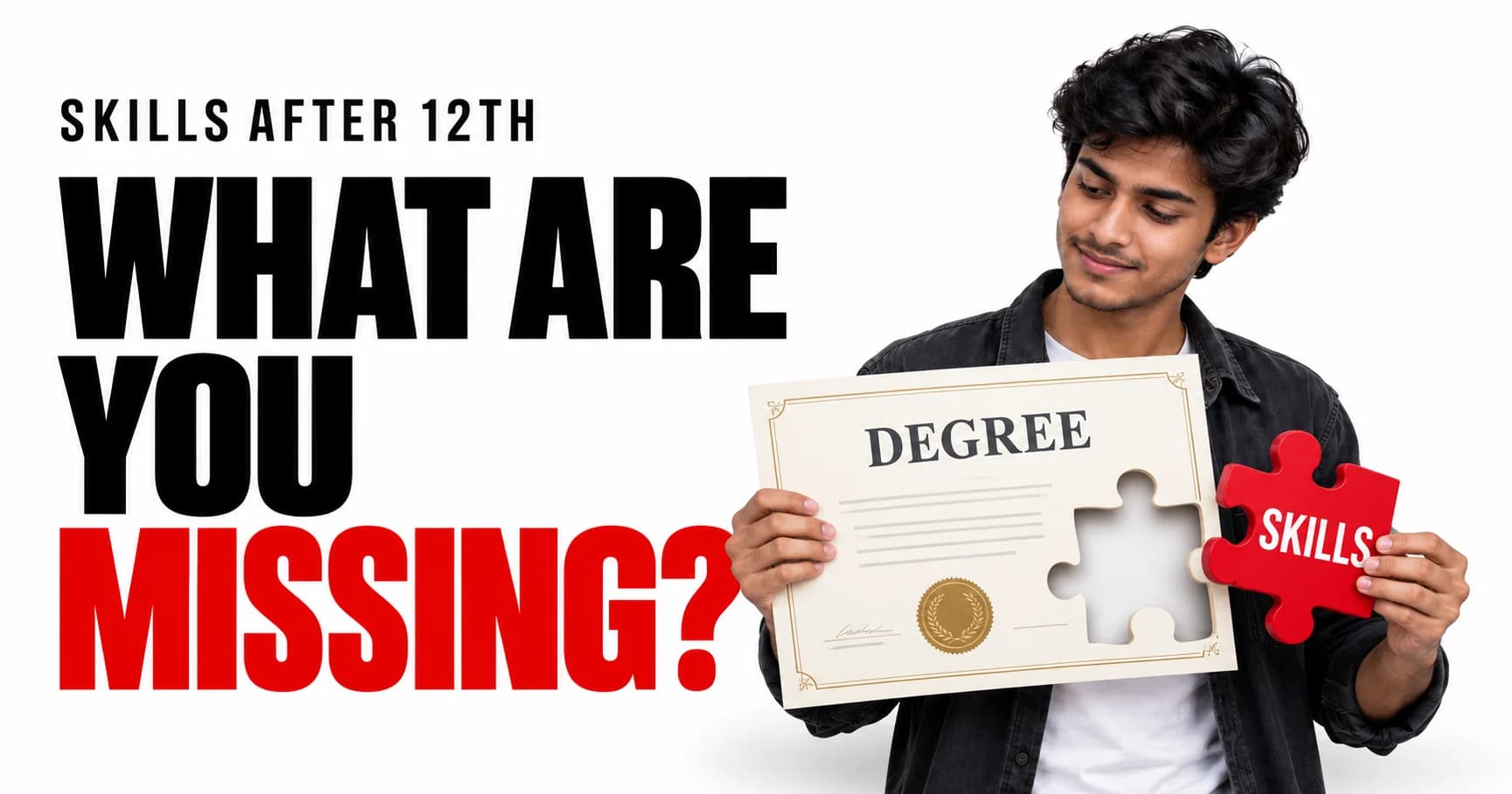
You have just finished 12th, and your parents are asking, "So, what next?" Here is the short answer on the skill to learn after 12th. Start in your first semester, not in your final year. Pick one core skill for your field, plus English communication and basic digital skills. The best skill courses after 12th are the free ones on official platforms. Your university's own credit rules already leave room for them.
Maybe you think a degree is enough. The official numbers say it may not be. In 2025, only 5.0% of Indian youth aged 15 to 29 had formal vocational training, as per the Periodic Labour Force Survey (PLFS). Graduate unemployment was 11.2%, against 3.1% for all adults. The survey does not give the reasons. But it is a good reason to choose the skill to learn after 12th early.
40%
Maximum share of a semester's courses a college may allow through SWAYAM
UGC Regulations 2021
20.10 million
Registrations on Skill India Digital Hub
As on 2 Aug 2026
4.5 hours
Length of the free YUVA AI for ALL course
Launched 18 Nov 2025
5.0%
Youth with formal vocational training
PLFS 2025
Why should you start learning skills before your final year?
Because the best courses after 12th skill to learn after 12th takes months to build, and employers want to see proof of it on your resume. Say you start the skill to learn after 12th only in final year. You will have very little to show. Now say you start in first year. By the end, you will have two years of practice and a project to talk about.
The numbers point the same way. PLFS 2025 shows 69.3% of youth aged 15 to 29 have no training of any kind. The Economic Survey 2025-26 names three causes of skill mismatch: weak foundations, a gap between curriculum and industry, and slow adoption of new technology. If you finish your first skill courses after 12th in the first two years, you are ahead before placement season starts.
You may ask, "Will I even have time for skill courses after 12th?" Your degree already gives you more room than you think.
How much room does your degree give for skill courses?
Quite a lot. The University Grants Commission (UGC) framework for four-year undergraduate programmes sets minimum credits for each part of the degree. Several of these parts are meant for exactly the skill courses after 12th that you want to take. Your university may change the numbers, so check its own scheme. Students interested in MBA in marketing should also understand what is MBA when exploring future academic and career options.
| Component | Minimum credits | What it is for |
|---|---|---|
| Ability enhancement courses | 8 | Language and English communication |
| Skill enhancement courses | 9 | Hands-on and soft skills for employability |
| Value-added courses | 6 to 8 | Ethics, culture, digital and technological skills |
| Summer internship | 2 to 4 | Work experience in a real organisation |
| Minor | 24 (3-year), 32 (4-year) | A second subject area |
The total is 120 credits for a three-year degree and 160 for a four-year degree. One credit equals 30 notional hours of learning, and 1,200 hours in a year equals 40 credits, as per the UGC National Credit Framework.
So treat your skill enhancement and minor courses as skill courses after 12th and choose with a purpose, because your minor can carry the skill to learn after 12th. Don't just pick the easiest ones.
Which free official platforms should you use?
"Which course should I take for the skill to learn after 12th, and what will it cost?" Four official routes cover most skill courses after 12th. Learning on SWAYAM, NPTEL and YUVA AI for ALL is free, so any skill to learn after 12th can start at no cost. Only the certificate exams carry a fee. Skill India Digital Hub has both free and paid courses, so check the fee on each one.
Can you learn free on SWAYAM and NPTEL?
Yes, you can. SWAYAM is the government's online platform, and its free skill courses after 12th cover most subjects. The Press Information Bureau (10 March 2026) reported over 4,400 unique courses and about 5.80 crore enrolments as of January 2026. SWAYAM also has more than 110 free AI courses (March 2026), which are easy skill courses after 12th to test whether AI interests you. The certificate exam is held in person and has a fee. Students preparing for entrance exams in india can also use SWAYAM courses to strengthen their subject knowledge alongside exam preparation.
NPTEL is run by the IITs and is a good place to start the skill to learn after 12th in engineering and science. It lists over 3,200 courses and 3.79 crore enrolments. To pass, you need at least 40 out of 100 in assignments and at least 40 out of 100 in the exam. The exam fee is around ₹1,000 per course at present.
Is Skill India Digital Hub worth using?
Yes, if you check the fee and the NSQF level of each of its skill courses after 12th first. The Skill India Digital Hub had 20.10 million registrations and 3,643 self-paced courses on 2 August 2026, as per the Press Information Bureau. Its courses are aligned to the National Skills Qualifications Framework (NSQF). They are delivered through awarding bodies recognised by the National Council for Vocational Education and Training (NCVET). Look at each course page for its NSQF level and awarding body.
Is there a free AI course from the government?
Yes. YUVA AI for ALL, under the IndiaAI Mission, is a free 4.5-hour course with a certificate from the Government of India. It was launched on 18 November 2025, and 85.27 lakh learners had enrolled by 8 July 2026. Take it as the first of your skill courses after 12th, not as the skill to learn after 12th. It teaches only the basics, so make it one of your free courses and not the only one. Central government scholarships can also help students access learning opportunities.
Can online courses count for degree credits?
Yes, if your college allows it, and this rule applies to online skill courses after 12th too. The UGC (Credit Framework for Online Learning Courses through SWAYAM) Regulations, 2021, say a university may allow only up to 40% of a semester's courses through SWAYAM. This is the college's choice, not your right. About 450 universities had adopted the rule by July 2026. So please ask your department before you enrol.
Credits you earn are stored in the Academic Bank of Credits (ABC), which works through your APAAR ID. Ask your college to register you in the first semester. As per the Press Information Bureau (data as on 2 July 2026), 2,899 institutions and 98 skill awarding bodies are registered. Credits from skill courses after 12th stay valid for seven years.
What should you learn in each year?
"Where do I even begin?" Go in this order for the skill to learn after 12th: basics first, then one deep skill, then proof. This plan is our advice, built on the credit rules above. It is our suggestion, not an official rule, and no government document fixes it.
Year 1
Basics
Learn English communication, a basic spreadsheet and documents, and take one introduction course in your field from SWAYAM or NPTEL to test the skill to learn after 12th. Do the free YUVA AI for ALL course too. Free skill courses after 12th are the safest start. Pay only after the checks in our course-choice guide.
Year 2
One core skill
Pick the skill to learn after 12th that the jobs you want are asking for. Give it 4 to 5 hours a week. Finish one small project and keep a record of it.
Year 3
Proof of work
Do a summer internship for credits, so you can show the skill to learn after 12th at work. The AICTE internship portal is free for students. Add one of the short skill courses after 12th that has an NSQF level, and build a second project.
Final year
Present it
Write a one-page summary of each project. Practise explaining the skill to learn after 12th that you chose, aloud, the way you would to an interviewer. Apply for internships and jobs early, once your skill to learn after 12th has a project behind it.
Your stream matters too, and skill courses after 12th differ by branch. The tabs below show the skill to learn after 12th for each stream.
The skill to learn after 12th in engineering is one programming or tool skill in your branch, such as Python, CAD or PLC basics. Add a project that uses real data or a real machine. Take NPTEL courses in your core subjects.
Can you study a second course or degree alongside?
Yes, but with limits, so pick the skill to learn after 12th first and the second course later. The UGC guideline of April 2022 allows two full-time programmes only if the timetables do not overlap. It also allows one physical programme along with one open-distance or online programme from a recognised institution. Check your own university's rules first. Students preparing for the 10 toughest exams in india should also plan their skill courses around their exam preparation schedules.
Your degree also has exit points, in case life changes. After 40 credits and a 4-credit vocational course, you can leave with a UG Certificate. After 80 credits and a vocational course, you can leave with a UG Diploma. You can re-enter within three years, and the whole degree must finish within seven years. Think of these as a safety net, not as your plan.
What should you check before you pay for any course?
Maybe someone you know paid for a course and got nothing from it. Before you pay for any of the skill courses after 12th, check who gives the certificate and what it is aligned to. A free course on an official platform costs only your time, so it is the safest way to test the skill to learn after 12th. If you want to pay for a course, use the checks in our guide on how to choose a course before spending your money.
For more on picking colleges, exams and the skill to learn after 12th, see the MSM Unify career and college guides.
FAQs on skills to learn after 12th
Commonly asked questions
Answers to what readers ask most often.
Q: Which skill to learn after 12th is best alongside my degree?
The best skill to learn after 12th starts with English communication and basic digital skills, then one core skill for your field. Use free skill courses after 12th on SWAYAM, NPTEL and Skill India Digital Hub. Add a small project each year, so you have something to show. Data Sources: UGC Curriculum and Credit Framework for Undergraduate Programmes, 2022.
Q: Which skill courses after 12th are free?
Learning on SWAYAM, NPTEL and YUVA AI for ALL is free, so these skill courses after 12th cost only your time. The certificate exam is held in person and has a fee, which is around ₹1,000 per course on NPTEL at present. Data Sources: Press Information Bureau, 10 March 2026; NPTEL.
Q: Can SWAYAM skill courses after 12th count for credits in my degree?
Yes, but only if your college allows it, and only up to 40% of a semester's courses. About 450 universities had adopted the UGC rule by July 2026. Please ask your department before you enrol. Data Sources: UGC Credit Framework for Online Learning Courses through SWAYAM Regulations, 2021.
Q: How many credits does a degree give for skill courses after 12th?
A four-year degree has a minimum of 8 credits for ability enhancement, 9 for skill enhancement, 6 to 8 for value-added courses and 2 to 4 for a summer internship. The total is 120 credits for a three-year degree and 160 for four years. Your university may change the scheme. Data Sources: UGC Curriculum and Credit Framework for Undergraduate Programmes, 2022.
Content authored by:
Updated on
Headline: EdTech Leader | AI & SEO Strategist | Computer Science Engineer: Atul leads SEO, content, and data at MSM Unify India. He plans the organic content strategy and also owns the structured data that feeds it. He works with a team of product managers, engineers, QA, designers, writers, and SEO specialists. Together they create guides for Indian students and parents on colleges, entrance exams, and studying abroad. Atul has built a step-by-step content process that uses AI tools with a human in the loop. Every page goes through several stages. It starts with research, where each fact is checked on the official source. A second, independent source is then used to confirm that the fact is correct and the latest. Third-party sites are used only to spot differences and are never treated as a source. Before writing, the team studies what students actually search for and what the top results leave out. This study covers Google, Bing, DuckDuckGo, ChatGPT, and Perplexity, including AI answers and “People also ask” questions. Pages written by Atul are in plain English that can be understood in one read, and they open with the question the reader is most likely to have. Before a page goes live, every number, name, date, and fact is checked again against its official source. Finally, an editor reads and humanises every page, however good the draft is. Atul believes that advice on education should be simple, honest, and based on official facts. Fees and figures should come with their source. A student should be told clearly when a college is not the right fit.